A doctor, scientist and founder in Belgrade on what gets lost between the laboratory, the clinic, the business case and the patient, and what building a patient platform has taught her about trust.
“A researcher celebrates a statistically significant improvement. A doctor asks whether it changes a treatment decision. A patient wonders whether they’ll have enough energy to pick up their children.”
An investor, she goes on, asks whether a solution can reach enough people to become commercially viable. “Same healthcare ecosystem. Different definitions of value,” says Dr. Milica Dervišević. “And none is necessarily wrong.” She put the problem more briefly in a LinkedIn post this September: “Healthcare doesn’t have a data shortage. It has a translation problem.”
Milica is a Belgrade-based doctor and scientist, and the founder of Patient Opinion Leaders, or POLs, an independent, early-stage platform where people share their lived experience of a health condition in a structured way. It started in May 2026 with multiple sclerosis communities in Serbia and the United States. There are no public comment threads: a user who wants to answer someone else’s experience does it by contributing their own. In an early seven-day period, POLs attracted more than 300 users, and it has signed a formal agreement with two established patient organizations.
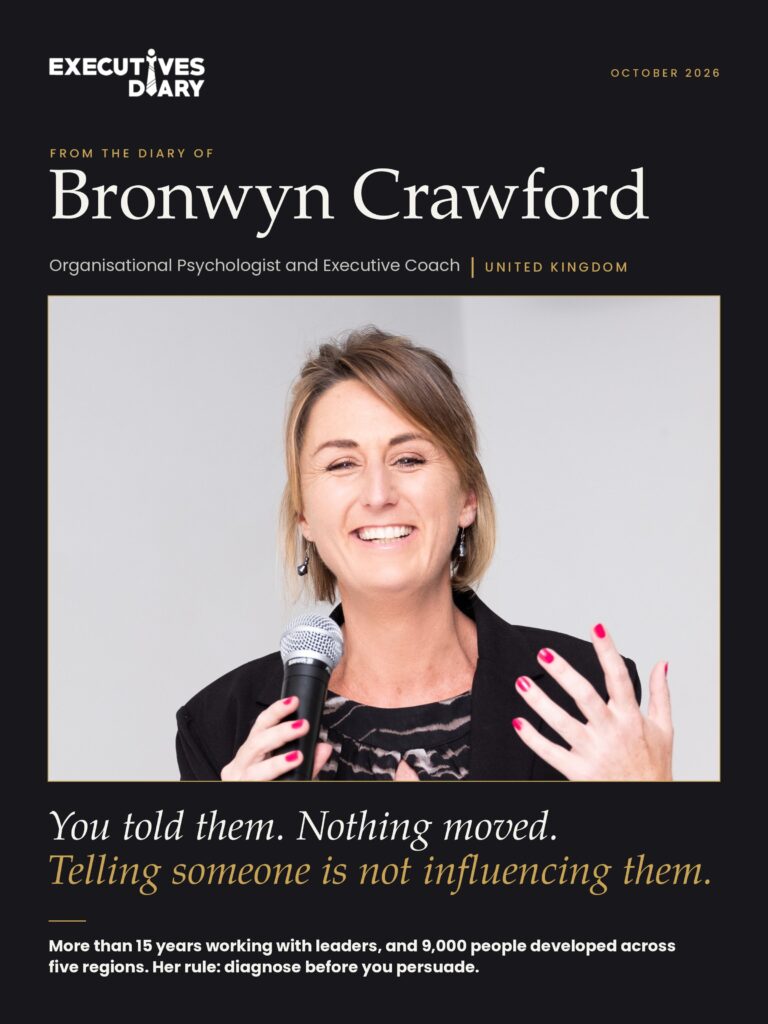
Leader in Spotlight: Read Bronwyn Crawford Feature in Executives Diary
Five Perspectives on One Disconnect
Asked to describe a single meeting where clinicians, scientists and business people failed to understand each other, Milica declined to pick one. “I wouldn’t reduce this to one meeting,” she says. “I’ve encountered the same disconnect throughout my professional and personal life, from five perspectives: as a doctor, scientist, businesswoman, patient, and caregiver.”
Each taught her something different. “Medicine taught me that clinical improvement doesn’t always translate into a better everyday life,” she says. Research taught her to tell evidence from assumptions, and business that even a compelling solution needs a sustainable model. “But being a patient and caregiver made the disconnect personal.”
She sees the same gap online. “Millions of people are already describing their health experiences online, often in extraordinary detail,” she says: symptoms, frustrations, treatment experiences, fears and small victories. Most of it, in her account, ends up in endless scrolling, buried between advertisements, entertainment and the next viral argument.
“We’ve become very good at talking about patients. We still have work to do on listening to them.”
Dr. Milica Dervišević, Founder, Patient Opinion Leaders (POLs)
Digital health, she says, can make the same mistake with its own numbers. “A company might celebrate 100,000 downloads, but how many people actually understand, trust, or benefit from the product?” Her answer is short: “We’ve measured distribution, not necessarily usefulness.” AI, she says, makes it more interesting still. Thousands of scientific papers can be summarized in seconds, but faster synthesis doesn’t automatically resolve conflicting evidence or explain what the findings mean for someone’s everyday life.
She believes solving specific parts of that gap is both a healthcare necessity and a commercial opportunity, and she adds the qualifier herself: “identifying a problem and proving a viable solution are two very different achievements.”
She arrived at that view one discipline at a time.
Science First, Then the Clinic
“I don’t see my career as a series of reinventions,” Milica says. “I see it as accumulating tools.”
The first came from research. As a Research Assistant Professor at the Vinča Institute of Nuclear Sciences, she contributed to research published in Scientific Reports, a journal in the Nature Portfolio, exploring tooth fluorescence and developing a novel model for assessing the optical properties of teeth. It taught her that even something as seemingly objective as color depends on the complex relationship between measurable physical properties and human perception. Those years shaped her approach to experimental design, evidence, and intellectual discipline, but also sparked a deeper fascination with the human factor in science. “Science taught me how to think. The science of color taught me that what we measure and what humans perceive are not always the same thing. Years later, I realized healthcare has a remarkably similar problem.”
She sees more in common between research and entrepreneurship than most people expect. Both begin with a hypothesis, require experimentation, operate under uncertainty and demand the humility to accept results that challenge your assumptions. “You can fall in love with a scientific hypothesis or a business idea, but neither the experiment nor the market owes you a favorable result.” Business, she says, taught her that the market is simply another laboratory, “with considerably more expensive experiments.”
What increasingly interested her was what happens after knowledge is produced, and how scientific value becomes practical value. That question followed her into aesthetic medicine. At Medica Aesthetica, which she describes as one of the largest regional aesthetic medicine centers, she practices as a doctor and educates peers on regenerative treatments focused on skin longevity.
What stayed with her was what many of the women she saw were really asking. “I met women whose concern wasn’t simply a visible sign of aging, but whether they would continue to recognize themselves in the mirror,” she says. Preserving that sense of identity across decades, in her view, can bring a profound psychological shift: “That is where beauty becomes more than appearance. It becomes agency.” She adds the caveat herself. No treatment guarantees that experience, she says, and aesthetic outcomes are personal. The lesson she took was to listen for what mattered beyond the visible result.
The next tools came from building something of her own.
A Toy Company Named for a Baby Tooth
Kosken Toys was her first start-up. It designed playful toys that teach children the importance of oral hygiene through educational play, and its name translates in the local dialect as “baby tooth.” As founder and CEO of what she calls, on her profile, a solopreneurship project, she set up and oversaw the whole manufacturing process, along with sales, brand positioning and advertising.
Manufacturing taught her the lesson she leads with. Entrepreneurship, especially when you’re starting out on your own, “is fundamentally about people,” she says. “You can have a brilliant product concept, but execution depends heavily on the skills, craftsmanship, and reliability of those bringing it to life.” Finding, developing and coordinating the right talent, in her experience, matters as much as financial resources, and in manufacturing, human capital is often the difference between a promising idea and a product that actually reaches the market.
The corporate environment came next. “My subsequent corporate career helped me develop a stronger understanding of business analysis, operational feasibility, stakeholder priorities, and commercial discipline,” she says. “I learned that being technically correct is only part of being effective. You also need to understand incentives, budgets, and the practical realities of execution.” Alongside it, she completed an Executive MBA at Quantic School of Business and Technology (Washington, DC).
Then she chose entrepreneurship again, “this time knowing considerably more about what could go wrong.”
How POLs Works
POLs grew, she says, out of her independent observations, personal experiences and a longstanding interest in how people navigate healthcare. Across research, aesthetic medicine, education and entrepreneurship, one lesson kept returning: “people define meaningful outcomes in ways that professional disciplines don’t always capture.”
“We started with a question, not a finished business model,” she says. The question was this: “Could we create a more structured way for people to share lived experiences and recognize recurring themes without presenting anecdotes as clinical evidence?”
The answer shaped the product. POLs deliberately leaves out public comment threads. Instead, users respond to someone else’s experience by contributing their own story, which she describes as “a different approach to community participation, one centered on shared experiences rather than public arguments or popularity.” The team has also started developing POLs Live, which brings external voices, podcast hosts and Earth-space future advocates into conversations about lived experience.
“A million likes don’t make something credible,” Milica says. “Social media measures popularity. We’re interested in context, repetition, and resonance across people and time.” At the heart of POLs is her proprietary Anecdote Filter, a framework designed to move from individual anecdotes to emerging signals and, where sources support them, structured insights. “We’re not trying to make anecdotes scientific evidence. We’re trying to make collective human experience harder to overlook.”
“I want POLs to do one thing exceptionally well: distinguish what attracts attention from what deserves attention.” In healthcare, she believes, that distinction is far more consequential than another engagement metric.
The obstacles, she says, have been substantial: privacy, credibility, legal considerations across two markets, and bringing together communities and institutions that haven’t traditionally communicated on equal terms. Under all of them sits a commercial question she states plainly. “How do you build a commercially viable platform around lived experience without compromising the trust of the people contributing it? That’s not a problem a clever algorithm can solve on its own.”
Of the first users and the agreements with the patient organizations, she says: “For a small founding team operating across two countries, that’s meaningful progress.” POLs is still working toward sustainable revenue, and she keeps a clear line between early traction and a proven business. The agreements matter to her for another reason. Of the first, she says: “It represents a step toward building relationships, not simply accumulating registrations.”
The relationships, she has found, are the slow part.
Trust on Its Own Schedule
“One of the hardest challenges has been recognizing that trust cannot be accelerated simply because you believe your intentions are good,” Milica says. People meeting something unfamiliar in healthcare have legitimate questions: who benefits, how their experiences will be used, what happens to their information. The team had to confront those questions early, rethink assumptions, and make credibility and responsible participation central to the approach.
“Building a platform is one challenge. Earning the trust of people who have spent years navigating fragmented healthcare systems is another entirely.”
Milica, Founder, POLs
POLs began in multiple sclerosis, a condition the Multiple Sclerosis International Federation’s Atlas of MS estimated 2.8 million people were living with worldwide in 2020, with a mean age at diagnosis of 32. Connecting patients, clinicians, researchers and commercial organizations, she says, takes more than an attractive interface or a compelling pitch. “It requires careful boundaries, transparency, and the willingness to listen before proposing solutions.” The aim is a space where people “feel respected rather than studied.”
“You can launch a platform in months,” she says. “You can’t put trust on a launch schedule.” And trust, in her words, “is not something you can buy your way into.”
The people who shaped her most, she says, shared one quality: they could defend an idea rigorously and still change their minds when the evidence demanded it. Building with a small team and limited resources has forced POLs to prioritize, test assumptions and establish partnerships before committing to expensive solutions. “I’d be much more concerned if we’d stopped questioning our assumptions this early.”
Where Milica Is Now
Over the next twelve months, she wants to build meaningful partnerships, contribute to higher-level conversations about healthcare innovation, and keep developing an idea that could eventually become a sustainable business. She isn’t particularly interested in collecting titles. “A board seat or speaking opportunity matters when there’s an opportunity to contribute something substantive.”
The reader she has in mind is “someone with the resources to build something consequential, the curiosity to challenge conventional thinking, and the humility to recognize that healthcare cannot be redesigned from a single discipline.” She would also like her story to reach people navigating unconventional careers, particularly women who feel pressured to choose one professional identity. “You don’t necessarily need to narrow yourself down,” she says. “Sometimes your greatest advantage is knowing how to connect the dots.”
She is a student again, too. “I’m going back to school. My questions have outgrown my toolkit,” she wrote this October, adding that she wants to understand the data scientist’s assumptions, the commercial director’s priorities and where the two need to challenge each other. Since January she has been Thought Leadership Lead for the Quantic European Society, designing and hosting discussion-driven events on subjects from AI-augmented leadership to aviation human factors.
Outside work, aviation and space exploration fascinate her, especially human factors and how systems are designed for environments that weren’t built for us. In October 2025 she volunteered as Chief Medical Support Officer for an independent analog astronaut habitat in New Hampshire. Healthcare, she believes, has a lot to learn from that thinking. “Technology should adapt to human limitations, not expect humans to adapt endlessly to technology.” She also needs solitude: running, yoga, or wandering through an unfamiliar city. “Sometimes the most productive thing I can do is stop producing things. Still working on that one.”
“As a doctor, scientist, founder and mother of two, I know ambition doesn’t make us exempt from being human,” she wrote after a women’s health summit this month.
“My background doesn’t qualify me to predict the future of healthcare,” she says. “It gives me several different ways to question the present. And I intend to put them to work.”
Five Lines from Milica’s Diary
1. “Information isn’t the same as understanding. And understanding isn’t the same as action.”
2. “Technology can connect systems. Trust is what allows people to participate.”
3. “Intellectual confidence without intellectual humility is a dangerous combination, particularly in healthcare.”
4. “You can start a business alone, but you rarely build anything meaningful alone.”
5. “We romanticize dramatic breakthroughs and underestimate consistent, unglamorous execution.”
From the Diary of Dr. Milica Dervišević
Dr. Milica Dervišević is a Belgrade-based doctor and scientist and the founder of Patient Opinion Leaders (POLs).
| Role | Founder, Patient Opinion Leaders (POLs) |
| Based in | Belgrade, Serbia |
| Previously | Vinča Institute of Nuclear Sciences, Research Assistant Professor (2015 to 2022), and Kosken Toys, Founder and CEO (2016 to 2022) |
| Also | Thought Leadership Lead, Quantic European Society |
“The only thing I insist on is progress. One percent compounds enormously.”
Editor’s Note
Executives Diary features Dr. Milica Dervišević because her argument about healthcare comes from inside each of the places she describes: the laboratory, the clinic, a small manufacturing business and the corporate environment. What convinced the editors is how she is building POLs, starting from a question rather than a business model and describing its progress at exactly the stage it has reached. She named her reader as someone who accepts that healthcare cannot be redesigned from a single discipline, and this feature is written for that reader.
Executives Diary, Editorial