

From the Diary of
Alvin Singh
For anyone still waiting on a first yes: how one opportunity became a career spent creating them for other people.
“Everyone has the ability to become the hero of their own story.”
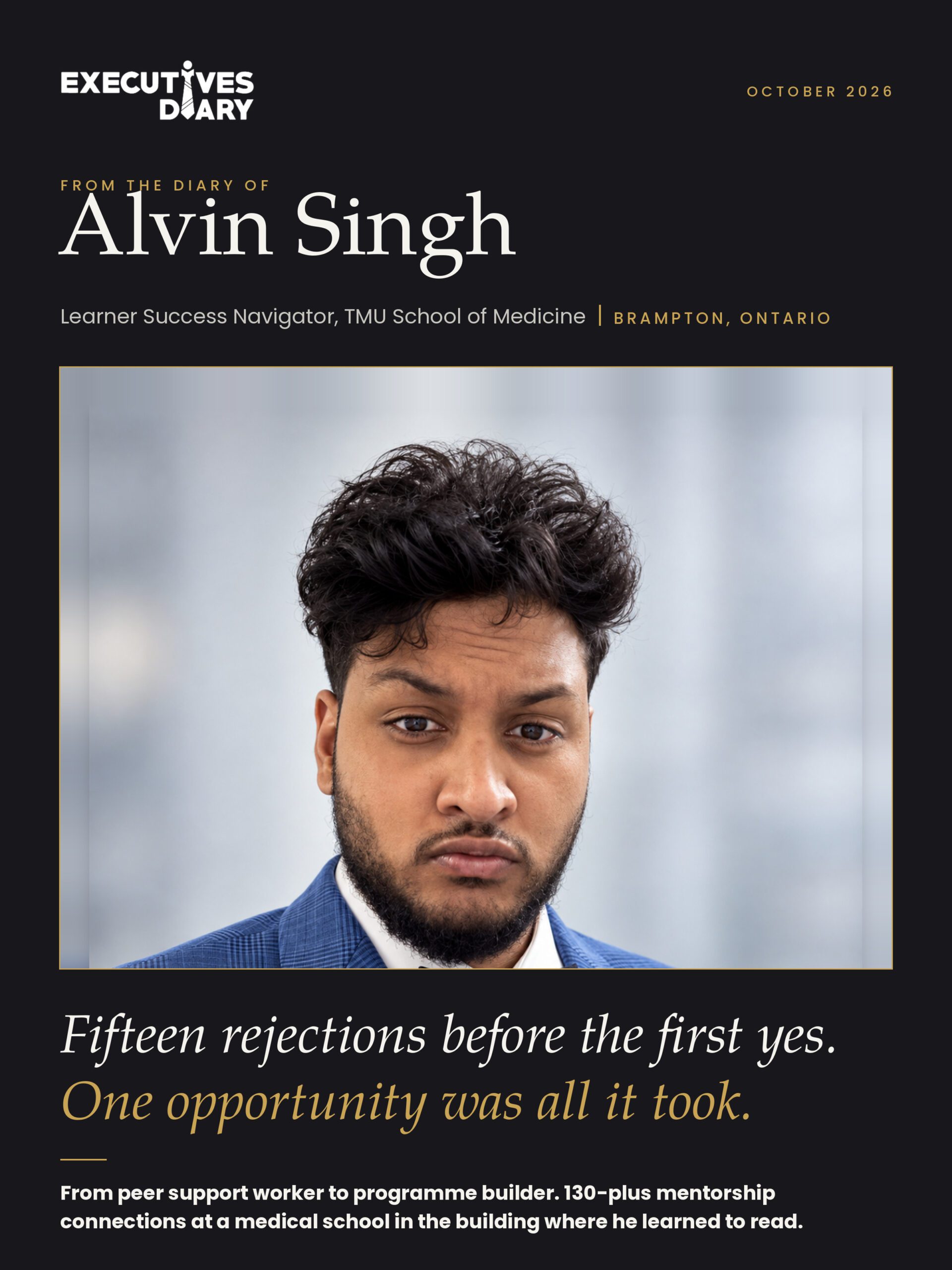
Alvin Singh learned to read in a library in Brampton, Ontario. He works in the same building today, though it’s no longer the public library.

Brampton Library had a branch in the Civic Centre from the building’s opening in 1972 until August 2023, when it closed to make way for a medical school. The former Civic Centre is now the site of the School of Medicine at Toronto Metropolitan University (TMU), and Alvin is a Learner Success Navigator there. He supports medical learners directly and helps develop the school’s mentorship and wellness programming.
“As a child, I could never have imagined that I would one day return to that same building and help support future physicians,” he says.
What he has helped build is countable. The Near-Peer Mentorship Program he helped develop at the school has created more than 130 mentorship connections between medical learners, upper-year students and resident physicians. He supports a medical student council portfolio of more than 40 student clubs and groups. Before any of it, he was rejected from approximately 15 opportunities and wondered, in his words, “whether I would ever get an opportunity to prove myself.”
He is clear about who this is for. “More than recognition, I would love for this article to reach someone who does not fully believe in themselves yet,” he says. “There was a time when I did not fully believe in myself either.”
About 15 rejections, then one opportunity
The first turn in Alvin’s career was getting into mental health at all. Before his placement, and later his job, at the Canadian Mental Health Association (CMHA) Peel Dufferin, the applications kept coming back as rejections.
“It was discouraging, but I kept applying,” he says. “I sometimes joke that I took the John Cena approach: never give up. I kept knocking because I believed that all I needed was one opportunity to show what I could do.”
It was discouraging, but I kept applying
CMHA became that opportunity. He worked there as a peer support worker, and what he learned is the idea he has carried into every role since.
Working there taught me that peer support is not about standing above someone and telling them how to fix their life. It is about meeting someone at an equal level, helping them recognize that they are not alone, and reminding them of strengths they may have forgotten they have.
He isn’t alone in that view. The Mental Health Commission of Canada, in practice guidelines published in 2013, says peer support “can be a valuable component on the path of recovery.” “That experience became the foundation of my career,” Alvin says.
He took it to a university next.
What he built at TMU
Alvin joined Toronto Metropolitan University as Program Specialist, Peer Support and Health Promotion. When he started, he says, there were two primary peer-support groups, one focused on self-care and another on improving sadness and low mood. He calls them valuable spaces. He also saw room for something broader: places where people could find community, identity, connection and informal support, and not only programming built around a specific challenge. “I wanted to bring some of what I saw in community mental health into the university environment,” he says.
I wanted to bring some of what I saw in community mental health into the university environment
He helped develop a men’s peer-support group, a women’s group and an Undergraduate Drop-In Art Lounge “where students could simply come together, create, talk, and connect without needing a formal reason to seek help.” What he is especially proud of is what the team chose not to do. “We did not try to decide every community for students,” he says. “We encouraged and empowered student staff to identify gaps themselves and develop spaces that reflected their own communities.” That contributed, he says, to groups such as the Queer Community Circle, along with other initiatives focused on identity, connection and self-care.
For me, that is one of the most important ideas behind peer support: it is not only about supporting people. It is about empowering people to support one another.
The programming he helped build and expand went on to receive significant funding in 2025, and many of the programs are still running now that he has moved on. “That means a lot to me because sustainability is one of the best measures of whether you created something meaningful,” he says.
The role also changed the scale of his thinking. “I went from thinking primarily about supporting individuals to thinking about programs, teams, budgets, systems, sustainability, and how entire communities could be empowered to support one another,” he says. It gave him the confidence to pursue an MBA. “I realized that if I wanted to eventually influence and improve larger systems, I wanted to deepen my understanding of strategy, leadership, finance, and organizational change.”
A program that keeps running after the person who started it has left is also how he describes leading.
When the leader leaves the room
On his profile, Alvin describes leadership as “creating the conditions where others can thrive.” Asked what that means, he starts with authenticity. “I do not think there is one perfect way to be a leader,” he says. “You have to understand who you are, be willing to be yourself, and create an environment where other people feel comfortable doing the same.”
I do not think there is one perfect way to be a leader
He likes the places he works to be, in his words, “welcoming, fun, and human,” and he doesn’t pretend they always will be. “Work and life both have highs and lows, and good leadership should leave room for both,” he says. The rest, as he lists it, is listening, removing barriers where you can, giving people opportunities and trusting them enough to take ownership.
If everything stops working when the leader leaves the room, I do not think you have truly built capacity. I want the people I work with to eventually recognize that they are capable of creating change themselves.
Support work has also taught him the limit of his own reach. “One of the hardest lessons I have learned in support work is that caring deeply does not mean you can control every outcome,” he says. When someone brings him a situation he can’t personally fix, he sees his responsibility as staying calm, being honest about what he can and can’t do, helping the person understand their options, connecting them with the appropriate people, and making sure “they do not feel like they have to navigate the system alone.”
Several people told him what they saw in him before he saw it himself.
The people who saw it first
Alvin doesn’t pick one person who shaped him. He names several.
His mother always told him, “Don’t be a follower, be a leader.” He says he understands it differently now. “Leadership is not about being above other people. To me, it means being willing to step forward, take responsibility, and create something that helps others.” His father is a tradesman, and what Alvin learned from watching him is generosity. “He has always been someone who helps people without asking what he will get back in return,” he says. “I think a lot of how I approach support work comes from watching that example throughout my life.”
Others reflected something back to him that he hadn’t completely recognized in himself. While working at St. Michael’s Hospital, he spent time supporting someone who was going through an extremely difficult period. That person told him he was capable of doing more with his career and had a gift for connecting with people. “He said it with the kind of warmth you would show a brother, and I have never forgotten it,” Alvin says.
Around 2024, he had conversations with Mujtaba, a friend and former coworker, that “almost felt like peer support for me,” he says. Mujtaba consistently encouraged him to believe in himself and helped him recognize that he could do more, particularly in developing programming, growing the peer-support program and thinking bigger about what he could contribute. “Those conversations were an important turning point in me beginning to see my own potential differently,” he says.
“Those moments have stayed with me because sometimes other people recognize something in us before we fully recognize it ourselves,” he says. The third turn in his career took him home.
Where Alvin Is Now
Alvin returned home to Brampton to join TMU’s School of Medicine. He supports learners directly, works with student leaders and collaborates with colleagues across a school that is, as he puts it, “still being built.”
He introduced Med Art programming for medical learners and helped develop the Near-Peer Mentorship Program, the one with more than 130 connections, which he says continues to grow. “For me, those numbers are not simply statistics,” he says. “Every connection represents someone potentially having another person they can turn to for guidance, community, encouragement, or perspective.”
He is completing his MBA alongside the job. “Doing that while completing my MBA, in the same community that helped shape me, genuinely feels full circle,” he says. He also runs Friendly Neighbourhood Collective, his social enterprise, built on a belief he has always held: “that people can become the hero of their own story.” As he puts it, “Sometimes people just need an opportunity, support, and someone who believes in them long enough for them to begin believing in themselves.”
What he wants next is conversation. He would welcome opportunities, he says, “to speak, collaborate, and continue conversations around peer support, mentorship, wellness, leadership, and community building.”
Outside work, the list starts with travel. “One of my dreams has always been to see the world,” he says. Friends have opened him up to concerts, and he reads and watches movies, “especially superhero stories.” He explains the pull: “There is something about those stories that has always resonated with me: the idea that ordinary people can become more than they initially believed they could be.” The line he lives by comes from one of them, Batman Begins, and its point is that what a person does is what defines them. He holds to balance too. “I care deeply about my career and education, but I also want to actually experience life while I am building them.”
One more belief sits beside it: “one day at a time.” He relied on it as a student and still comes back to it as an adult. When life, school or work feels overwhelming, he says, “it reminds me that I don’t need to solve everything at once.” He has shared the reminder with students he supports as well, “because it continues to keep me grounded.”

“If there is one thing I would want someone to take away from my story, it is that where you begin does not determine where you can go,” he says. “Sometimes you just need to keep knocking until somebody gives you the opportunity,” he adds, “and once you receive it, try to create opportunities for the people coming behind you.”
The Playbook
Five Lines from Alvin’s Diary
- “I kept knocking because I believed that all I needed was one opportunity to show what I could do.”
- “It is about empowering people to support one another.”
- “Caring deeply does not mean you can control every outcome.”
- “Sometimes other people recognize something in us before we fully recognize it ourselves.”
- “Where you begin does not determine where you can go.”
