

How one AI consultant decides where a company should start, and what he has built from there.
A clever automation can save an employee ten minutes a day. Ahmed Karrar adds a condition. If nobody has looked at the part of the company where leads are being lost, customers aren’t getting responses, or hundreds of hours of manual work are being spent every month, he says, “you may be optimizing the wrong thing.” The technology, in his words, “can work perfectly and still be a bad investment.”
McKinsey’s 2026 State of AI survey found that eight in ten respondents say AI has improved their individual productivity, but only 37 percent say it has contributed positively to their organization’s EBIT, a share that is essentially unchanged from the year before.
Ahmed is the founder and CEO of AK Consulting, which, in his words, “helps companies identify, build and implement AI systems tied to measurable business outcomes and growth.” The people he most wants to reach are CEOs, founders and business leaders who “know AI is going to transform their companies, but are trying to figure out how to turn that potential into actual growth.”
Ahmed’s answer is to start with the business instead of the technology. The biggest mistake he sees, he says, is “companies starting with the technology instead of the business.” They ask, “Where can we use AI?” The better question, in his view, is “Where is the business losing the most time, money or opportunity?”
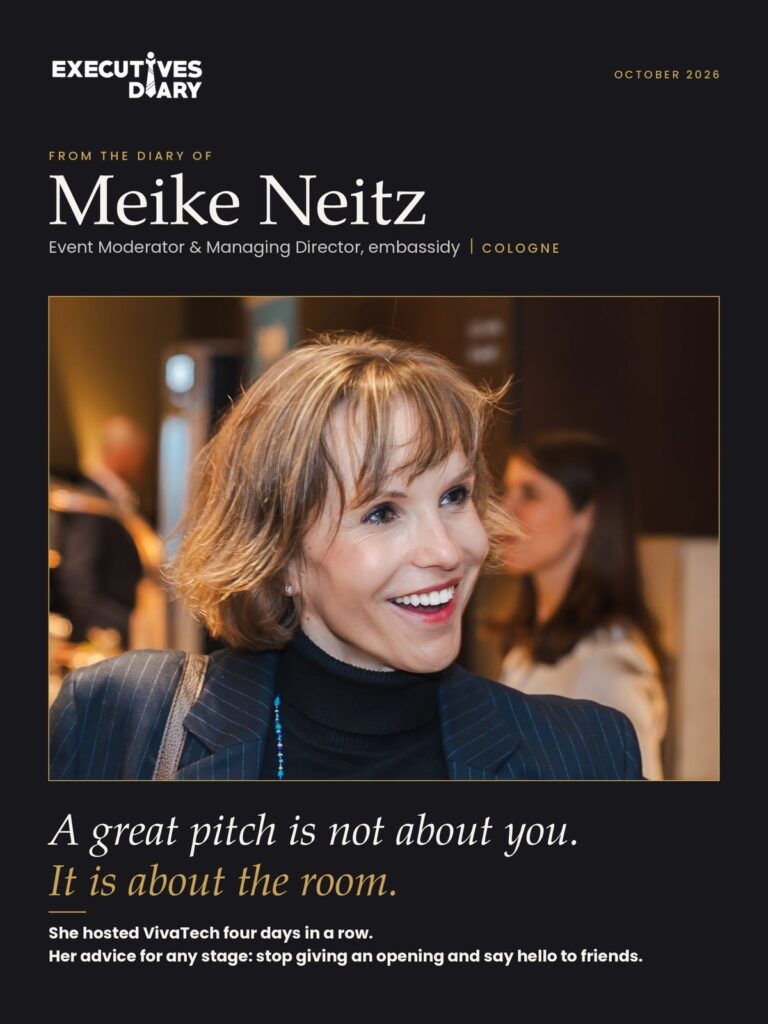
Leader in Spotlight: Read Meike Neitz Feature in Executives Diary
The Audit
“We start with an AI audit,” Ahmed says. Before building anything, he wants to understand as much as possible about the company: how it makes money, how customers enter the business, how the team works, where information moves, where people spend their time, what systems are already in use and where the bottlenecks are.
From there, the opportunities are broken into individual projects and prioritized by impact. He sometimes thinks of it as “finding the largest fire first.” The question for each is what problem, if solved, would create the greatest measurable improvement for the business. Then the work is implemented one project at a time, with an expected ROI attached to it.
“Find the highest-impact problem, implement against it, measure what happened, learn from it, and then move to the next one.”
Ahmed Karrar, Founder and CEO, AK Consulting
He doesn’t believe in trying to “AI-transform” an entire company overnight. Over time, he says, “those individual systems start becoming infrastructure.”
He has a rule for where the first project goes.
The Top of the Funnel
The rule rests on a pattern. After speaking with more than 50 CEOs, Ahmed wrote in a post, he has noticed that most companies start their AI work in the wrong place. They chase the newest tools, automate internal admin and build chatbots. “AI shouldn’t start by saving time,” he wrote. “It should start by creating value.”
Every AI transformation he leads, he wrote, starts at the top of the funnel. The questions are how to attract better leads, how to respond faster, how to nurture prospects more personally and how to help the sales team spend more time selling instead of doing repetitive work. Operations come next, then product, then administration: “Layer by layer. System by system.”
“Start where revenue enters the business. Then build everything else around it.”
Ahmed, Founder and CEO, AK Consulting
On the revenue side, McKinsey’s 2026 survey found that respondents most often attribute revenue gains from AI to its use in marketing and sales, followed by product and service development and software engineering.
He offers two projects as evidence.
Two Projects
The first is AquaFun, which Ahmed describes as the world’s largest inflatable water park. AK Consulting built an AI voice system capable of handling customer calls across more than 100 languages. “The goal wasn’t to build a voice agent because voice AI was exciting,” he says. AquaFun serves customers from around the world, so the operational problem was how to give people fast, consistent answers to their questions at scale, whatever language they speak.
The second involved automating a highly manual sourcing and research process for a land-sourcing business. After rebuilding how the system reads council registers, the contact hit rate in the test batch went from roughly 15 percent to roughly 60 percent, or 15 successful contacts out of 25.
Ahmed keeps the measured numbers apart from the estimated ones. The contact results are measured directly from the system. The time savings and financial return are estimates, based on timing and pricing the equivalent manual process. The workflow the system replaces was estimated to take around 115 to 136 hours a month of manual sourcing, research and writing. Valuing that work at £25 an hour, he estimates approximately £3,000 a month, or around £36,000 a year, in time and software value after the £375 monthly fee. That is approximately £9 of estimated value for every £1 spent.
He says he has worked with more than 70 businesses, including AquaFun and Guidance Residential, which he notes has financed more than $10 billion in homes.
A third engagement, which he described in a post, took him to Jeddah.
A Week in Jeddah
The company’s CEO had called him in because his 16-person team was drowning. Engineers, marketing, operations. The platform had to serve a network of 100+ travel agencies and 200+ agents, booking pilgrims from over 20 countries into Makkah and Madinah. Ahmed flew to Jeddah and “sat in their meetings in person for a week before I said a single word.”
The team, he wrote, “had every skill they needed.” What it lacked was a plan for how to build the platform, with no roadmap. So they started over. He and the partners mapped the whole mission, then broke it into the problems that mattered, from how a pilgrim in Indonesia books on the same system as one in Canada to tracking visa, booking and arrival in one place instead of five spreadsheets.
“Three months later, the team wasn’t drowning anymore. They were shipping.” The work, he wrote, was never really about software. “It was about helping people arrive in Makkah with ease, with dignity, and with joy.”
That is what he says he does: “I come in, I find the thing quietly bleeding time, and I build the system that fixes it with AI.”
Running His Own Companies
On his profile, Ahmed describes how he got to this way of working. He started helping companies adopt AI and kept running into the same problem. “Everyone was shipping ChatGPT wrappers and AI demos,” he writes. Almost no one was tying the work back to real revenue, real cost reduction or real ROI. That, he says, is what pushed him into what he calls operator-grade implementation.
He points to two other companies, Halal Automations and Reeltors AI, as examples of companies he has built and operated. Halal Automations is an AI automation agency serving Muslim-owned businesses worldwide. Reeltors AI helps real estate agents turn listing photos into property videos using AI.
“When you’re the operator, you can’t stop at the recommendation. You have to live with what you build.”
Ahmed, Founder and CEO, AK Consulting
As the operator, he says, you see what happens when an automation breaks, when the data isn’t clean, when a customer behaves differently from how you expected, or when a system technically works but nobody on the team wants to use it. It also changes how he thinks about ROI. When it’s your own money, time and reputation on the line, “you become much less interested in AI for the sake of AI.” The question becomes very simple: “does this make the business better?”
He doesn’t point to one dramatic moment. “What building companies has taught me is that things will constantly go wrong,” he says. “The important part is how quickly you can understand what happened, adjust and keep moving.”
Where Ahmed Is Now
For AK Consulting, Ahmed wants to work with more companies where the firm can go beyond advising and actually implement the systems. “There is already more than enough conversation around AI,” he says. “I’m interested in what happens when you get inside a business, understand how it really operates, identify where AI can have the greatest impact, and then build it.”
The reaction he hopes for from a reader is simple: “We don’t need another AI presentation. We need someone who can actually help us implement this.”
Alongside AK Consulting, Ahmed is launching a new software company, Phantasic, an AI video editor that turns raw phone footage into finished short-form videos for anyone who talks to a camera. You record on your phone and it picks the best takes, trims the pauses and times captions to every word. It is in development and opening first to a small founding group of creators ahead of a public launch. The company overview describes his approach to every company this way: “find the thing quietly bleeding time, then build the system that fixes it.” For creators and founders, it says, that thing is editing.
What comes next is wider. “I want to go incredibly deep into AI, build companies and systems that demonstrate what the technology can actually do,” he says, “and ultimately use everything I’ve learned to help rebuild Sudan with the power of AI.” He wrote about two days spent in the archives at Durham University, studying historical documents on Sudan’s healthcare system, some dating to the 1800s. “Before thinking about solutions,” he wrote, “I want to understand what has already been tried, what worked, what didn’t, and why.”
Outside work, there is tennis whenever he gets the chance, and running and the gym. “I like finding where I think my limit is and then discovering that I can go a little further,” he says, and that mentality carries into how he works.
One idea has shaped how he works: the old advice about spending most of your time sharpening the axe before cutting down the tree. “I would rather spend more time understanding the problem properly,” he says, “and then move extremely fast than rush into solving the wrong problem.”
The Ahmed Karrar Playbook: Where to Begin With AI
Ask where the business is losing the most. Time, money or opportunity: that question comes before “Where can we use AI?”
Start where revenue enters. Attract better leads, respond faster, nurture prospects, and free the sales team to sell.
Audit before you build. Learn how the company makes money, how customers enter, where information moves and where the bottlenecks are.
Take the largest fire first. Break the work into projects, rank them by measurable impact and implement one at a time, each with an expected ROI.
Measure, learn, then move on. Find out what happened before the next project starts.
From the Diary of Ahmed Karrar
Ahmed Karrar is a US-based AI consultant and the Founder and CEO of AK Consulting.
| Role | Founder and CEO, AK Consulting |
| Based in | United States |
| Also | Founder and CEO, Halal Automations, Reeltors AI and Phantasic |
“Start where revenue enters the business. Then build everything else around it.”
Editor’s Note
Executives Diary chose Ahmed Karrar because he begins AI work from a business question and says plainly which of his figures are measured and which are estimates. He has built a multilingual voice system for AquaFun and an automated sourcing system for a land-sourcing business, and he runs his own companies, so he has lived with the systems he recommends. His answers are specific about method and careful with numbers, which is what convinces the editors.
Executives Diary, Editorial