

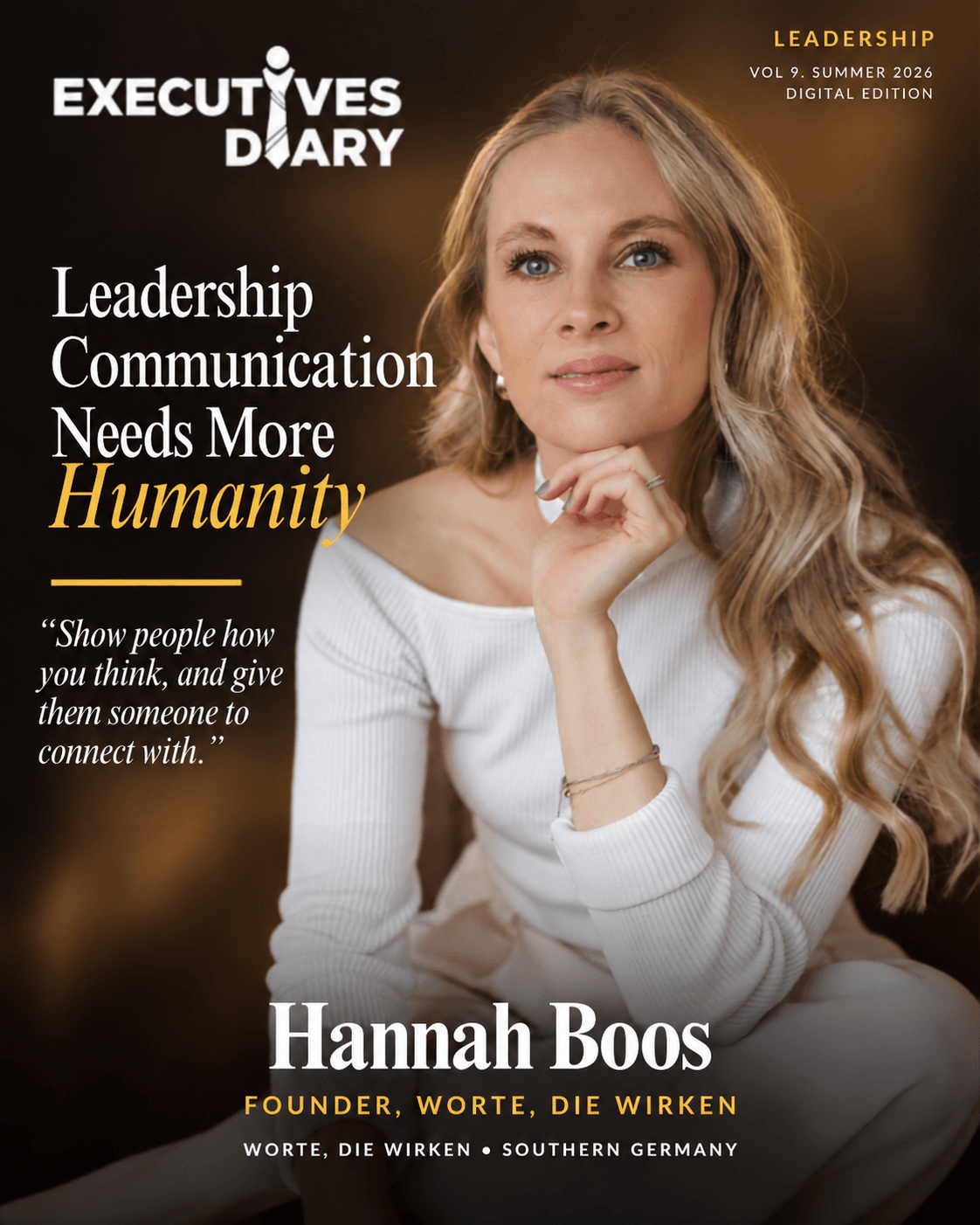
Hannah Boos
What makes leadership communication worth reading is the person who has not been edited out of it.“Okay, but when did you actually realize that?” Hannah Boos asks it after a draft comes back clean. The drafts were never badly written, and that was the problem. “I would receive drafts or ideas that were technically correct, professionally written and completely interchangeable,” she says. Her field answers that with volume: more content, more visibility, more disclosure. Boos locates the failure one step earlier, in the process that produced the sentences.
Hannah Boos runs Worte, die wirken, words that have an impact, from Southern Germany, and performed on the Rocketeer Festival main stage in 2025.
Humanity Is How You Think, Not What You Disclose
Boos defines humanity by what it is not. “I think one thing our industry gets wrong is confusing humanity with vulnerability,” she says. “Humanity doesn’t mean showing people more of your private life. It means showing them more of how you think.” Three things follow from that, and she states them as refusals: “I won’t manufacture personalities because a certain type of content performs well. I won’t turn employees into walking company brochures. And I won’t use vulnerability as a marketing tactic just because emotional content gets engagement.”
The definition came out of ghostwriting, where the same failure kept arriving in her inbox. The drafts were competent. “Nothing was wrong with those sentences. But I could have put almost any executive’s name above them.” What was missing was not candour or craft but the moment behind the claim, so she began asking for it directly. The questions she puts to an executive are about judgment rather than biography: “What do you believe about leadership that you wouldn’t find in your company values? What decision did you make that was uncomfortable but necessary? What have you changed your mind about?” One answer at that depth changes what she is listening to. “Suddenly, I wasn’t listening to a CEO communicating leadership. I was listening to a person who happened to be a CEO.”
The test came from an engagement that was never designed as a programme. It began with one chief executive who had the raw material and almost none of the visibility. “He was an experienced leader with plenty of stories, opinions and insights, but very little of that was visible on LinkedIn,” she says. The sequence inside a first session is deliberately inverted. “I don’t start with content pillars or ask what someone wants to post about. I ask how they think,” she says. Her part was the conversations first, then the positioning, then the writing in a voice that read as his rather than as a communications department’s. Over six months the content generated more than 400,000 impressions and reached more than 50,000 LinkedIn members.
The result that mattered inside the company was not on the dashboard. “At one point, the CEO messaged me saying that a product management role that had previously taken them up to two years to fill had now been filled within four months,” Boos says. The reason surfaced in the hiring process itself. “The candidate himself said during the interview that he had applied because of what he had seen on LinkedIn.”
Nine Employees, the Same Method, No Script
The company extended the work to nine employees, which is the harder test, because employees are the population most likely to be handed a script and asked to read it. Boos ran it the other way. “We had to find out what each of them could talk about credibly from their own perspective,” she says. Over three months those nine generated more than 315,000 impressions and reached more than 105,000 LinkedIn members. The commercial trail was one partnership enquiry, three customer enquiries, and a podcast invitation for someone on the sales team. Her summary of the arc is one sentence long: “A company becomes interesting from the outside when you can see the people inside it.”

What Anyone Who Puts People In Front of a Room Can Take From This
On paper her corporate influencer sessions are LinkedIn training: positioning, storytelling, how an employee becomes a credible voice for the company that employs them. The room rarely needs that part. “Most people in the room already understand that being visible could be valuable. They don’t need another 40 slides explaining why personal branding matters,” she says. The barrier is elsewhere: “Who am I to talk about this? Is my story interesting enough? What will my colleagues think?”
The stage is where she learned to treat that barrier as the work rather than the warm-up. “As a performer, I’ve learned that you can’t move a room with information alone,” she says. “You have to create a moment in which people recognize themselves.” So the workshop changed shape. Instead of teaching storytelling she tells stories, and success is no longer measured by how much material got covered. She watches for one specific reversal instead: “the moment when someone who entered saying, ‘I have nothing to post about,’ suddenly starts telling me a story and realizes: ‘Wait. Maybe I do.'”
The largest version of that room came in 2025, on stage at the Rocketeer Festival in Augsburg. Boos had four minutes on the main stage, more than 1,500 people in front of her, and no experience of an audience that size. The four minutes were a spoken word piece about the future. What stayed with her happened afterwards, when the people who came up to her turned out to have almost nothing in common: businessmen in suits, students, people at entirely different points in their lives. One student was in tears and asked whether she could hug her. “She heard the same words as the other 1,500 people in that room, but they had become her story for a moment.”
Emotion Before Information
Six rules come out of the two practices. The first three govern the order of a session. Emotion before information, because “if people don’t care, the framework doesn’t matter.” Then “make it personal before you make it publishable,” which means locating the thought or the experience before anyone opens a drafting document. Then the correction that keeps a good room from being only a good room: inspiration needs somewhere to go. “Inspiration without structure evaporates.”
The last three govern the work and how to judge it. Start with the human rather than the company message, and resist the pull toward a single house voice; the executive and the nine employees “shouldn’t sound the same. Their different perspectives are the point.” Do not manufacture material: “The best content usually came from conversations, everyday work and experiences people initially didn’t even consider ‘content’.” And do not mistake the dashboard for the result. “Reach is evidence of attention, not the final outcome. I’m much more interested in what that attention makes possible afterwards, whether that is a candidate applying, a customer starting a conversation or someone receiving a podcast invitation,” she says.
“The consultant in me gives people clarity and structure. The performer in me gives them the courage to use it,” she says. What the four minutes in Augsburg settled is the part that does not fit on a slide: “A good story doesn’t tell 1,500 people what to feel. It gives 1,500 people a chance to find something of themselves inside it.”
