

From the Diary of
Christie L. Engler
What a small business owner should fix before the team-building, from an HR consultant who has been a small business owner twice over.
“HR is an experience game.”
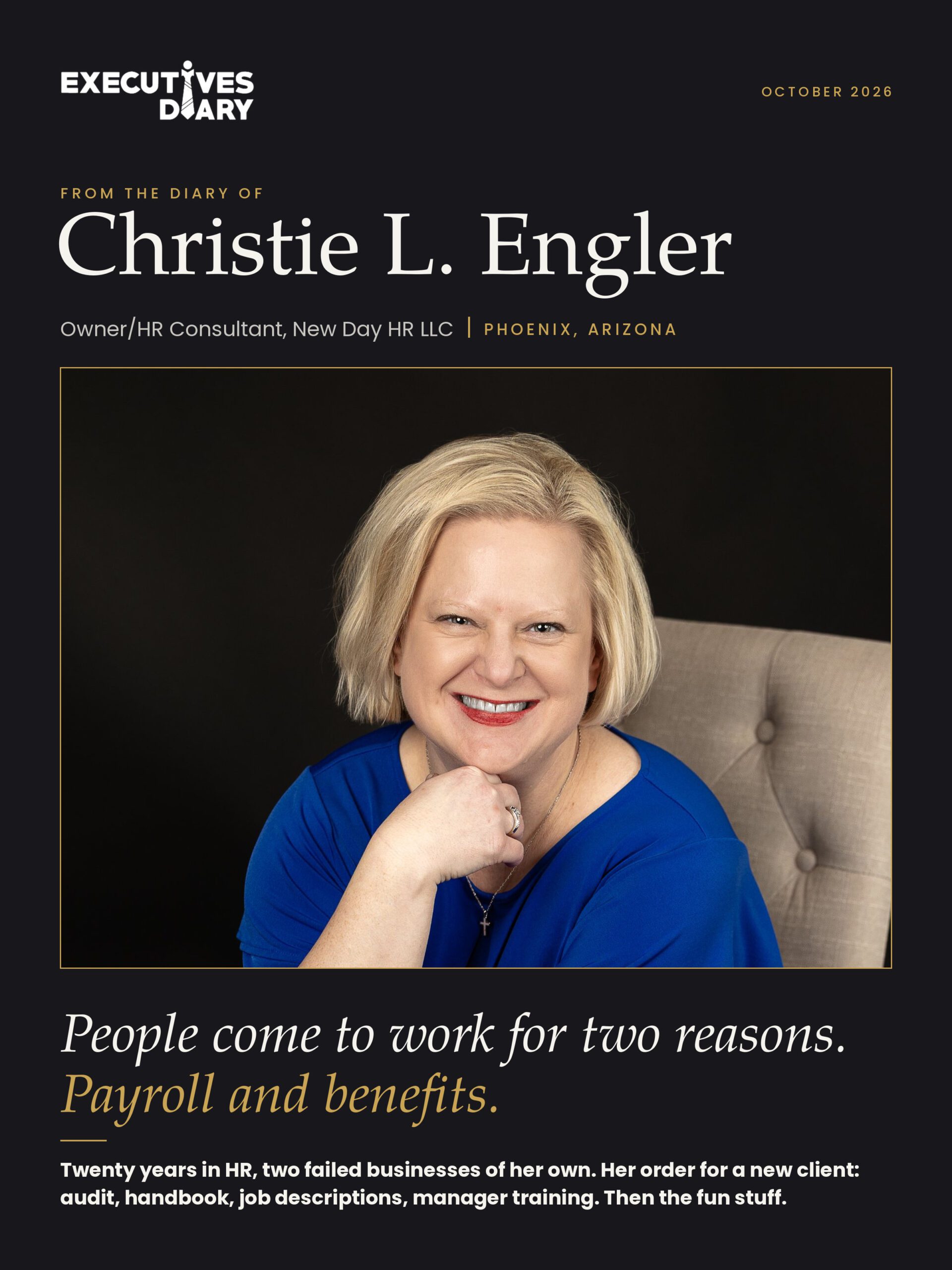
In a lot of small businesses, HR belongs to whoever was nearest when the first hire needed paperwork. The office manager. The controller. The owner, in between everything else. Christie L. Engler doesn’t see that person as the problem. “For the most part, they have done a good job,” she says. The problem is what the business does next.
For the most part, they have done a good job.
“Small businesses get HR wrong because they simply try to ‘get by’ with putting the HR duties in the hands of inexperienced people who have no background in HR,” she says. “They only focus on the administrative side. People get paid and they offer some benefits so they think they are okay. At the same time, they have compliance issues, bad managers, and high turnover.”
That shape of business is common. In August 2026, FrankCrum, a professional employer organization, surveyed 1,000 small business owners and employees who handle HR at their companies, and found that nearly four in ten small businesses have no dedicated HR department or employee: the owner does it, or it’s shared informally, or it has been absorbed by an office manager. Seventy-two percent of the people doing the work had felt unqualified or unprepared for a high-stakes HR situation.
Christie is the Owner/HR Consultant of New Day HR LLC, based in Phoenix, Arizona, with 20 years as an HR practitioner in manufacturing, construction, non-profit, healthcare, and hospitality. She builds the HR function for small businesses that have never had one, and provides fractional or interim HR leadership. She calls herself the HR Wizard Behind the Curtain, and the name is about the office manager.
“When I come in, I am not trying to get rid of that person or to take over everything from them,” she says. “I am there to support them and give them the extra boost of experience and knowledge they need to move people initiatives forward. It is truly a partnership.”

The House Before the Fun Stuff
The first conversation with a new client usually has to be redirected. “Most businesses want to jump to the ‘fun stuff’ first: team building, professional development, community involvement,” Christie says. “But it’s important to build the foundation first.”
So she starts with an HR audit, to identify risks, strengths, and opportunities. From the audit comes a master project plan with a timeline. And from the plan come four items, before anything else: the employee handbook, job descriptions, manager training, and employee files. “It is crucial to get the house in order before we move onto other areas,” she says.
It is crucial to get the house in order before we move onto other areas.
“HR isn’t a checklist; it’s a strategy to create an amazing workplace culture that employees want to be a part of,” she says. The part of the house she checks hardest is the one most owners assume is already fine.
Payroll and Benefits Are the Point
On Labor Day this year Christie posted a reminder to the HR community about why people go to work. There are two reasons, she wrote: payroll and benefits. “Take everything else off the table…everyone has to make a living, pay bills, and take care of themselves and their loved ones.” Her conclusion for HR was blunt. “Your payroll and benefits administration needs to be outstanding. Near flawless. These should be areas of strategic focus for your department. Hire well, pay them even better, and put them on the pedestals they deserve.”
You can have great employee engagement scores. You can be a ‘best place to work’. Your head of HR can be viewed as an industry thought leader. But if your payroll and benefits operations are lacking…you’re missing the entire point.
Asked for an example, she reaches for a public one. Several years ago, a larger employer’s payroll and leave of absence processes were disrupted, people were paid incorrectly, and leaves were mismanaged. The head of HR at the time, an engineer by trade, blamed the technology. “I know from experience that is not a good excuse,” she says. “Experienced HR professionals can process payroll and administer leaves with paper and pencil if they have to, no technology needed. It was such an insult to the industry.”
She sees the same thing further down the market. “I see too many HR practitioners today focused on having fancy technology or making a list of top employers. Meanwhile, their compensation and benefits strategies are lacking and employees are not happy.” The goal of HR, as she puts it, is to make the workplace the best it can be for everyone, management and labor, and to help companies mitigate risk. “To achieve those goals, HR has to get back to basics and practitioners have to know their stuff. HR is an experience game. No book, degree, or certification is going to teach everything someone needs to know.”
Some of her experience came from a chair most HR leaders never sit in.
The Owner’s Side of the Desk
Christie started a wedding and event planning business in 2009. In 2011 she and her husband bought a coffee shop. “I have been a small business owner twice over,” she writes on her profile, and both businesses failed. “I know what that feels like,” she says. “I have had to make very difficult financial decisions while having employees who depended on me for their livelihood. It is an awesome responsibility.”
It changed what she notices about the owners she works for. “One thing that is interesting about many small business owners is that they put a high value on the loyalty of their employees. When someone decides to leave, they often take it personally. HR often sweeps that feeling under the rug.”
When you’ve been a business owner, you learn that no one will ever care about the business as much as you do. It truly becomes a part of you; often aligns with one’s identity. No employee can ever truly appreciate that.
In 2020 she was Director of HR Client Services at Consolidated Employer Services, where her profile has her overseeing outsourced HR for more than 100 small business clients. “During the pandemic, I talked with owners every day who were just plain freaking out,” she says. “Should they lay people off, can we afford to shut down operations for a while, will I lose my business? I had these conversations daily for months in 2020. And I was able to handle them with empathy and understanding because of my previous experience as an owner.”
It also set the rule she works by. “As an HR leader, I practice people-first. Sometimes you have to throw the policy out the window to do what is right for the people.”
Sometimes you have to throw the policy out the window to do what is right for the people.
Twenty Years, Four Seats
Christie studied political science and human resources at The Ohio State University and took her master’s in human resources at the Keller Graduate School of Management of DeVry University. She has held the SPHR since 2015 and is SHRM-CP certified. Her profile lists small business clients across manufacturing, construction, non-profit, healthcare, and hospitality, and describes the work in three verbs: “I strategize, I coach, I support.”
The seats came in order. From 2018 to 2022 she was Director of HR Client Services at Consolidated Employer Services, working with owners and company leaders on HR operations and strategy, coaching managers on employee relations and employment law, and sitting on client leadership teams as the HR adviser. She moved to Willory as Director of People Operations and Culture in 2022, then to Diversified Systems as Vice President Human Resources in 2023. In January 2025 she opened New Day HR.
Alongside the day jobs she has kept a second track. In 2019 she started a blog, Living in the Gray, the name a reference to HR not being black and white. It now lives on her website. She taught as an adjunct professor at The Ohio State University from 2022 to 2026 and continues to teach at Franklin University. She mentors students in HR-related degrees and speaks at HR conferences around the country. “I feel it is important to pay it forward and assist the next generation of HR professionals,” she writes.
Twenty years in, she still finds the results hard to put a number on.
What the Owner Can See
“This one is tricky,” Christie says when asked for evidence. “Because HR is the business of people, it is very difficult to measure or quantify success.” What she watches instead is behavior. “People are not only showing up for work; they’re happier and display positive behaviors. Turnover slows down. Managers call to talk through employee situations before they act.”
Recently an owner told her something she takes as the result. “He just feels better having me to talk through his people issues with and he also appreciates that his managers have support as well. The burden is no longer only falling on his shoulders.” It doesn’t happen quickly. “It takes time to change a company culture and often times there is resistance when HR is introduced for the first time.”
She thinks the timing matters more now. “In 2026, a lot of small business owners are preparing for retirement and turning the reins over to the next generation.” The numbers agree with her. Chase surveyed about 1,000 small business owners in March 2026 and found that nearly half expect to step away within the next decade, while only a small share have a fully developed succession plan. “Having a solid HR foundation in place makes that transition more smooth and sets everyone up for future success,” Christie says.
A Bad Hire and a Boss’s Line
Her own hard moment was a hiring decision. “I once made a bad hiring decision. My team let me know that choice was not the right one. I listened to them and corrected course. I put new practices into place for recruiting. And we moved forward.”
The line she carries came from a former boss: don’t make things a bigger deal than they need to be. “That has stayed with me for years,” she says. “I have used it with teams that I led to help keep things in perspective during tough or stressful situations.”
The habit a colleague would call very her is the one she asks owners to copy. “Assume positive intent. I always start by asking questions and assume that people are doing their best. I encourage owners and leaders to do the same.”
Where Christie Is Now
Christie recently relocated from Ohio to Phoenix, Arizona, and New Day HR runs from there. The work is what the profile lists: establishing an HR department and foundation, fractional or interim HR leadership, talent acquisition strategy, training and development, compliance and risk. Over the next twelve months she wants two things, more small business clients and more speaking engagements, and the readers she has in mind are the two groups who decide both: small business owners and event organizers. The talk she is asked for most often is titled Training Managers How to be Managers.
Outside work she puts it in one sentence. “I am a follower of Christ, a wife, mother to two amazing daughters (one with special needs), an avid fan of Ohio State football, and an Orangetheory Fitness enthusiast. These make me who I am and contribute to my success in my field.”
What’s next, in the line she wants quoted: “I recently relocated to Phoenix, Arizona and I am excited to make new connections in the Southwest!”
The Playbook
The Christie L. Engler Playbook: Building HR Where There Was None
- Audit before you build. Start with an HR audit to find the risks, strengths, and opportunities, then write the master project plan with a timeline.
- Get the house in order first. Employee handbook, job descriptions, manager training, employee files. The fun stuff waits.
- Make payroll and benefits near flawless. Hire experienced people for both and treat them as strategic, because those are the two reasons people come to work.
- Keep the person already doing HR. The office manager or controller has done a good job. Back them up rather than replace them.
- Assume positive intent. Start by asking questions, and ask owners and managers to do the same before they act.
