

From the Diary of
Ryoichi Honma
A Tokyo pharmacist and certified lecturer on why resilience comes from people as well as plans.
“Disaster preparedness should not only protect lives during emergencies. It should also strengthen communities and support sustainable development in everyday life.”
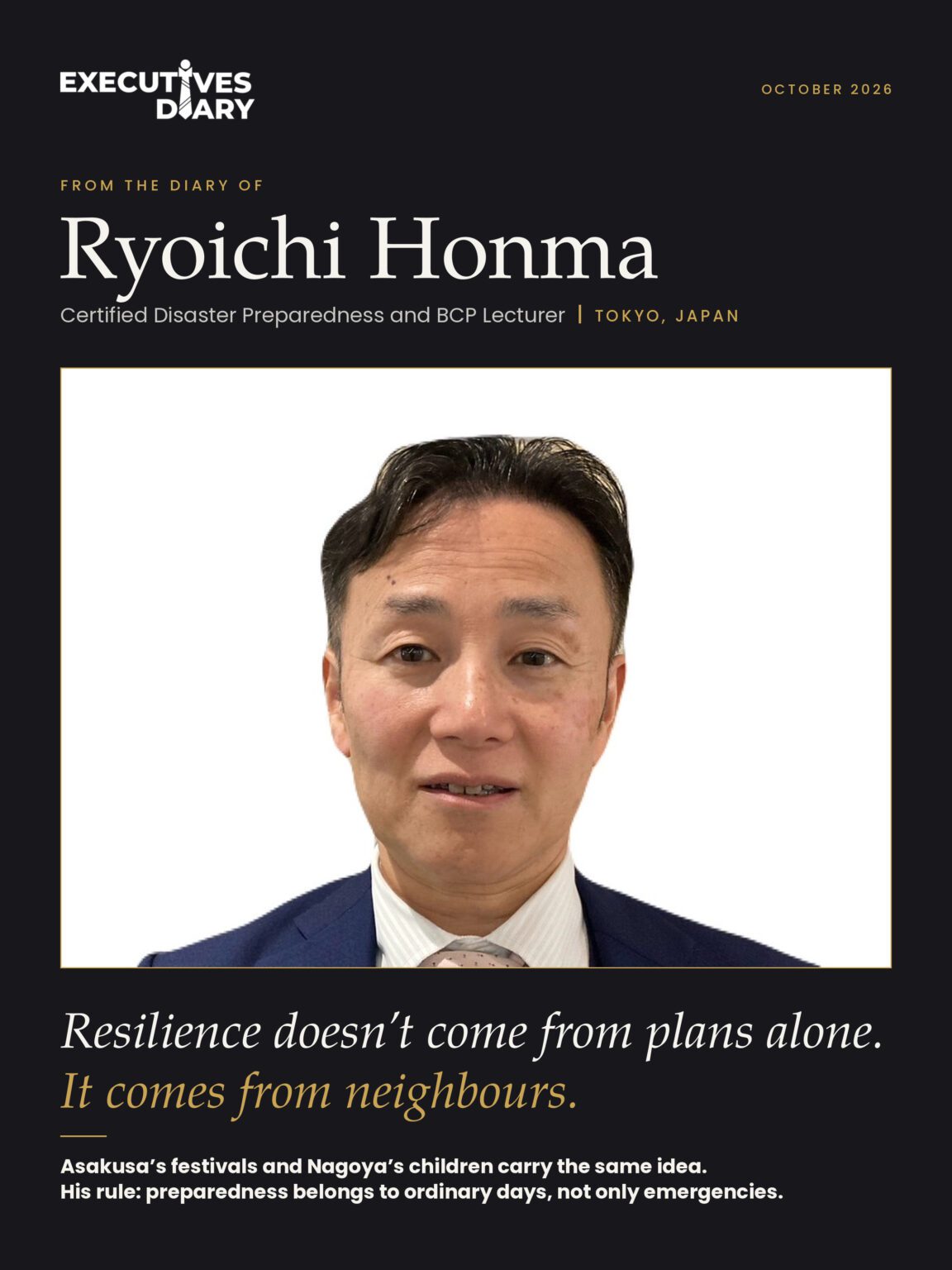
In the disaster prevention management office at Nagoya City Hall, Ryoichi Honma spent an hour and twenty minutes exchanging information with a Nagoya City Council member, three members of the city’s disaster prevention division and three other people. In Taito Ward, Tokyo, he received information from the ward’s disaster prevention manager in an online meeting. He thanked both offices in a post after a recent lecture.
In that lecture he presented two models. One is Asakusa, where traditional neighborhood bonds remain deeply rooted. The other is an urban model in which children bring disaster awareness home to their families and, from there, to the wider community.
Ryoichi is a licensed pharmacist in Tokyo and a certified lecturer with the Japan Disaster Prevention Co-Education Association. He provides training and consulting in disaster preparedness, business continuity planning (BCP) and the Sustainable Development Goals (SDGs). Behind both models is one idea, which he took to an international conference in Narita in October:
Disaster preparedness should not only protect lives during emergencies. It should also strengthen communities and support sustainable development in everyday life.
The talk in Narita
The conference was the 2nd International Conference on Climate Change and Environmental Sustainability, held on October 8 and 9. On the first day Ryoichi gave a keynote titled “Beyond Disaster Preparedness: Building Climate-Resilient Communities through Continuity, Collaboration, and Local Action.” On the second he gave an oral presentation titled “Beyond Disaster Preparedness: An Integrated Community Resilience Model Linking Climate Adaptation, Business Continuity Planning, SDGs, and Disaster Risk Reduction in Japan.”
Afterward he wrote that he had discussed how to bridge “the gap between the immediate aftermath of a disaster and the return to normalcy,” by strengthening local communities. The mission he describes is the same shape: “to serve as a bridge between disaster prevention experts and the everyday citizens who live in these communities.”
He ties the work to Japan’s history. Japan, he wrote, “having historically faced numerous natural disasters, possesses a wealth of accumulated data and practical expertise,” and that knowledge is “a valuable asset that can significantly contribute to global resilience.” The two models are where that expertise gets specific.
Asakusa and Nagoya
Ryoichi has written that drills run strictly by the manual don’t always lead to the right action when a disaster arrives. In his view, what’s needed now is the sensibility of Generation Z, the lens of the SDGs, and cooperation among communities, businesses, government and universities.
Asakusa is his community-rooted case. He describes a historic town where connections with neighbors and the local community are cherished and passed down through festivals and local events. Nagoya is the urban case, built on the chain he wrote as “Children → Families → Communities.” He says the urban model can be replicated in other regions.
Gamification is already in use in Nagoya, he says, and his team proposed gamified educational content on Roblox. His reason is plain. Only a small number of people are enthusiastic about disaster preparedness, and for most it doesn’t become personal until they live through a disaster. The aim is to spark interest first. He also believes it works as disaster preparedness education.
He asks for other people’s examples in the same posts. “I believe each of your regions also has wonderful disaster prevention initiatives in place,” he wrote, and he invited readers to share knowledge, insights or advice in the comments or by direct message. Where he learned to do this work is a shorter story.
I believe each of your regions also has wonderful disaster prevention initiatives in place
Where he started
Ryoichi studied pharmacology at Kitasato University and graduated from its School of Pharmacy in 1993. He says he has worked at four foreign-owned pharmaceutical companies since then, with head offices in Switzerland, the United States, France and the United States. His profile lists a sales position at a pharmaceutical company from January 2015.
He says his interest in disaster preparedness developed naturally from that work. As a pharmacist and Medical Representative, he has long believed that protecting people’s health involves much more than providing medicines and medical information. When disasters occur, he says, it isn’t only healthcare services and pharmaceutical supply chains that can be disrupted. Electricity, water and transportation can be too, with serious consequences for patients and communities. That led him to realize that “protecting lives also means ensuring the continuity of healthcare and supporting people’s everyday lives, even under difficult circumstances.” Over time his activities expanded from healthcare to disaster risk reduction, BCP, sustainability and community resilience.
As he puts it on his profile, he built his expertise in emergency management on analytical and data analysis skills. Since July 2022 he has worked on a freelance basis as a certified lecturer with the Japan Disaster Prevention Co-Education Association. Continuity, the first word in his keynote title, is the one with public data behind it.
Business continuity
Ryoichi draws BCP wide. After writing about the risk of information leaks through APIs when AI agents are used in cyberattacks, he argued that cybersecurity isn’t only an IT department matter. It bears directly, he said, on business continuity, information management and management risk. He sees an era that asks for two abilities at once: using AI well, and judging what must never be handed to it.
Japan’s Cabinet Office has surveyed company continuity planning every other year since 2007. In its fiscal 2023 survey, 76.4 percent of large companies and 45.5 percent of mid-sized companies said they had a plan in place. The obstacles companies named included coordinating inside the company and with suppliers and customers, and training employees so that awareness reaches the front line. Companies without a finished plan also cited shortages of staff and expertise.
The same survey is a fair test of his argument. The measures companies said had worked when they were hit were mostly basics, such as confirming that staff are safe and keeping stockpiles, along with BCP items. Ryoichi doesn’t say otherwise. His claim is that resilience doesn’t come from plans alone. Collaboration, the second word in his title, comes with a list.
Who has to be in the room
“I believe that meaningful progress requires collaboration among governments, businesses, healthcare professionals, researchers, and local communities,” he wrote.
I believe that meaningful progress requires collaboration among governments, businesses, healthcare professionals, researchers, and local communities
In March 2015, 187 UN member states adopted the Sendai Framework for Disaster Risk Reduction 2015 to 2030, which the UN’s disaster risk office calls the global blueprint for the field. It asks for engagement from all of society, under the leadership of national governments. Researchers have noted the difficulty. In a 2019 paper in Geosciences on a Kochi Prefecture town preparing for a tsunami, Kaori Kitagawa observed that the framework doesn’t offer a clear definition of “all-of-society engagement.”
Ryoichi’s examples are specific: a historic district where neighbors pass bonds down through festivals, and children who carry what they learn home. He puts the same question to his network. Before Bosai Kokutai 2026, held in Kurayoshi, Tottori on October 17 and 18, he posted three questions. What trends and challenges do others see in corporate BCP and in new disaster technology such as AI and drones? What must businesses and communities prepare? And which viewpoint tends to be overlooked?
Where Ryoichi Is Now
Ryoichi has been invited to join the organizing committee of a climate change conference in London in 2027. A keynote there is a possible future opportunity, he says, not a confirmed engagement. In a post he wrote that he hopes to use the chance to share “Japan’s exceptional disaster prevention wisdom and cutting-edge approaches” with an international audience.
He wants to hear from partners in other fields, and from people running regional disaster prevention or BCP initiatives of their own.
Away from work, he has visited all 47 prefectures of Japan. He says he enjoys traveling, exploring local food cultures and meeting people from different backgrounds, and he holds two qualifications from the Japan Sommelier Association: J.S.A. Wine Expert, awarded in 2016, and J.S.A. SAKE DIPLOMA, awarded in 2018. Those experiences, he says, “have strengthened my belief that the true resilience of a community comes not only from infrastructure and disaster preparedness plans, but also from human connections, mutual trust, and a culture of supporting one another.”
“For me, traveling is more than a hobby,” he says. “It is an opportunity to learn how people live, what they value, and how communities support each other.” That perspective also shapes his belief that “disaster preparedness should be a natural part of everyday life, rather than something we think about only during emergencies.”
The Playbook
Five Reflections from Ryoichi
- Who is in the room? Ryoichi names governments, businesses, healthcare professionals, researchers and local communities, so ask which of them is missing from your own planning.
- What makes people act? He says drills run strictly by the manual don’t always lead to action, so ask what in your training would make someone care before an emergency.
- Who is learning from whom? His urban model runs from children to families to communities, so ask where knowledge moves from the youngest person in your organization or neighborhood.
- What does the plan do on an ordinary day? He wants preparedness to be part of everyday life, so ask what yours does when nothing is going wrong.
- What would you never hand to AI? He says using AI well comes with the judgment to know what must never be handed to it, so ask what your own list would say.