

From the Diary of
Victoria Eagle
The founder of Poppy’s Light Foundation on the faint after exercise, the reassuring ECG, and the question that should come next.
“Yield to escalation, not reassurance.”
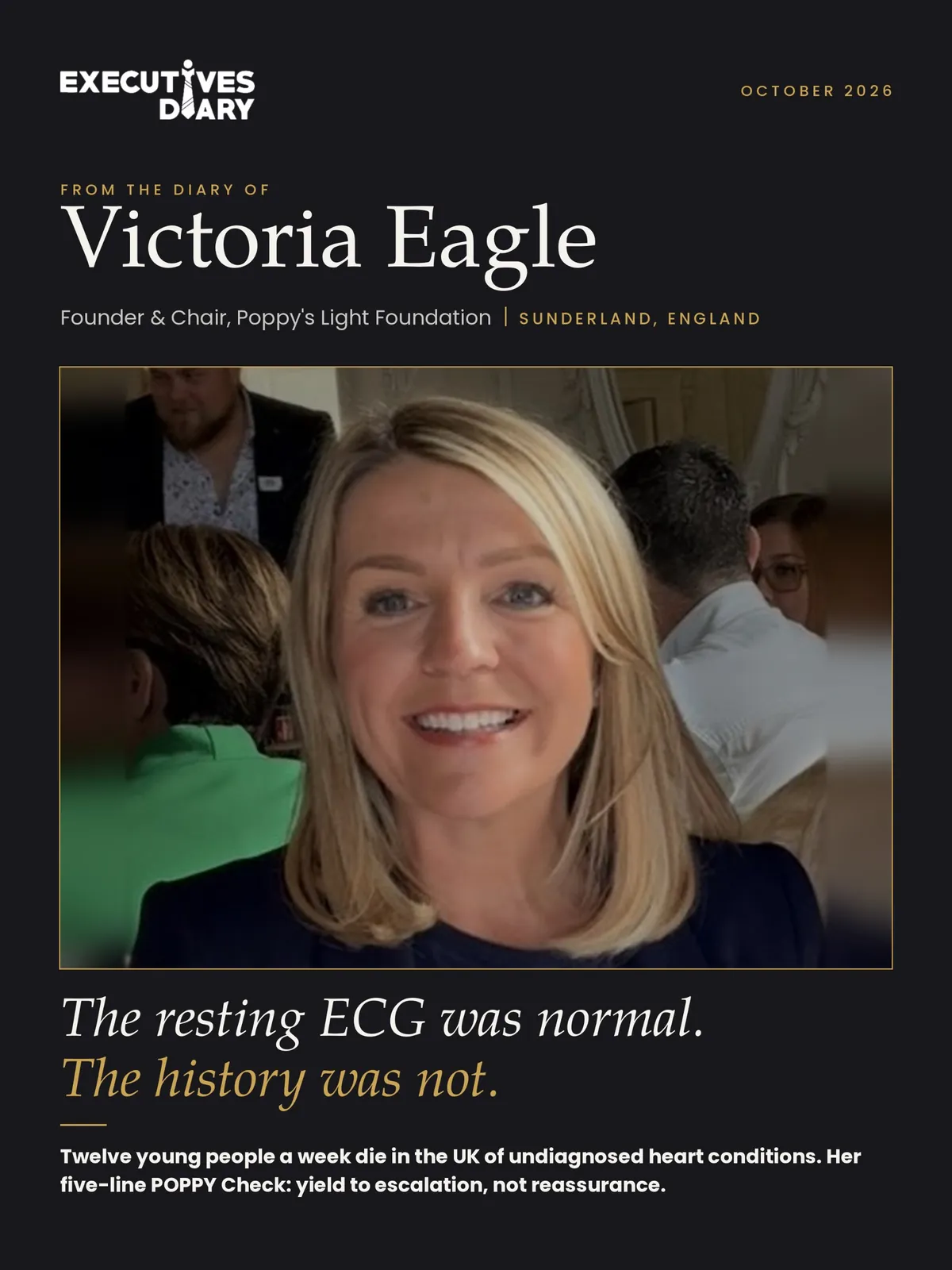
She fainted after exercise. She was 18. Her family took her to A&E, she had a resting ECG, it was normal, and she was discharged without cardiology follow-up. Nothing about that is unusual. Fainting in a teenager gets put down to dehydration, hormones, anxiety or simply being a teenager, and a normal resting ECG can feel reassuring. Sometimes it is.
Two years later she died. Her name was Poppy. She was 20, and she had CPVT, an inherited arrhythmia in which the resting ECG can be entirely normal because the abnormal rhythm is typically triggered by adrenergic stimulation such as exercise or emotional stress. “But sometimes the history is telling you something the resting ECG cannot,” her mother says. “That was Poppy.”
Poppy’s is not a rare shape of story. At least 12 young people in the UK die every week from undiagnosed heart conditions, by Cardiac Risk in the Young’s count, and many of them had already been seen by a healthcare professional.
Her mother is Victoria Eagle, Founder & Chair of Poppy’s Light Foundation, and the foundation’s answer to that history is five lines long. It’s called the POPPY Check, one letter per line, written for the emergency clinician, GP, paediatrician or cardiologist who sees a young person after a collapse and has to decide what happens next.
P, presenting syncope or collapse. O, occurring during or after exertion. P, personal or family cardiac history. P, potential inherited arrhythmia, where a normal resting ECG does not necessarily exclude one. Y, yield to escalation or specialist assessment.
“It isn’t a diagnostic tool, and it doesn’t replace clinical judgement,” Victoria says. “It is a prompt to think again when something doesn’t quite fit.” In the post that set it out on LinkedIn, she has written that it takes seconds to remember. The rest of this piece is what sits behind those five lines.
The Danger Is Reassurance Arriving Too Early
“Inherited cardiac conditions can look deceptively ordinary,” Victoria says. “A young person may look fit and healthy. Fainting can be attributed to dehydration, hormones, anxiety or simply being a teenager, and a normal resting ECG can feel reassuring.”
The foundation’s work starts from the point where that reassurance arrives. Poppy’s family only learned what she had after she died. “We subsequently learned that she had CPVT,” Victoria says, and the detail she returns to is that the test which sent Poppy home was not wrong on its own terms. It simply could not see what the history was describing.
Particularly with syncope associated with exertion, I want people to pause before reassurance becomes the endpoint.
“That’s why I keep coming back to the history,” she says. “A normal test shouldn’t erase an abnormal story.” In her own post she has written that this isn’t about blame. It’s about recognising red flags, and about how ordinary they can look: a faint after exercise, a dizzy episode, a panic attack, a seizure that isn’t quite a seizure.
Go Back to the History
When somebody comes to the foundation because a young person has collapsed around exercise and has already been reassured, the first thing Victoria says is the same every time: go back to the history.
“When did it happen? What were they doing? Was it during or after exertion? Were there palpitations, chest pain or other symptoms? Is there relevant family history? And has the exertional nature of the episode been clearly communicated?”
The last of those questions is where the POPPY Check earns its place. It’s built to be carried into a consultation and used. “Right now, we’re trying to turn awareness into something people can actually use,” she says. The line under her name, and the Y of the prompt, is “Yield to escalation, not reassurance,” and she’s careful about what it means and what it doesn’t.
“For me, ‘Yield to escalation, not reassurance’ means that when the history contains an important cardiac red flag, particularly syncope associated with exertion, a reassuring resting ECG should not necessarily be the end of the clinical thought process.”
It isn’t about undermining clinical judgement. It is about prompting the next question.
She’s equally clear about what she is not. “I don’t need them to finish the article thinking I’m an expert cardiologist or medic, I’m not.” What she would like a clinician to conclude is that lived experience can identify gaps worth listening to, and that the foundation is prepared to do the work of bringing families, clinicians, evidence and the NHS together to close them. The first of those gaps is recognition. The second is what happens after it.
I don’t need them to finish the article thinking I’m an expert cardiologist or medic, I’m not.
Recognition Without a Pathway

“The thing we perhaps do differently is that we don’t separate identification from what happens afterwards,” Victoria says. “Recognition without a pathway isn’t enough.”
The foundation is working on the clinical escalation and referral piece. It’s also developing psychological and family support, and on LinkedIn it has been surveying families about a Peer Support Programme for those affected by inherited cardiac conditions and Sudden Arrhythmic Death Syndrome. The reason is the one she gives from the inside: “a diagnosis of an inherited cardiac condition doesn’t land on one person. It can change how an entire family understands its health, its children and sometimes its bereavement.”
One of the most useful pieces of work this year came through conversations with a regional children’s cardiac network, which she prefers not to name. “There was already enormous clinical expertise in the system. The problem wasn’t that clinicians didn’t care or didn’t understand cardiac disease. What emerged was that pathways weren’t always as clear or consistent as they could be, particularly around recognition, referral and access to specialist inherited cardiac expertise.”
A survey involving 23 consultants highlighted the need for clearer guidance and pathways and training, alongside practical pressures around clinic capacity and access. For Victoria, that shifted the conversation. It stopped being simply “a bereaved mum thinks something needs to change” and became “clinicians working in the system are identifying some of the same gaps.”
“That’s where I think meaningful change starts,” she says, “not with Poppy’s Light telling the NHS what it is doing wrong, but with lived experience and clinical experience finding the same problem and working on the solution together.” That work is now feeding into wider discussions around referral pathways, education and how neighbourhood services could complement specialist and tertiary cardiac care.
Before Poppy’s Light
The person doing this work spent the previous quarter century inside the NHS, in roles that sat close to families rather than to cardiology. Her profile lists the sequence in her own words: Registered Nurse (Adult) in 2000, Health Visitor in 2006, Community Practice Teacher in 2014, NMC Teacher Status in 2015 and an MEd in Education in Professional Practice from Northumbria University in 2016, after a BSc in Public Health from the University of Sunderland. From June 2018 to November 2024 she was a Band 7 Specialist Nurse Child Protection at Harrogate and District NHS Foundation Trust.
Then the page she would tear out.
“Without question, 7 August 2024, the day our daughter Poppy died. There isn’t a professional failure or difficult day at work that comes remotely close. I lost my beautiful 20-year-old daughter suddenly to an inherited cardiac condition we didn’t know she had. I would tear that page out of our lives in a heartbeat.”
Asked what she did the next morning, she says she got up. “Not because I was strong, and certainly not because I knew what I was going to do next. I got up because I was still Poppy’s mam and still a mother to her brother and sisters. Somehow, one day followed another.”
“Eventually, the questions started. How could this happen to a seemingly healthy young woman? Why hadn’t we known? Were there signs? Could another family be spared this? Those questions ultimately became Poppy’s Light Foundation.”
Her profile dates the foundation from February 2025. She has written, on the second anniversary of Poppy’s death, that treatment as simple as a beta blocker could have saved her daughter’s life, and that “what we know now might save another young person.” That sentence is the whole case for the charity, and it explains the discipline she now asks of herself and of anyone who would start something similar.

Passion and Evidence
“Don’t confuse passion with evidence,” Victoria says. It’s what she would tell someone starting now.
“When something matters to you deeply, particularly when it comes from lived experience, you can feel an enormous urgency to change everything immediately. But if you want clinicians, commissioners, government and healthcare systems to take you seriously, passion has to sit alongside evidence, governance and collaboration.”
The practical version is an open door. “Find people who know more than you do and invite them in. Let clinicians challenge you. Let finance people challenge you. Let trustees challenge you. Ask families what they actually need rather than assuming you know. And don’t be frightened when an idea changes as a result. That’s usually how it becomes stronger.”
Find people who know more than you do and invite them in.
She applies that to the POPPY Check itself. The lived experience and the words are hers, and the clinical framing around the prompt is being challenged and informed by the foundation’s consultant colleagues as it develops. The same principle governs how she thinks about the charity’s future.
The mission may begin with one person’s story, but the solution has to belong to many people.
“I started Poppy’s Light because I am Poppy’s mam,” she says. “But building something capable of lasting beyond me means accepting that.”
Where Victoria Is Now
“The next chapter is turning awareness into access, building pathways that help young people with potential inherited cardiac conditions reach the right expertise sooner,” Victoria says. Alongside that sits the foundation’s wider campaign to make inherited cardiac conditions a national priority. With the UK National Screening Committee consultation underway, she has written that the campaign is gathering momentum, with April 2027 as the horizon the foundation is working towards. The charity is, in her words, entering a significant period of growth and developing new models of healthcare support and delivery, and a monthly newsletter, Heart & Light, carries its updates.
The people she most wants this piece to reach are the clinicians who may see a young person before specialist inherited cardiac care: emergency medicine, paediatrics, primary care and general cardiology. Beyond them, NHS patient-safety leaders, commissioners, NHS executives and policymakers, and the wider inherited cardiac condition clinical community. “Most of all, I want somebody to remember Poppy when the next apparently healthy young person presents after collapsing around exercise and think: is there something here that needs escalating?”
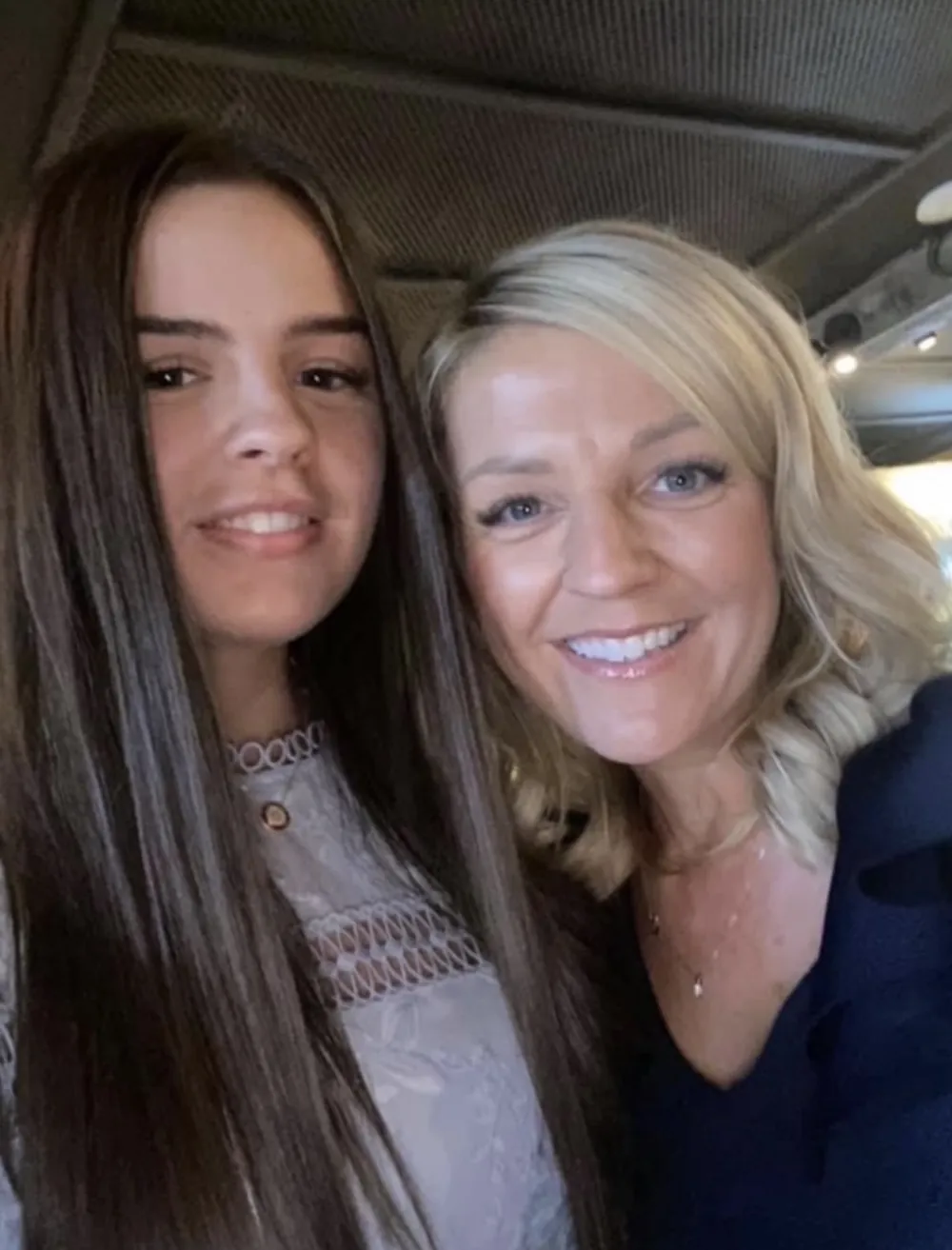
Outside the work, there’s the family the work came from. “I am a mam of five, and that remains the most important role I will ever have. Poppy remains very much part of our family and everything we do; love doesn’t end when somebody dies.”
“I would give absolutely anything not to have the reason for this work,” she says. “But because I cannot change what happened to Poppy, I can use everything I have learned since to try to change what happens next for somebody else’s child.”
Five Lines from Victoria’s Diary
- “A normal test shouldn’t erase an abnormal story.”
- “Go back to the history.”
- “Recognition without a pathway isn’t enough.”
- “Don’t confuse passion with evidence.”
- “Find people who know more than you do and invite them in.”
