

From the Diary of
Simona Deckers
What changes when a leader stops asking how to manage performance and starts asking what kind of environment they are creating.
“Self-leadership comes before leadership of others.”
For a long time, leadership was associated with having the answers, controlling outcomes and driving performance through targets and KPIs. In many organizations, especially at the top, the pressure for results still dominates how decisions are made. The people inside those organizations are showing the strain.
Gallup’s State of the Global Workplace 2026 found that only 22% of managers worldwide were engaged at work in 2025, down five points from the year before. Managers, Gallup reports, are increasingly only as engaged as the people they lead.
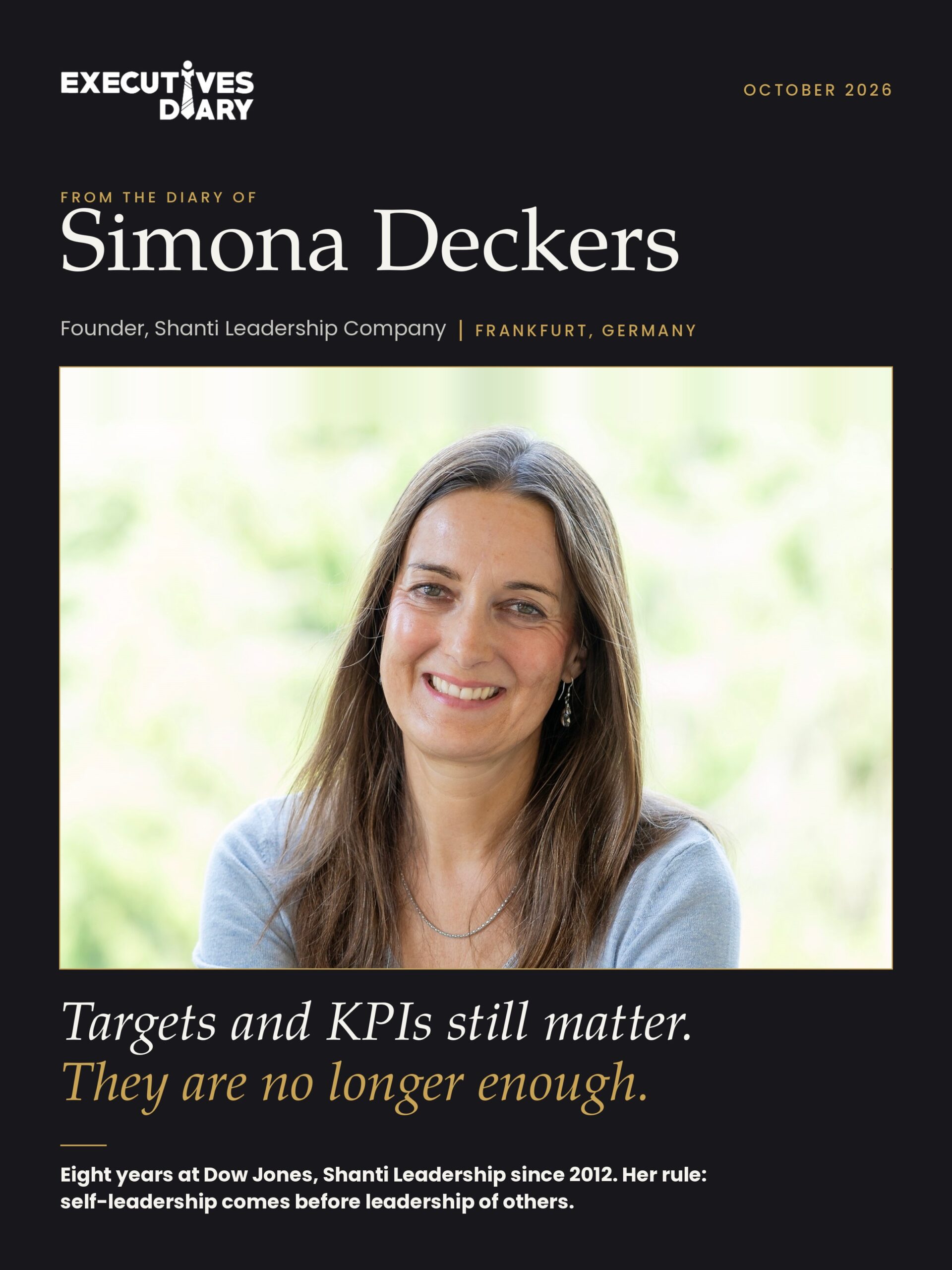
Simona Deckers, the founder of Shanti Leadership Company in Frankfurt, advises CEOs, executives and entrepreneurs. She describes her role as a partner to leaders, “helping them become more clear, more courageous and more conscious in the way they lead.” Her starting point is that the question in front of a CEO has changed. For her, it’s no longer “How do I manage performance?” but “What kind of environment am I creating, and what kind of future am I enabling?”
Where Control Ends
Simona believes the biggest shift leaders have to make is “from control to responsibility, from top down authority to equality.” Targets and KPIs, she says, still matter. “But they are no longer sufficient.”
“True leadership begins where control and top down ends,” she says, “in the ability to create clarity in uncertainty, to build trust, to listen deeply, to create equal partners and to take responsibility for the environment in which people can perform and grow.” She thinks the pace of change raises the stakes rather than lowering them. “Especially in an age of accelerating transformation, human leadership becomes more important, not less.”
Technology can process enormous amounts of information. It cannot replace human judgment, courage, integrity or the ability to create genuine trust.
That conviction shapes how Shanti Leadership Company works. “We do not treat leadership, strategy and culture as separate topics,” Simona says. The company brings business transformation, emotional intelligence and purpose-driven leadership together in one approach, and sets out to integrate “humanity, values, personal development and long-term impact into strategic leadership.”
She came to that view gradually.
Paris, Venice and Dow Jones
“There wasn’t one single moment,” Simona says. “It was a gradual realization that became increasingly clear through the different chapters of my career that leadership has to be different.”
She studied at the Université Paris-Sorbonne (Maitrise, DEA) and the University of Hamburg (Magister). Her earliest roles were in the art world: art exhibits at Gallery Daniel Templon in Paris, and the international program at the Peggy Guggenheim Collection in Venice, covering public and international relations, cultural management and museum administration.
From 2002 to 2010 she worked in communications and strategy at Dow Jones, at Dow Jones Indexes. “I spent many years working in international communications, strategy and corporate environments, including global companies and financial institutions,” she says. “Throughout my career, I observed that many organizations often lacked human-centered leadership, clear values and a deeper sense of purpose. This gap between performance and meaningful impact became increasingly apparent to me and I felt a strong responsibility to address it.”
The idea for Shanti Leadership Company, which she founded in 2012, grew out of that insight. Her own experience as an entrepreneur then showed her what she calls a different dimension of performance.
What happens inside a person determines, to a large extent, what they are able to create outside.
It was in her work with CEOs that the two ideas met.
The Pressure Leaders Carry
“Especially in my work with CEOs and senior executives, these two worlds came together for me,” Simona says. She saw “highly successful leaders who were extraordinarily capable externally, but who were sometimes carrying enormous pressure internally: the responsibility of making difficult decisions, navigating uncertainty, managing expectations and remaining strong for everyone else.”
The research finds the same pressure. In DDI’s Global Leadership Forecast 2025, a study of 10,796 leaders, 71% said their stress had risen significantly since they stepped into their current role, and 40% of those under strain had considered leaving leadership roles to improve their wellbeing.
“That shaped the mission of Shanti Leadership Company,” Simona says. She wanted “to create a space where leaders could step out of the constant pressure of their role, think more deeply, challenge their assumptions and reconnect with what really matters without losing their ambition or their performance orientation.” Ambition stays in the picture. She wants to contribute to an understanding of leadership “that combines performance with humanity, ambition with responsibility and innovation with values.”
The work also asks something of the leader. “We actively challenge existing mindsets,” she says. “We encourage leaders to rethink power, redefine success, and lead with courage, self-reflection and responsibility.”
We encourage leaders to rethink power, redefine success, and lead with courage, self-reflection and responsibility.
That challenge begins with the leader.
Self-Leadership Comes First
Asked for a signature framework, Simona starts by turning the idea down. “I don’t believe in a one-size-fits-all leadership formula,” she says. “Every CEO and every organization has its own context, history and challenges.”
I don’t believe in a one-size-fits-all leadership formula.
What she does hold to is one principle: “self-leadership comes before leadership of others.” She works with leaders across what she calls “three interconnected dimensions: clarity, inner stability and courageous action through vision, transformation and innovation.”
Clarity starts with her questions: “Who are you? What are your values?” and “What is really happening? What actually matters? What decision is being avoided?” As she puts it, “Often, the most powerful leadership development happens when a leader becomes aware of what is driving them.” Then the work turns to the leader: “How are pressure, fear, ambition or the need for control influencing their behaviour?”
And then to action. “Leadership ultimately requires courage to have the difficult conversation, to make the unpopular decision, to let go of control, to trust others or sometimes to change direction,” she says. “My approach is about developing the inner capacity to remain stable, human and decisive in external environments that become increasingly more complex.”
One belief, she says, connects the rest of her work too.
A Podcast, Three Books and Two Foundations
On The Paths of Purpose Podcast, Simona talks with thought leaders about their ideas and their answers to the questions of the moment. “I have the privilege of bringing different perspectives into that conversation and exploring the stories, decisions and principles behind people who are creating something meaningful and transformative,” she says.
In a recent episode, the top referee Deniz Aytekin told her about his son, a videographer who works behind the camera. On shoots, his son had found that the same people who greet prominent guests warmly often do not notice him at all. Asked what he hoped listeners would take away, Aytekin said, as Simona recounted in a post, that people should really see the ones they deal with.
She is also one of the authors of the Frauen schaffen Zukunft series from FAZ Buch Verlag, with contributions to the volumes on values, innovation and, most recently, leadership. Announcing the new volume, she wrote that the next level of leadership does not need more new tools, and that modern leadership begins with a new attitude to responsibility, humanity, power and impact. She is an ambassador and lecturer for the Impact MBA New Work at Tomorrow University of Applied Sciences.
She founded the Children Empowerment Foundation and the Gaia Foundation, which work worldwide to support children in need and to protect animals and ecosystems. “My foundation work is a very different but equally important expression of the same belief,” she says. “Supporting children, education and the protection of ecosystems is ultimately about investing in the conditions for a future we want to live in.”
Where Simona Is Now
The leadership volume is out, and Simona has received the Lifetime Impact Game Changer Award from She’s Club, given this year for the first time, in three categories. Favikon lists her among the Top 10 in Management & Leadership in Germany and the Top 100 Most Influential Personalities in DACH on LinkedIn.
Her advisory work is with CEOs, top executives and entrepreneurs. Looking toward 2027, she returns to the belief that “the future is shaped by the quality of the choices we make today.” She also has a question for the moment. “Today we are becoming technologically more powerful at extraordinary speed. The question is whether we are developing our human capabilities at the same pace, our ability to listen, to think independently, to take responsibility, to collaborate, to lead with courage and to create meaning.”
“If my work can contribute to leaders who don’t simply navigate the future, but shape it with greater consciousness, courage, equality for all and responsibility,” she says, “that would be a meaningful legacy for me.”
The Playbook
Five Reflections from Simona
- What kind of environment am I creating? It is the question she puts in place of “How do I manage performance?”
- What decision is being avoided? In her experience, the most powerful development often begins when a leader sees what is driving them.
- How are pressure, fear, ambition or the need for control shaping my behavior? She looks at the leader before the organization, because self-leadership comes before leadership of others.
- Where could I let go of control? Courage, in her work, can mean trusting others as much as making the unpopular decision.
- Are my human capabilities keeping pace with my technology? She asks whether the ability to listen, think independently and take responsibility is growing as fast as the tools.