

From the Diary of
Dr. Annette Doms
Why giving everyone the same AI tool does not give everyone the same judgement, and what boards cannot delegate to IT, Legal or external providers.
“The more intelligence we delegate to machines, the more responsibility we must demand from humans.”
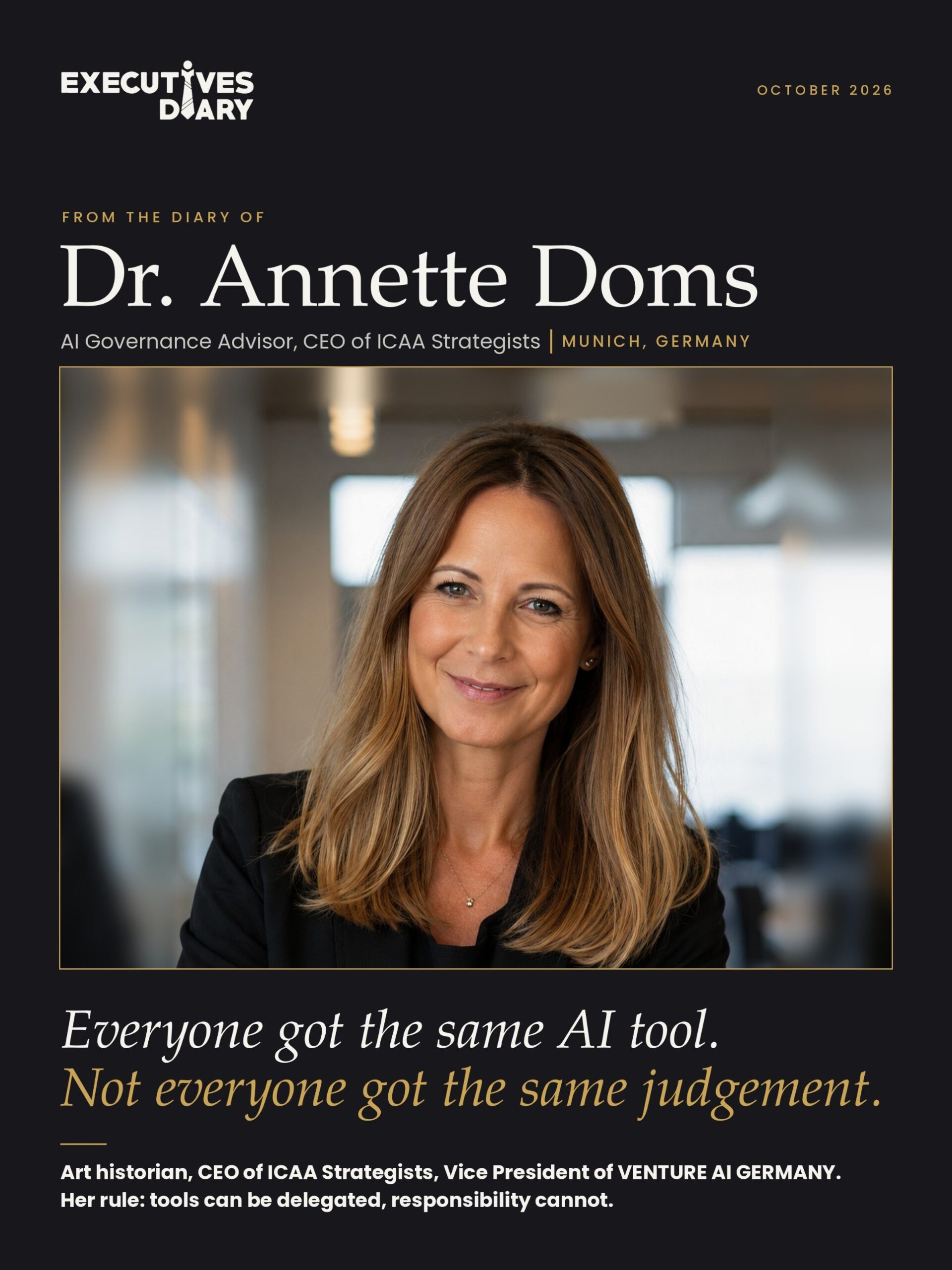
A company can give everyone the same AI tool and still leave most of its people unprepared to use it well. Everyone now has access to the same technology. They do not have the same knowledge, confidence or understanding of where responsibility begins.
A company buys licences for a generative AI tool, gives it to the whole workforce and assumes that access will lead to transformation. Within a few weeks, three groups tend to form. The enthusiasts experiment constantly and become remarkably productive. A second group uses the tool now and then but remains unsure what happens to its data, when an output can be trusted and where its own responsibility starts. A third group barely uses it at all. Six months later the most curious have accelerated and the others have fallen further behind.
“The organisation believes it has democratised AI,” says Dr. Annette Doms, who has seen this happen repeatedly. “In reality, it has democratised access and privatised understanding.”
The German picture supports her observation: in a Bitkom survey of 603 German companies published in September 2026, 57 per cent said they use AI. Seven in ten now offer some AI training, but only 11 per cent train every employee, and 66 per cent rate their employees’ AI skills as low.
Annette is an art historian by training and the CEO of ICAA Strategists GmbH, a Munich-based boutique AI advisory firm that works on AI strategy, governance, education and responsible implementation. She advises boards, executive teams and public institutions, is a keynote speaker and serves as Vice President of VENTURE AI GERMANY, the German association for AI transformation. Her argument to all of them is that keeping a human in the loop is no longer enough, and that organisations need what she calls Human in Command: not merely a human present in the process, but a human with the knowledge, authority and accountability to set boundaries and intervene. “Tools can be delegated,” she says. “Responsibility cannot.”
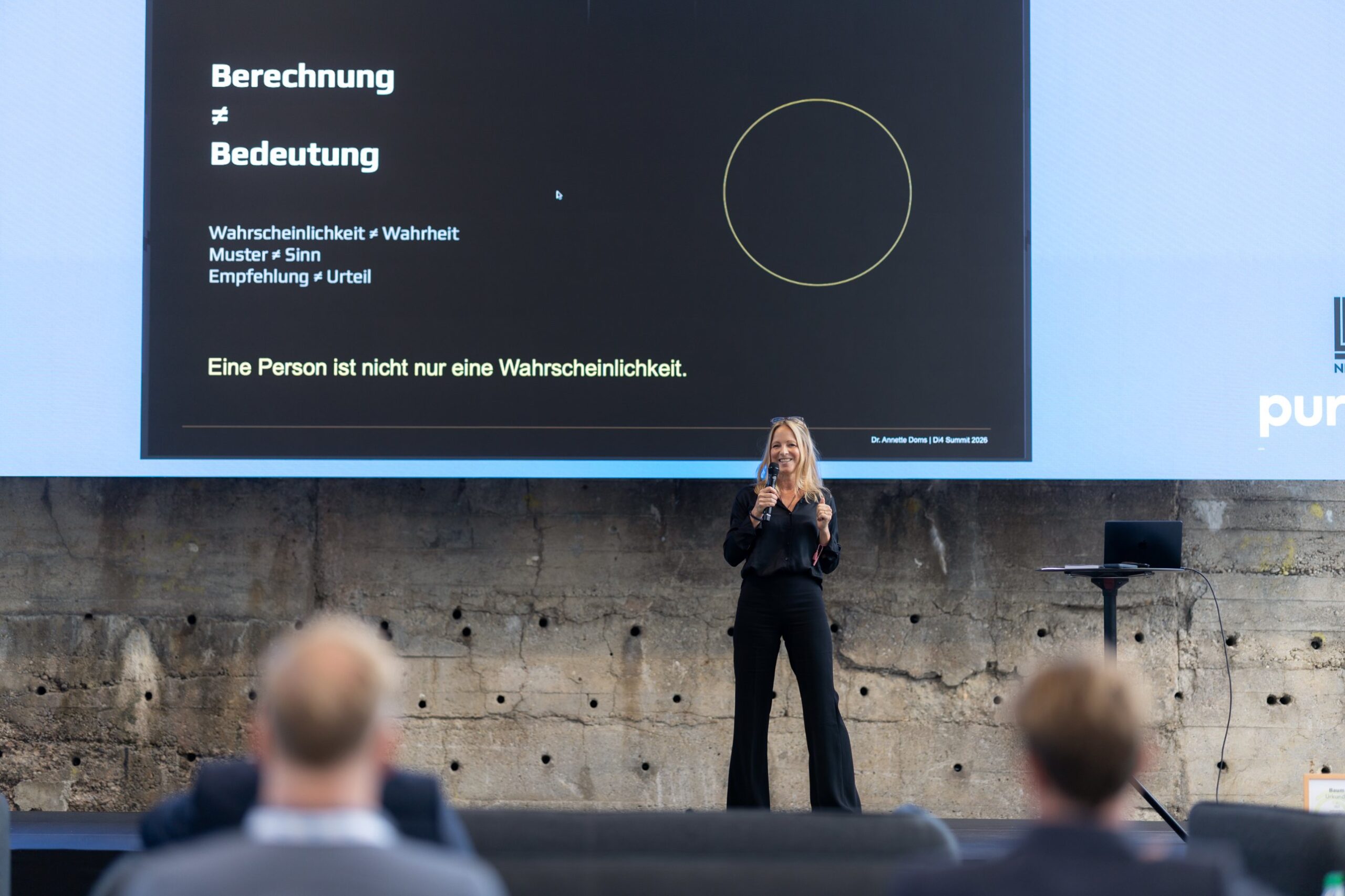
A Knowledge Problem, Not an Age Problem
Her summary of what the rollout produces is in German: “Der KI-Graben ist kein Altersproblem. Er ist ein Wissensproblem.” The AI divide, that is, has to do with knowledge and not with age. “I have met executives in their sixties who use AI with extraordinary sophistication, and young employees who remain deeply uncertain about it,” she says. “Age is a convenient explanation. Knowledge, confidence and context are the real variables.”
She has seen organisations invest significantly in licences while treating education as a one-off webinar: here is the tool, here are some prompts, here are the basic rules. What that leaves untouched is the harder skill. “Knowing how to prompt is not the same as knowing how to judge,” she says.
Knowing how to prompt is not the same as knowing how to judge.
An employee can produce an excellent-looking analysis in seconds. Can that person recognise when the underlying reasoning is wrong? Do they know which information should never have been entered? Can they distinguish probability from fact? And do they understand that delegating a task to AI does not delegate responsibility for its outcome?
The real AI divide will not be between people who use AI and people who do not. It will be between people who can judge AI and people who merely operate it.
Her answer is education that follows the role and not the tool. “AI literacy must become role literacy,” she says. A CEO, an HR director, a compliance officer and an employee using generative AI face different decisions and different risks. The law points the same way. Article 4 of the EU AI Act, as amended in 2026, asks providers and deployers of AI systems to support the AI literacy of their staff, “taking into account their technical knowledge, experience, education and training” and the context in which the systems are used. Annette takes the principle one step further, to what each person is allowed to delegate, needs to verify and must protect.
What an Art Historian Asks of a Dashboard
“Art history taught me not to stop at what I see,” she says. One of the methods she was trained in goes back to the art historian Erwin Panofsky. As she describes it, the method looks at an image on three levels: what do I see, what does it mean, and what does it tell me about the culture, values and worldview that produced it? Applied to AI, the first question is technical: what can this system do? The second is analytical: what does its output mean, and can I trust it? The third is the one that interests her most. “What happens to us when we begin to delegate parts of thinking, creating and deciding to machines?”
The discipline also taught her to be careful about claims of truth. A painting can look convincing and still have the wrong attribution. That discipline teaches the art historian to ask where something comes from, what the evidence is, what is missing and who made the attribution. “These are almost perfect questions for the age of generative AI,” she says. “AI is extraordinarily good at producing plausibility.”
We have created machines that can reproduce the appearance of knowledge without guaranteeing its truth.
“I bring the same instinct into a boardroom,” she says. “A dashboard may look perfect. A model may produce an impressive score. An AI strategy may be technically flawless. But I want to know what sits underneath it: Which data? Which assumptions? Which omissions? Who challenged the result? And who takes responsibility if it is wrong?”
Technical expertise, she says, can tell us whether a system works. But that is no longer the only question. It’s why she believes the humanities will become more important in the AI age, not less. Their skills were often called soft. “In an age of synthetic reality, they are becoming hard skills,” she says.
From Digital Art to AI Governance
Annette holds a doctorate in art history from Ludwig-Maximilians-Universität München, with psychology, archaeology and Italian philology as minor fields. “Every technological revolution transforms culture long before it transforms markets,” as she puts it on her profile.
Long before AI governance became her field, she was working on the cultural consequences of emerging technology. She co-founded UNPAINTED in Munich, described the digital-art fair in 2014 as “too early”, and came to see that being early is both the privilege and the burden of pioneering work. Artists, she wrote in a post, have always been the seismographs of social change.
She has been CEO of ICAA Strategists since 2015. In 2024 she published Web3: KI, Metaverse und Blockchain with GABAL, and in 2025 Von Gutenberg zu ChatGPT. As a keynote speaker she is represented by Speakers Excellence.
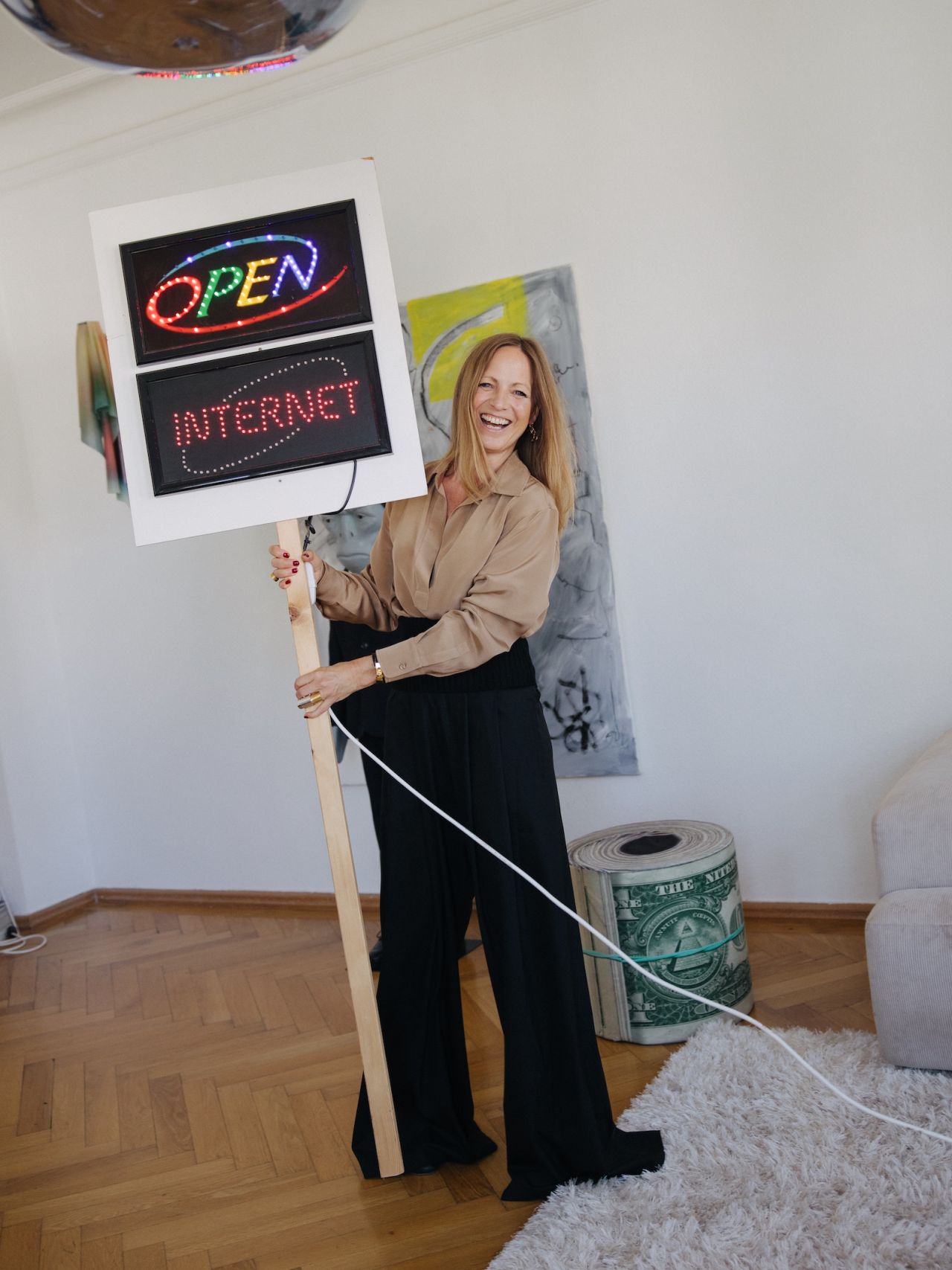
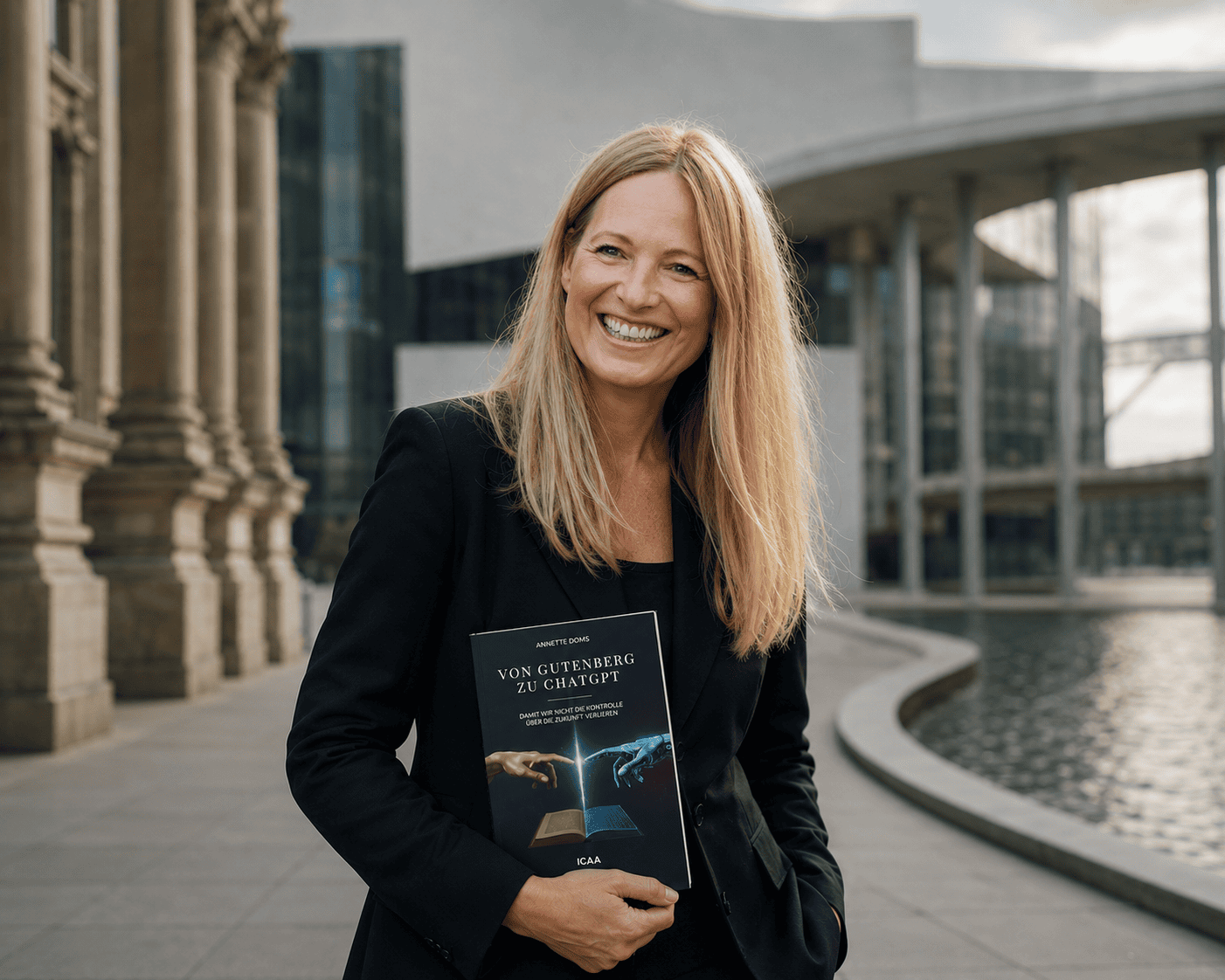
The long view is the one she brings to AI. Printing, photography and the internet, she says, “were not merely better ways to reproduce, create or communicate. Each of them changed structures of knowledge, authority and power.” AI, for her, belongs in that lineage. “That is why I believe AI is first and foremost a leadership issue.”
“After 20 years of pioneering work, I’ve learned that falling and getting back up is part of the job,” she says. “The real challenge is to keep believing in your idea without losing the joy of seeing the world differently.”
“Picasso taught me that you have to understand the rules deeply enough to know when it is time to break them,” she says. “That idea has shaped almost every transformation in my career.”
Why Human in the Loop Is No Longer Enough
She made the case in a recent post about the 2014 film Ex Machina. “At what point does delegation become abdication?” she asked. “The more capable a system becomes, the more tempting it is for humans to step back. And yet that may be precisely the moment when human responsibility matters most.”
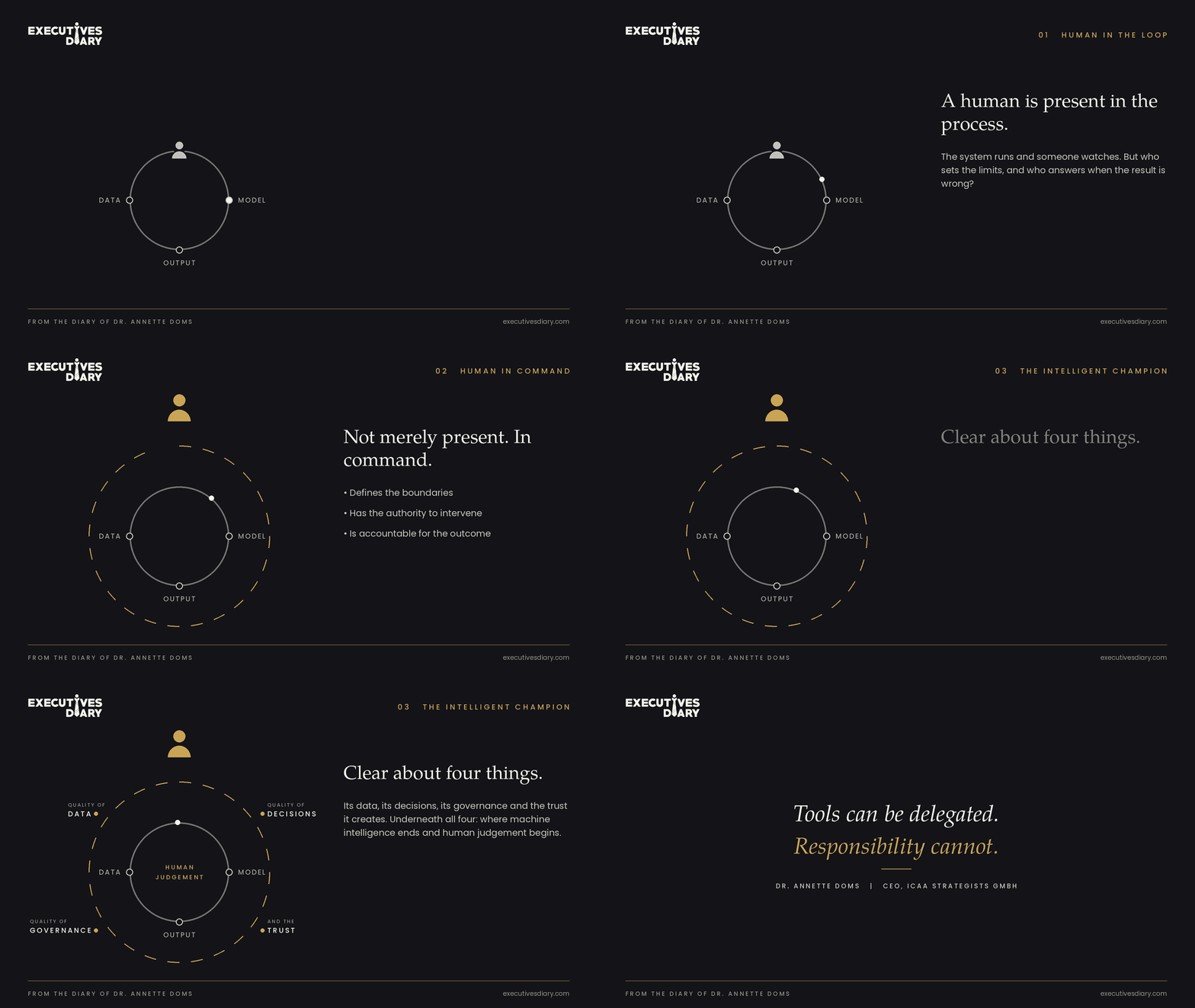
Human in Command, as she uses it, arrives with three questions: who defines the boundaries, who has the authority to intervene, and who is accountable when AI systems act faster and at a scale humans can no longer match. She ended the post with a question to her readers, asking whether humans can remain meaningfully in command of systems that may eventually become more capable than themselves, or whether an entirely new concept of responsibility is needed.
The people who most need to hear this, she says, are those who carry responsibility: boards, CEOs and executive teams, and the people who translate their decisions into organisations. “They need to understand that AI governance cannot simply be delegated to IT, Legal or an external provider.”
From Hidden Champion to Intelligent Champion
She calls an organisation that preserves that judgement an Intelligent Champion, which she describes as “a leadership model for organisations that want to create value with AI without surrendering judgement, accountability or trust.” She developed the idea by looking at something Germany has been exceptionally good at: the Hidden Champion. Hidden Champions, she says, succeeded “through precision, quality, specialisation, reliability, long-term thinking and trust.” When almost every company can access similar AI models, technology itself increasingly becomes infrastructure, and the competitive question changes from “Who has AI?” to “Who knows how to lead with it?”
In practical terms, an Intelligent Champion is clear about four things: the quality of its data, the quality of its decisions, the quality of its governance and the trust it creates around the use of AI. Underneath all four, she says, sits the question of where machine intelligence ends and human judgement begins.
The Hidden Champion of the industrial age had to master its machines. The Intelligent Champion of the AI age has to master something more difficult: the boundary between human judgement and machine intelligence.
Leadership, in this model, defines what may be delegated and what must remain under human authority. Education is one of its foundations. “You cannot govern what your people do not understand,” she says.
You cannot govern what your people do not understand.
She is direct about where the work stands. “The Intelligent Champion framework is still being built,” she says, “and I think it is important to be transparent about that.” The thinking behind it is already being applied: through ICAA, she and her colleagues work with organisations on AI strategy, governance, EU AI Act readiness and role-specific education. The formal model is developing around it. “I did not want to invent another consulting model on a whiteboard and then try to make companies fit into it,” she says. “I want the framework to grow out of the questions organisations are actually struggling with.”
The model is being built to answer diagnostic questions: where an organisation really stands, and which decisions should be augmented by AI and which should remain explicitly human. It also has to measure, she says, “whether an organisation is becoming more intelligent rather than simply more automated.”
Where Annette Is Now
Her next chapter is ICAA: “Our ambition is to build a highly respected boutique AI advisory firm known for combining strategy, governance, education and implementation, rather than treating them as separate disciplines,” she says.
She also wants to connect that European perspective more strongly with what is happening in the United States, India, the UAE and China. Europe’s contribution, in her view, should not be to imitate all of them but to insist that capability and responsibility develop together. “Europe has an important voice in the global AI conversation, especially around responsibility and governance, but it cannot have that conversation with itself,” she says.
What she wants this article to do over the next twelve months is, in her words, “something more important than generate visibility: I want it to replace fear with understanding.” The public conversation, she says, still oscillates between AI as salvation and AI as existential threat. “Neither helps a CEO make a responsible decision on Monday morning.”
Neither helps a CEO make a responsible decision on Monday morning.
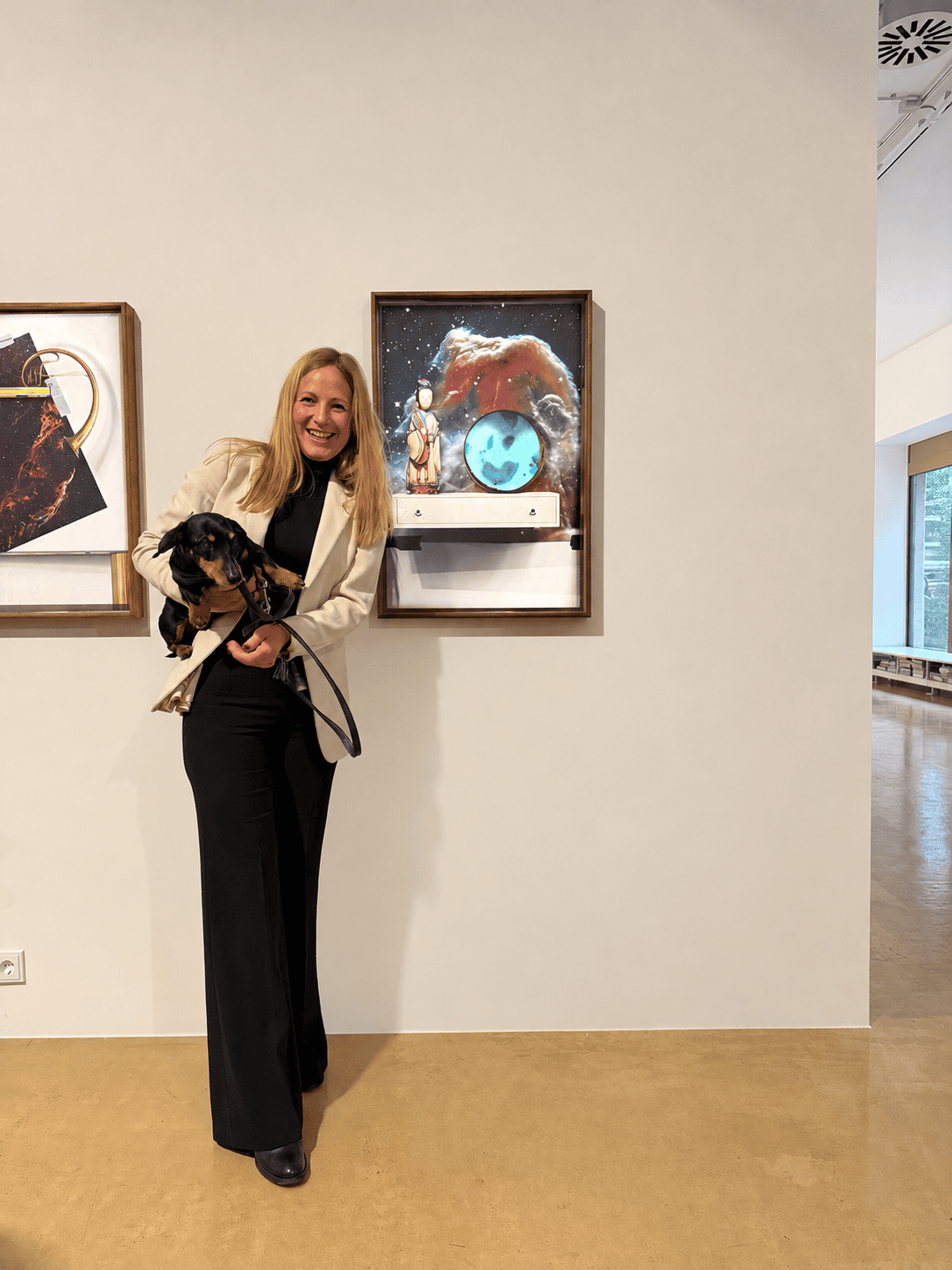
Asked for a habit, she gave this: “Calling my daughter ten times a day. No AI has convinced me yet that this should be automated.” And at home there is a dachshund, whose “eleven years of stubborn independence have taught me that not everything in life needs to be optimised.”
“I want to help write the next chapter of the human-machine age,” she says, “building bridges between technology, culture and humanity.” The sentence she wants readers to remember is clear: “The more intelligence we delegate to machines, the more responsibility we must demand from humans. That, for me, is what it means to be Human in Command.”
Five Lines from Annette’s Diary
- “When answers become cheap, judgement becomes expensive.”
- “Knowing how to prompt is not the same as knowing how to judge.”
- “You cannot govern what your people do not understand.”
- “I want to understand what AI can do. But I also want to understand what AI does to us.”
- “Technology without culture is blind. Innovation without trust cannot endure.”
