

From the Diary of
Lisa Armytage
If you are choosing who will voice your book, your training film or your commercial, here is what an actor does with your words before she presses record.
“Only the human voice connects deeply with another mind.”
At a casual glance, audiobook narration is reading aloud, and anyone with a nice voice can do it. It’s the same glance that makes a publisher, or a business owner with a training video to make, reach for a synthetic voice. What the glance misses is a step between the text and the listener. Before a phrase is spoken, somebody has to have pictured it. When nobody has, the listener hears a gap they can’t name, and the words don’t stay.
The glance has become an industry. In May 2025, Audible began offering publishers a choice of more than 100 AI-generated voices in English, Spanish, French and Italian, with accent and dialect options, to produce audiobooks from their catalogues. Whether listeners keep what those voices tell them is a separate question, and an older one. A 2023 experiment published in New Media & Society played stories to sixty habitual audiobook listeners in a human voice and in a synthetic one. The human-voiced stories were enjoyed more, produced more mental imagery, and their content was better recognised afterwards.
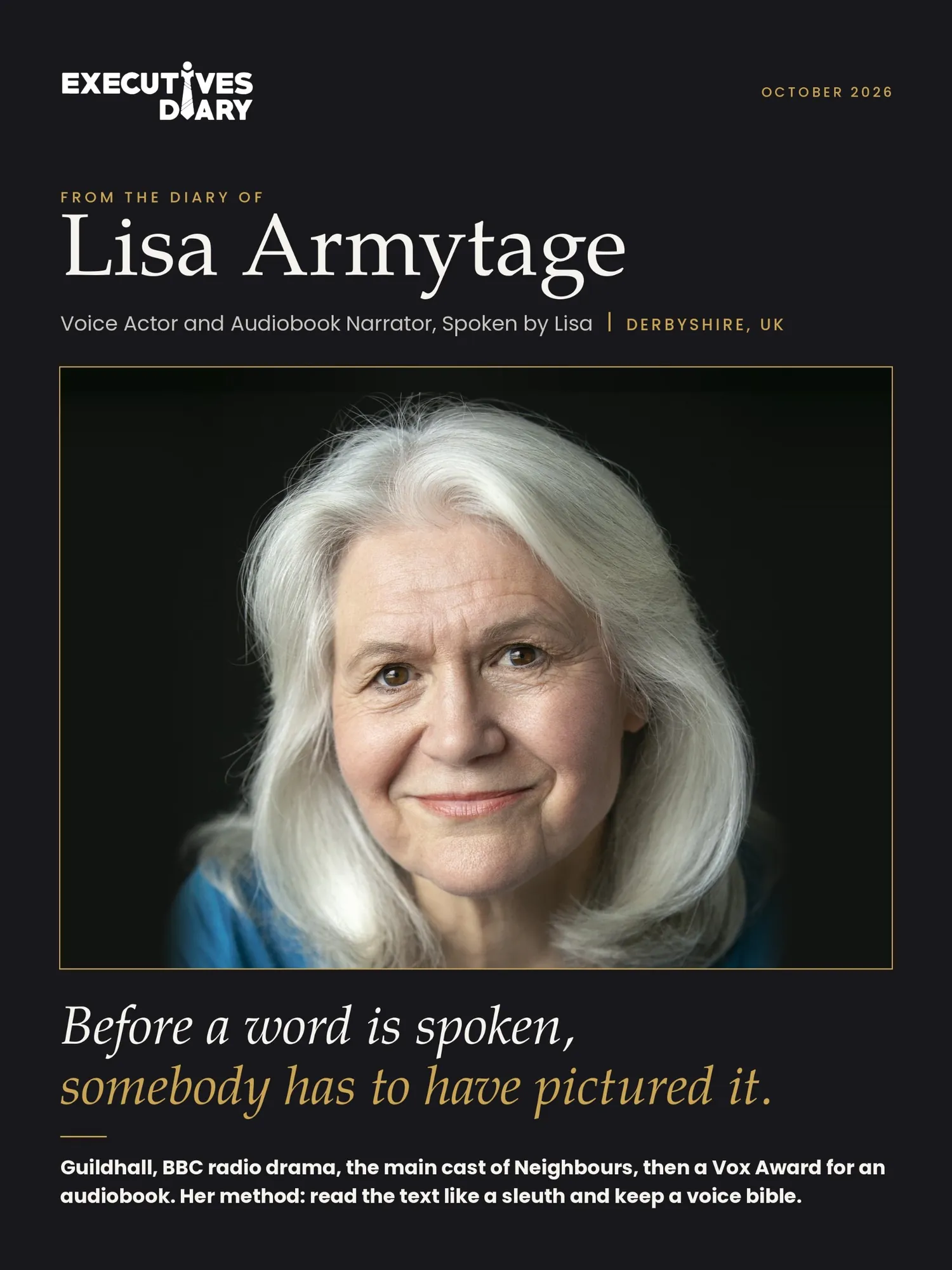
Lisa Armytage has spent her working life on the human side of that gap. She’s a British-Australian actor, voice actor and audiobook narrator, trading as Spoken by Lisa from her own studio in Derbyshire. She narrates fiction and non-fiction for publishers including Ulverscroft and HarperCollins and for indie authors, and voices audio drama, animation, commercials, e-learning and corporate video. Her Australian credits include the main cast of Neighbours, as Dr Beverley Marshall. What she brings to a manuscript is what a trained actor brings to a script. “When an actor prepares a script, the ability to form an image and a connection to each phrase is essential,” she says. “When that is not done, it feels like a blank piece in what is spoken. It doesn’t ‘land’ with the listener.”
Her question about the research is a practical one. “There are ways this can be modified, (by inserting ‘breaths’ or adding visual images), but if understanding, enjoyment and memory are key, why are we compromising by attempting to use AI instead of a human voice?”
Reading Like a Sleuth
Because of her background as an actor and what she calls “a love of creating characters through voice”, Lisa tends to be sought for text that involves character creation: audiobooks, audio drama, animation, and “less obvious places, like commercials, where character voices as well as straight narration are often used.” She thinks even other actors can underestimate the work in narrating an audiobook with many characters.
“I read the text like a sleuth, making notes on each one of the characters as I go,” she says. She notes where they come from and what their background is, and any clue the author gives about how they sound and how they look. Some authors, she has noticed, are more “auditory” than others, and how they describe their characters’ voices is an integral part of each character. Physical description is a catalyst too, and she feels the voice in her own body. “Are they fat, thin, open and energetic, or guarded and perhaps a bit resentful, maybe slower in their speech? Where is their voice placed, their head, their chest? Does it have a nasal quality, perhaps?” When a book needs a voice she isn’t familiar with, she collects it from clips of YouTube interviews and podcasts, and refers to what she calls her “voice bible” as she works.
The approach earns its keep, she says, when the main characters are of a similar age and background. She narrated Cary J Hansson’s Midlife series, built around three women in their fifties with distinctive personalities, Kay, Caro and Helen.
Each one is drawn from my careful reading of the book: nothing is by chance. It’s rather like being a director preparing the script for a film, before the casting is done. Every choice is careful and deliberate.
“I’ve got quicker,” she says, “but being an audiobook narrator is still a labour of love for me!” The sleuthing begins before there is a job.
From Audition Sample to Finished File
When a book comes her way, from an author directly or through a publishing house, Lisa first prepares a sample for the audition. “I may have very little context at this stage, so it could be a bit of a shot in the dark.”
Once the job is landed, she reads the whole text, noting every character and highlighting any word she isn’t sure how to pronounce. Then, if she can, she sets up a Zoom call with the author. How do they see the characters? “If a non-fiction book is to be narrated in first person, I want to catch the energy and humour of the author.” Raising Tiny Humans was written by Kerre Burley, an Australian author and parental development speaker and trainer. “Kerre has a quirky sense of humour and energy that I really caught through speaking to her. I used that directly in narrating her book.”
Kerre has a quirky sense of humour and energy that I really caught through speaking to her.
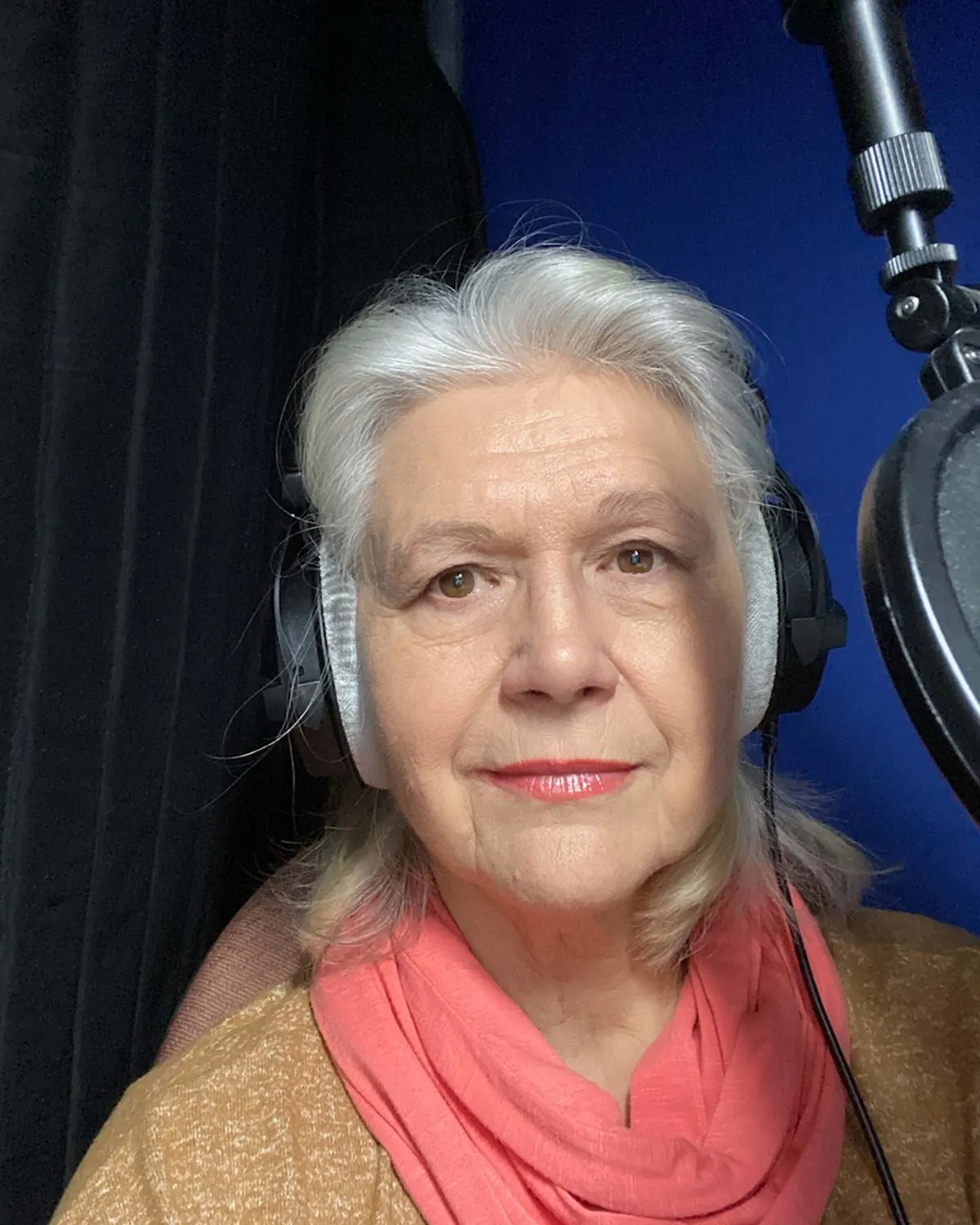
Production, she says, is completely different with a publisher and with an indie author. A publisher has its own team for casting, editing, processing and proof listening. “With publishers, my job is much more straightforward. But ‘my job’ becomes ‘our job’ when working with indie authors.” Spoken by Lisa is a production team of two: Lisa and her husband, Alan Boyd, whose background is in project management “of all stripes” and who uses the same ability to oversee an audiobook and keep the wheels turning. There’s an initial online meeting with the author. Lisa records the whole book in her own professional-level studio. The raw files are processed so the sound becomes richer and the volume more consistent, and any lumps and bumps are edited out. Alan did that himself until recently. As his other management work grew, they now outsource the editing. A proof listener checks the prepared audio for errors and inconsistencies, Lisa drops in the corrected phrases, and they’re edited back in. “It is now ready for upload, and this is in the hands of the author. Our job is now done.”
Some of those authors come back with the next book.
Six Books for One Author
“Sometimes you get the chance as a narrator to form an ongoing relationship with an author through their work,” Lisa says. She has narrated six books for Cary J Hansson, who now publishes through her own company, Storied House Ltd. Cary was one of the five Kindle Storyteller Award finalists of 2023 with A Midlife Gamble, part of the Midlife series. The same year Lisa was named Winner in the Audiobook category of the Vox Awards 2023, and in the post announcing it she thanked Cary, whose book, she wrote, “is a real fire-cracker”. She was a finalist in the audio drama category too, for The Robots with Big Finish Productions.
Asked why she chose Lisa to narrate her books, Cary wrote: “With voice work, the ability to wrench every last drop of anger, or embarrassment, happiness or shame from a spoken line is essential. Lisa has this quality in abundance. She could narrate the telephone book, and I guarantee you’d want to listen.”
Not every job is a novel. Lisa remembers a corporate voice job where the main client, in her words, was bad-tempered and irritable at the outset. “I kept my calm, remained cheerful and kept focused on being friendly while delivering the job to the best of my ability. By the end of the session the feeling of ‘ice’ in the group of online clients who were giving me feedback had melted.” The training behind that began in London in 1974.
Guildhall, the BBC and Twenty-Four Years in Australia
Lisa trained on the three-year Professional Acting course at the Guildhall School of Music and Drama in London, graduating in 1977, and worked in theatre and BBC radio drama before emigrating to Australia in 1979. She had married an Australian she met on an overseas trip in her twenties, and she stayed for twenty-four years. She worked in Australian TV, film, theatre and radio drama: the main cast of Neighbours as Dr Beverley Marshall, the co-lead in the feature film Cool Change as a mountain cattle farmer, guest roles in series including The Flying Doctors, and several years with ABC Radio Drama in Melbourne. She also took a BA at Macquarie University in Sydney, majoring in Creative Writing.
Her voice work began in Sydney in 1995 at Classroom Video, an educational production house, narrating educational videos, playing character voices in humorous cartoons that taught chemistry, and recording short stories for children.
She returned to the UK in 2003 and turned first to theatre and then to voice acting. The voice work “really took off” in 2007, as she puts it on her profile, with short stories for Short Story Radio, then fiction and non-fiction for AudioGo, the home of BBC Audio, in Bath. In 2014 she toured Australia as Clara, the eccentric housekeeper, in Lindsay Posner’s production of Hay Fever for Theatre Royal Bath. In 2017 she began narrating audiobooks from her own recording studio, and moved into commercials, training videos, e-learning and animation. She reconnected with audio drama through podcasts and Big Finish’s Doctor Who audio dramas, and has returned to on-camera work, with credits in short film and an episode of The Crown.
All of it, she says, feeds into the work.
What the Stage Taught the Booth
Asked what a career on stage and on camera taught her that a narrator who came straight to the booth would not know, Lisa starts with text. “As a trained actor I have learnt to analyse text, picking up on the clues about the different characters in a play or script.” Then voice: many hours of classes that minimise the strain on her voice and made her aware of how differently everyday people speak, a “head voice” or a “chest voice” for example. Then two years of linguistics at Macquarie, with ear training and the International Phonetic Alphabet. That was useful, she says, in three ways: “listening for the way people speak, quickly learning new accents, and phonetically transcribing words which are difficult to pronounce. This has given me the confidence to take on any accent in a novel with an ability to catch the ‘flavour’ of it convincingly for the listener.”
The person who most shaped how she works was her improvisation teacher at Guildhall, Ben Benison, an actor, writer and mime artist. “I loved working with Ben. As a pretty uptight teenager I gradually thawed and responded to his sense of fun and playfulness.”
I take that sense of improvisation and allowing the unexpected into every audiobook I record.
She narrates as a British-born English speaker and as an Australian. “My daughters and grand-children are still there, and are through and through Australians, so I have two sides to my life, the English side and the Australian side, and I draw on them both in creating characters and for narration. I carry voices in my head from my childhood onwards, and the way someone speaks is often one of the first things I will notice about them.”
Where Lisa Is Now
The people Lisa wants reading this are the ones who cast the voices: casting directors at the major audiobook publishers, indie authors looking for a narrator to work with directly, and business owners who use voice actors for their corporate and commercial videos. “As an actor and audiobook narrator I never know what might be around the corner, but I’m looking forward to celebrating online my next audiobook release, as the narrator in ‘The Chronicles of Narnia Devotional’ by C.S. Lewis and Rachel Dodge, with a stellar cast including Lynn Redgrave and Kenneth Branagh.” The audiobook, Journey into the Wardrobe: Meditations on the Beloved C.S. Lewis Classic, is narrated by Lisa alongside Michael York, Lynn Redgrave, Derek Jacobi, Jeremy Northam, Alex Jennings and Kenneth Branagh.
Asked for one entry outside work, she sent this. “It seems to me that AI is the ultimate progression of the Industrial Revolution to the point where we have a choice. Do we accept the mechanisation of our thoughts and words, the dehumanisation of our interactions, or do we finally acknowledge, with Hamlet, that ‘There are more things in heaven and earth, Horatio, than are dreamt of in your philosophy’? Perhaps the ultimate irony of AI is that it will help us finally realise what it is to be human. Let’s hope that valuing what we truly are and what we have within us doesn’t come too late.”
Her daughters and their children live in Sydney, “out and out Australians”, and she visits as often as she can, next in January. In the meantime she reads bedtime stories to her grandchildren every week. “They are a nail-bitingly truthful audience and always let me know when I’m on track!”
They are a nail-bitingly truthful audience and always let me know when I’m on track!
Five Lines from Lisa’s Diary
- Only the human voice connects deeply with another mind.
- I read the text like a sleuth, making notes on each one of the characters as I go.
- Every choice is careful and deliberate.
- I carry voices in my head from my childhood onwards.
- They are a nail-bitingly truthful audience and always let me know when I’m on track!
