

From the Diary of
Richard Godfrey
The future of business isn’t handing thinking to AI. It’s handing it back to you.
“Let AI do the research so we have more time for the things humans are good at: thinking, judgement, relationships and making better decisions.”
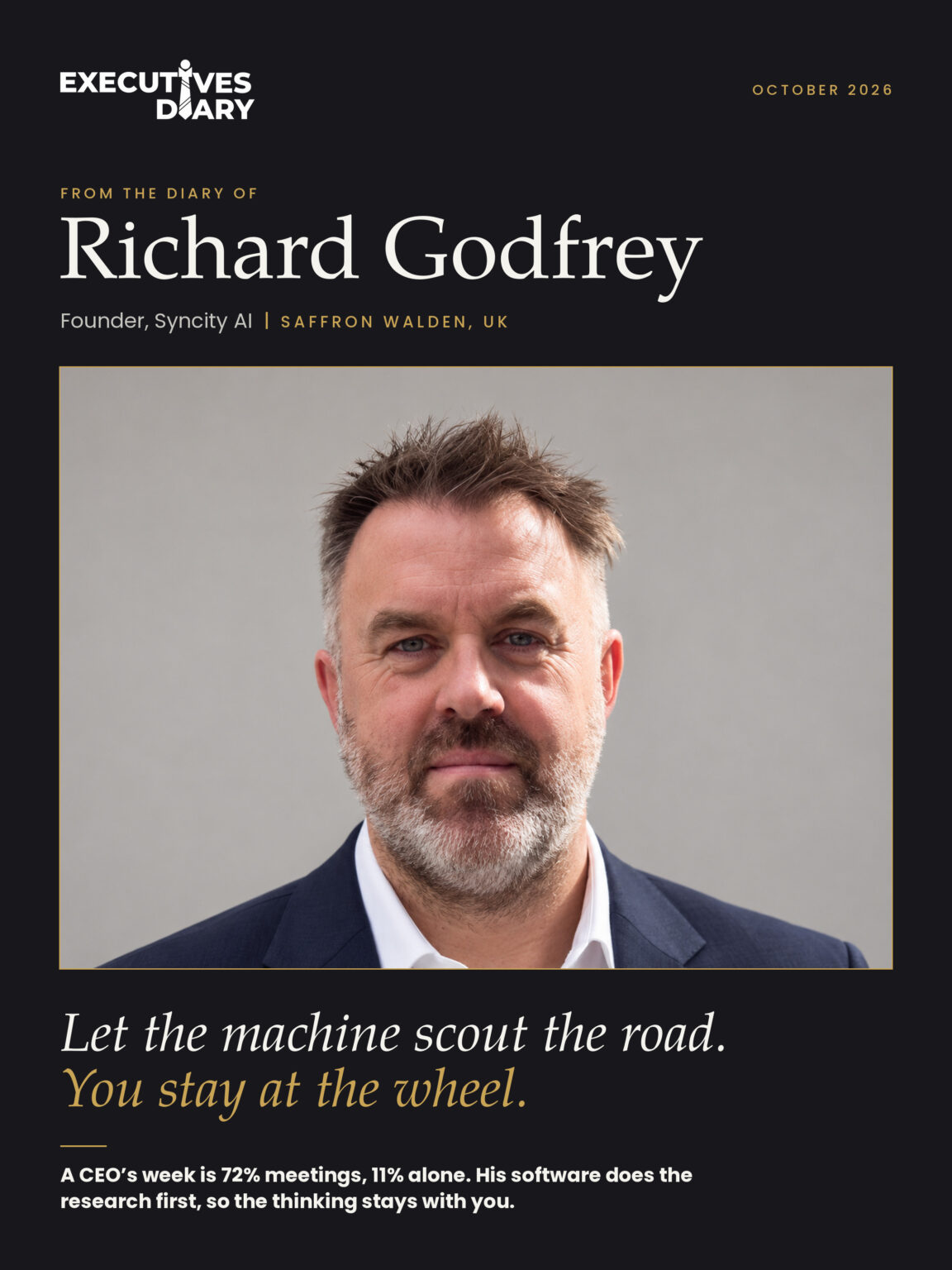
A study of 500 CEOs across major companies found that only 11 percent of their time was spent alone, the hours when strategic thinking actually happens. Those same leaders spend 72 percent of their week in meetings, most of them reactive, responding to what landed in their inbox that morning rather than what could change where their business is headed.
The cost is measurable. Companies whose leaders demonstrate strong strategic decision-making capabilities are 30 percent more likely to experience positive revenue growth. Yet most leaders cannot apply that thinking to their decisions because of what they cannot seem to escape: pressure, urgency, and the sheer volume of information that arrives every day.
Richard Godfrey has watched this trap for more than 20 years. He has led large transformation projects for governments and councils, built consulting practices and now built software. In every role, the pattern was the same: founders and leaders buried so deep in the day job that looking up to see what is changing around them feels like a luxury they cannot afford.
He built Syncity AI to change that equation. Not to make anyone work faster, but to buy them back the one thing their business actually needs: time to think.
The Efficiency Trap
When most business owners think about AI, the conversation starts in the same place: speed. Writing emails faster, summarizing meetings, saving a bit of time here and there. All useful. But it is also the smallest possible return on what is actually an incredibly powerful capability.
Richard’s observation is simpler and starker than most: most businesses do not have a shortage of ideas or information. They have a shortage of time to think. And when you save someone 30 minutes through automation, the instinct is almost always to fill it with another 30 minutes of activity.
If AI saves you half an hour and you immediately fill it with another half-hour of activity, we’ve missed a much bigger opportunity.
This is where efficiency and effectiveness split. Efficiency is doing more with the resources you have. Effectiveness is making better choices about what you should be doing in the first place. One is about speed. The other is about direction.
A manager facing a struggling employee usually asks how to get better performance. Richard would start with a different set of questions: Where do we want to get to? What is actually getting in the way? What support is missing? What in the environment needs to change? The problem is not usually effort. The problem is the question itself.
Destination First
His method comes from a piece of architecture that sounds simple but is not: start with where you are and where you want to go. Full stop. Everything else follows from that.
The sat nav metaphor came from Richard trying to work out what category Syncity belonged in. He experimented with ideas like an AI backroom team and even a business operating system, but neither was quite right. “The backroom language put us alongside agentic AI tools that automate work, while an operating system sounds operational. Syncity isn’t really either of those things. It’s strategic.”
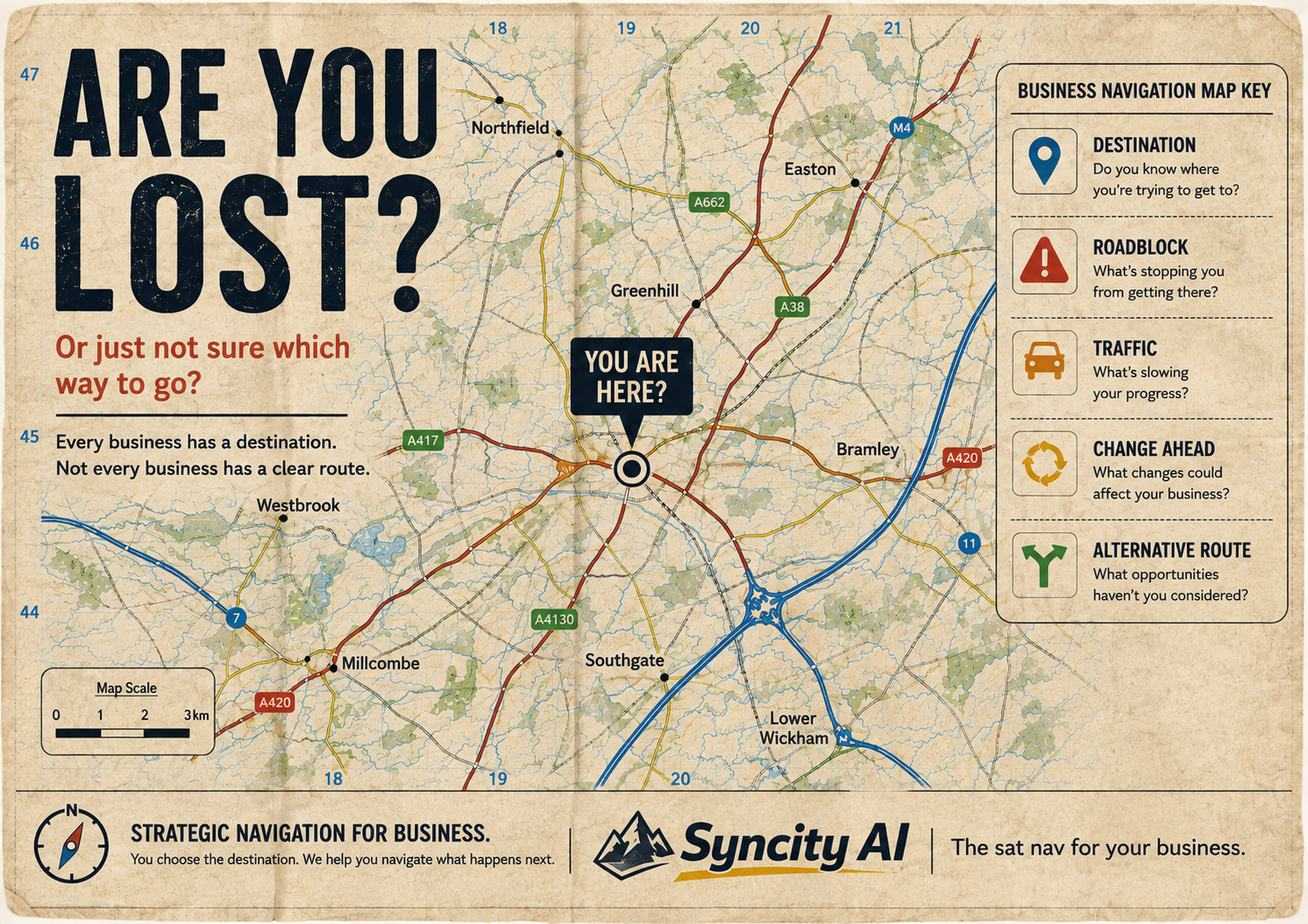
He has always thought about strategy as a journey rather than a document. “You know where you are, you decide where you want to get to, and then you have to navigate everything that happens between those two points. The route isn’t static because the world around the business keeps changing.” That led to Strategic Navigation, and suddenly he could explain Syncity in one sentence instead of needing paragraphs: It’s the sat nav for your business.
“You set the destination. The technology monitors the road ahead and suggests different routes. But you’re still at the wheel. It also helped us draw a clearer line around what we weren’t trying to build. We don’t want AI to drive your business. We want it to help you navigate it.”
This is where the sat nav metaphor stops being cute and becomes precise. A sat nav does not tell you to drive faster or take fewer wrong turns. It watches the road ahead, sees something you cannot see, and presents it to you. Then you decide. Perhaps you take the shortcut. Perhaps you know that road is full of potholes and you stay exactly where you are.
The technology has done its job. It spotted something you couldn’t see, calculated an alternative and presented it to you. But you made the judgement.
What makes this different from having a consultant walk into your office with a recommendation is the consistency. A consultant comes once. Syncity runs continuously in the background. Syncity does continuous reconnaissance and works inside the context you defined: where your business is today and where you have decided it needs to go.
The reconnaissance is constant. The decision stays with you.
Thinking Time Is Work
Richard’s background in sport probably shapes how he thinks about this. There is a white line around the pitch. The manager or coach stays on one side of it. They set the team up, study the opposition, decide the tactics and give the players direction. Then the players cross the white line and execute. The manager does not run onto the pitch and try to play. The manager’s job is to see.
“Businesses need both sides of that line. AI can make an enormous difference operationally, but we should also be asking how its extraordinary ability to process information and knowledge can help us on the strategic side.”
He does not claim to have suddenly stopped reacting and reclaimed his time. He has always been quite strategic. But his bigger realisation has been how little value organisations sometimes place on thinking itself. He came from local government, where at senior level it wasn’t unusual to spend seven hours a day in meetings. There can almost be an assumption that if your diary isn’t full, you’re not busy enough.
Some of the most valuable time he had in that period was away from the office. He was lucky enough to attend AWS re:Invent in Las Vegas and Salesforce Dreamforce in San Francisco. “From the outside, sending someone from a council to a technology conference in Vegas could easily be portrayed as a waste of money. But in three days at those events I probably learned more about how we could achieve some of the organisation’s ambitions, and what was becoming technically possible, than I would have done in weeks of sitting in the office going from meeting to meeting.”
We confuse busyness with progress because activity is visible. Sitting quietly for half an hour thinking about where an organisation is going can look less productive than answering emails or attending another meeting. Strategically, either could be far more valuable.
This has shaped his view. “Thinking time has to be treated as part of the work, rather than something you do when the work stops.”
What a Quarter Looks Like
Success after a quarter with Syncity is not about producing more output. It is about changing the way a founder works and thinks about their business.
Strategic thinking is difficult when you start with a blank sheet of paper. Before you can make a good decision, you often need to understand what’s changing in your market, what competitors are doing, where opportunities might exist and what could be standing between you and where you’re trying to get to. “Doing all of that homework takes time, so quite often it simply doesn’t happen. What we’re trying to do with Syncity is get you perhaps 80% of the way there before you sit down to think. The Scouts have been doing the reconnaissance. They’ve found the information, identified opportunities, explored possible partnerships and prepared the evidence. Then comes the really important 20%: human judgement.”
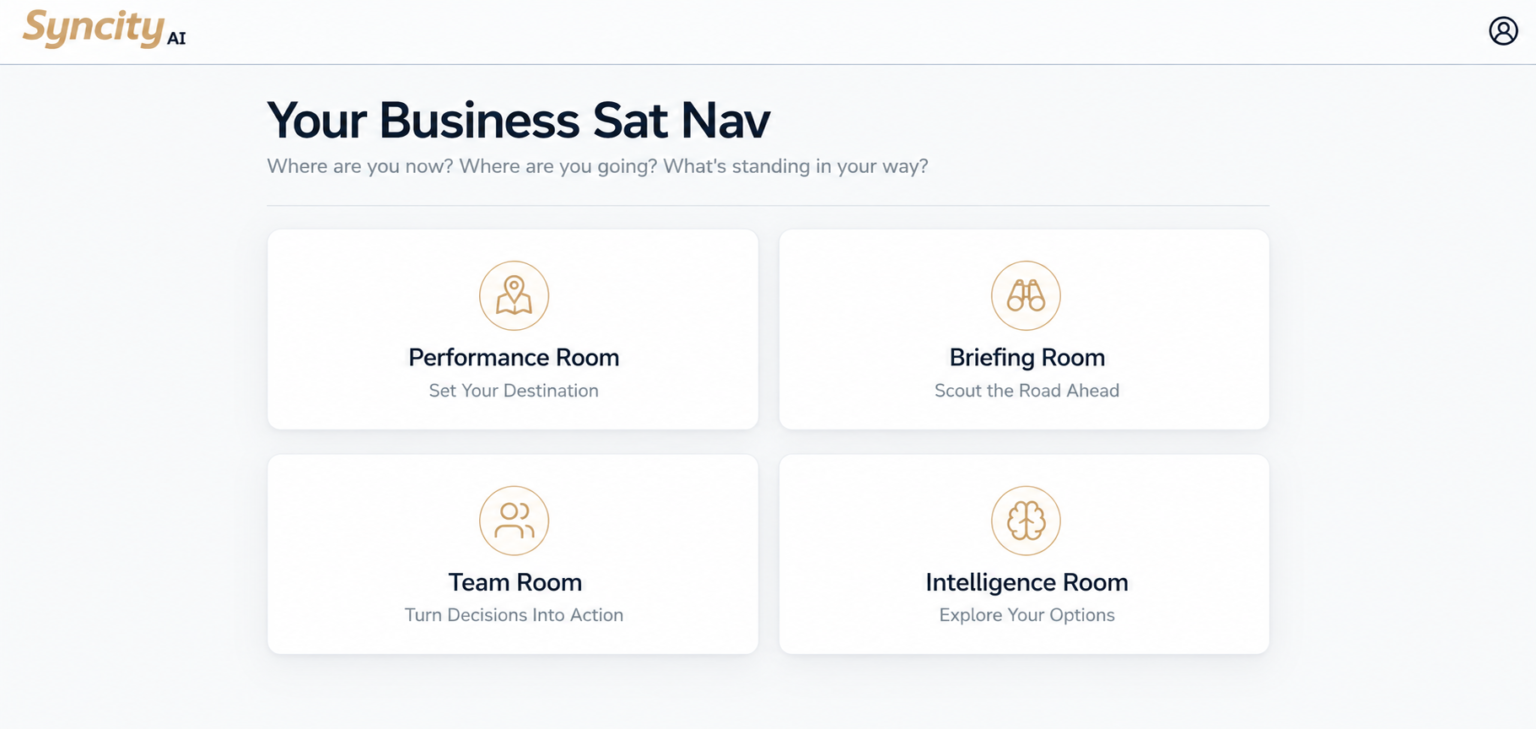
What this creates is a different rhythm. “Instead of starting every morning by diving straight into emails, meetings and operational work, you give yourself permission to spend 15 or 20 minutes thinking about the business first. Where are we going? What’s changed? What have we learned? Is there an opportunity here? Does this help us get closer to our destination? That becomes a daily and weekly habit rather than something reserved for an annual strategy day.”
His clients already know how to do the day job. The shift is that a founder who arrived looking inside the business for issues to solve is now looking outside for opportunities to take. He becomes clearer about what he can take on, more direct about what he needs, less likely to measure his value by how much he can carry.
Why Richard Godfrey
He brings together professional credibility, lived observation, and a particular conviction about what AI should actually do.
His 20 years in digital transformation taught him how to move organisations from one state to another. He did it at scale: large transformation programmes for councils and governments, growing businesses trying to make better decisions and get people pulling in the same direction. He saw the same problem every time. Leaders buried. Time gone. Thinking deferred.
Be The Five is about delivering digital efficiency in an organisation. Syncity AI is now the next step, moving toward digital effectiveness. It is about understanding the role of technology in your business and the role you now actually need to play. He has spoken at conferences around the world on the same theme: how to think differently about using technology in your business, not just how to use it faster.
But the proof he offers first is the pattern he has noticed, over decades, in every business he has worked in. “Most businesses don’t have a shortage of ideas or information. They have a shortage of time to think. Founders and leaders get buried in the day job. They’re busy driving the business, which makes it increasingly difficult to look up, see what’s changing around them and think about whether there’s a better route.”
A recommendation from Simon Ta, a colleague from his time in corporate roles, describes him simply: “Completely personable, always willing to give you time to brainstorm and discuss complex projects. His ability to build rapport with clients and help them understand the efficiencies of evolving with technology is an invaluable asset.”
Where Richard Is Now
Richard is based in Saffron Walden and building Syncity AI alongside a co-founder role at Perch, a community for business coaches trained in delivering Syncity AI to their customers. He spends his time between the product, the strategy, and the conversations with founders who are starting to reclaim the hours they need to think.
He is fascinated by three things: AI, leadership, and what happens when intelligence becomes abundant but the decisions still matter. He writes regularly about the relationship between human judgment and machine reconnaissance. He has become a vocal skeptic of the idea that AI should ever replace the thinking humans do. Instead, it should do more of the homework so humans have more time for it.
His picture of this relationship is deliberate and clear: “Use AI to see more of the road ahead, but keep the human at the wheel.”
Use AI to see more of the road ahead, but keep the human at the wheel.
The Playbook
The Richard Godfrey Playbook: From Reactive to Strategic
- Give AI a destination, not a prompt. Tell it where your business is and where you want it to go. Let it search for what matters to that journey.
- Let AI do the reconnaissance constantly, give yourself time to decide what gets your attention. Syncity brings back what it found. You decide what deserves your attention in one focused 30-minute window.
- Separate the homework from the decision. AI does the research. You bring the context, the people, the history and your appetite for risk.
- Put the human at the wheel. Strategic decisions need human judgement. They need to stay there.
- Protect your thinking time. If AI saves you 30 minutes, use at least some of it to think. Do not immediately fill it with more activity.

