

From the Diary of
Tünde Macarie
A leader’s emotional maturity and availability matter as much as professional productivity and performance.
“Slow & Steady Coaching for Sustainable & Predictable results in a Fast & Uncertain World”
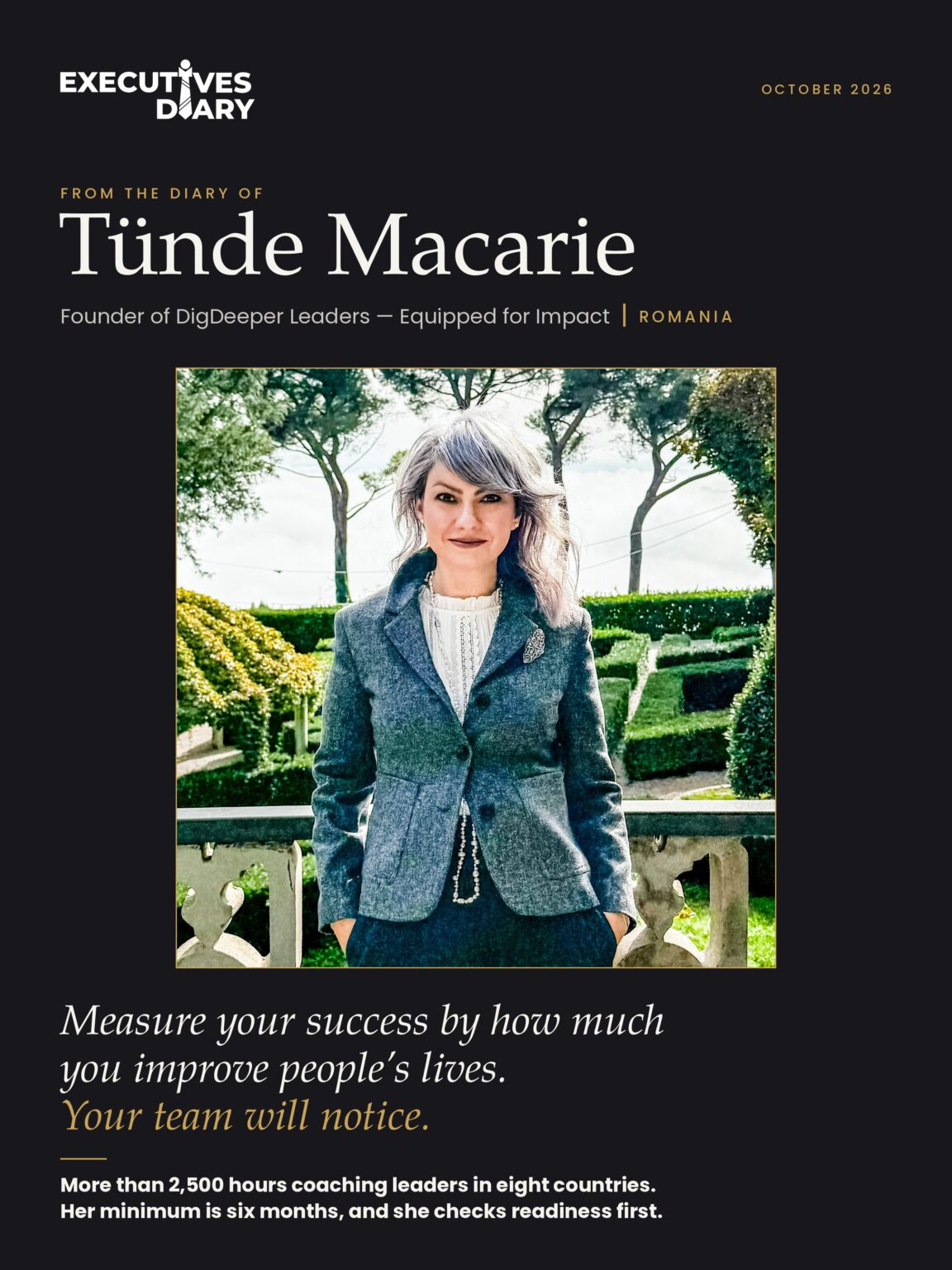
According to Tünde Macarie’s posts on LinkedIn, leaders and entrepreneurs looking for a coach and for sustainable results should be highly aware of the empty and hyped up promises promoted in a market where quick fixes, performative results and magic pills rule.
And if any experts promise they can quickly change an ineffective communication style, a toxic company culture or a dysfunctional team dynamic by just following a few specific “secret steps” in a few weeks or months, she wrote, “RUN!”
She wrote that we need to be aware of “all the magic, hot-air type, superficial quick fixes and overpromises we are getting more and more used to hearing.” Especially when it comes to “decoding and shifting thoughts, emotions, reactions, and behaviors,” she wrote, the work “isn’t something you achieve fast, easily, or effortlessly.” In her opinion:
Anyone who has ever achieved anything substantial in life or business, any real success and exceptional results, has also paid the price of commitment, consistency and time. Nothing meaningful and worthwhile is free, fast and effortless. Attractive, performative shortcuts and magic pills are dead ends in disguise.
Tünde founded DigDeeper Leaders — Equipped for Impact, where she coaches leaders, entrepreneurs and startup founders one to one. The engagements last from six months to three years, and the work is built on emotional intelligence: the skills behind how a leader communicates, makes decisions and relates to a team. Since 2018 she has invested more than 2,500 hours coaching more than 100 leaders, entrepreneurs and startup founders in Romania, the USA, Canada, the UK, Mongolia, Ecuador, Germany and Denmark.
Why Most Coaching Doesn’t Hold
Tünde’s argument starts with the difference between a behavior and its cause. Most leadership coaching doesn’t hold, she says, because it works on surface-level behaviors and their effects, not on what produces the thinking or the behavior underneath.
Without knowing the cause, the mindset and emotional triggers behind a behavior, you’ll never truly change anything.
A list of steps rarely changes anyone, she says, because knowledge alone doesn’t transform behavior. She points to Hermann Ebbinghaus’s Forgetting Curve, which, in her words, perfectly highlights just how leaky the human brain is when it comes to retaining new information. The curve itself has been tested since: a 2015 replication of Ebbinghaus’s forgetting experiment from 1880, published in PLOS ONE, found results similar to his original data, and the authors describe it as a successful replication.
That, she says, is why people spend so much on courses, training and workshops and still don’t reach their goals. Only those who apply what they learn and stay accountable make things happen, she says, and most of us do neither. Some of the leaders who came to her had bought several courses on leadership and business, and their communication was still “anything but effective and clear.”
She sees two extremes. Some leaders think leadership is all about empathy, others that it’s all about getting things done. The first group builds close relationships, she says, but action, productivity and performance suffer. The second gets things done, but on the relationship and culture side “things were falling apart.” Neither holds long term. What works is “combining skills and competencies in a way that they complement each other.”
She builds the point from her own case. She was always assertive and direct, she wrote in a post, and only when she paired that with active listening, effective communication and interpersonal skills did she see what new skills can do for the ones a person already has. Leaders reach her in one of two ways, she says.
Who Comes to Her

Some come before anything has gone wrong. Startup founders in particular, she says, can build well from the ground up, with functional patterns and a clear view of the skills that make a difference. She calls them proactive leaders.
Others come after. She has worked with reactive leaders who sought help for themselves and their team, in her words, “when things went really bad.” Before that point, she says, overwhelm, frustration and disappointment can harden into “a resigned type of leadership,” where the leader is physically present and keeps the title but has mentally and emotionally checked out. Or the leader turns rebellious, angry and cynical, and leads harshly: controlling, relying on punishment.
Gallup’s 2026 State of the Global Workplace report found that manager engagement fell from 27% to 22% between 2024 and 2025, and it is down nine points since 2022.
Her concern is what that does inside a team. She says that “when you tolerate and accept dysfunctional behaviors, you normalize dysfunctionality.” By the time the damage shows in results and performance, she says, that’s usually when leaders start looking for a coach, and very few prepare before it does. Most believe running a business is about strategy and financial gains. She agrees both matter, but says you can’t build a successful business without the right people.
She likes a line from Viktor Frankl: when a situation can no longer be changed, the challenge is to change yourself. Many leaders look for help when they think they’ve tried everything, she says, and “sometimes the situation changes when you change.” Before she agrees to work with anyone, she checks whether that kind of change is something they’re ready for.
Before the First Session
She uses the Transtheoretical Model of Change to see where a person stands. If someone doesn’t see the behavior as a problem, that is the precontemplation stage, and “nothing will move the needle.” Behavior change is a gradual, cyclical process rather than a single event, she says, and pressuring someone to change never works, because change that lasts “happens within, autonomously.”
So she doesn’t start a collaboration without clarity on “where a client stands.” That means whether they have the resources and knowledge to make a lasting change, what might be getting in the way, what could trigger a return to an old behavior, and whether the two of them are a good fit.
Then she measures. At the start of a collaboration she assesses a client’s emotional intelligence with the EQ-i 2.0, which scores 15 competencies that together make up a total EQ. A one-to-one debrief follows because, she says, the results need to be interpreted by a certified administrator. Those 15 competencies become the building blocks for the skills they work on next. She isn’t a fan of listing certifications. What she points to is continuous learning and curiosity about best practices, in theory and in intense practice. How long the work runs after that depends on the client.
Six Months to Three Years
The minimum is six months. She says the choice rests on science and on her own experience. Research puts the time it takes to build a habit or change a behavior between 18 and 254 days, she says, depending on the person, the environment and how complex the change is. Add the work of building several emotional intelligence skills at once, and six months “can seem short.”
For some clients, six months is enough to move the needle, and they consider themselves fulfilled. Others want to work through the thinking patterns, biases and blind spots that surfaced, and to build the communication, relational, decision-making and stress management skills to act on them. For them it’s a year, two or three. The length is decided together: “It’s not me who decides, it’s us, together.” She doesn’t believe in “the one-size-fits-all type of approach.”
It’s not me who decides, it’s us, together.
Startup founders sometimes ask her to help close the gap between themselves and their team: clear communication, stress management, conflict resolution, clarity over roles and responsibilities, company culture and goal setting. With more people involved, she says, the work is more complex and takes a different approach. Whatever the length, she tracks whether the work is changing anything.
How She Measures Change
A good session isn’t the only measure, she says: “it’s not about a good session, it’s about continuity, it’s about consistency.” She tracks continuous feedback, whether the client follows through on what they’ve agreed to do, and whether they can apply new skills. She also asks what friends, family, collaborators and the team say about the client’s behavior, communication and decisions, and what the change is doing to their leadership, business results and relationships.
Awareness is just the first step. And no one has ever reached a destination by taking only one step.
Her work isn’t only one to one. She led a workshop of about four hours for the team at fischer România, and shared their message afterward in a LinkedIn post. The team wrote: “Conversations became more open, more honest, and deeper than we were used to.” Part of how she listens comes from her earlier work with words.
From Copywriting to Coaching
Before DigDeeper Leaders, Tünde wrote for a living. From 2013 to 2018 she was a content writer, copywriter and marketing specialist at Cubic SoftLab in Cluj, running social media for up to eight companies in the United States. She then spent about two years at SocialBee.io as content and training manager and social media coach, and wrote its guide Copywriting for Social Media.
Marketing taught her to notice “the nonsense, the manipulation, the incongruency, the hype” in how people communicate, she says, and to drop the jargon. It also taught her what not to do. She supports ethical, honest marketing “even if that costs me, even if I never get viral.”
In the first year of her business she interrupted a collaboration with a high-paying, influential client, doing what she thought was right in that context. There was always a risk it would backfire, she says, and at the start of a new career it was risky, but “doing what’s right was and is more important to me than any gain or lack of it.”
Where Tünde Is Now
As an international coach, Tünde loves working with clients from all over the world and continues to do so with dedication and professionalism. And as she and her family are planning to move to the Netherlands, she wants to also start coaching collaborations and work with Dutch leaders, entrepreneurs, founders and teams through one-to-one coaching, team training and facilitation, and speaking engagements. After her second time in the Netherlands, staying for two weeks while visiting eleven Dutch cities, she wrote that the people she met were “really kind, straightforward and open.” And the entrepreneurs she met with “also showcased the same great Dutch traits: kind, open, direct, intelligent, not self-promoting, humble and very normal regardless of their wealth.” Something she liked very much.
At the moment, she works in English and Romanian, and she’s learning Dutch.

She gives two reasons for wanting to have Dutch collaborations as well. One is to bring her work into a culture she plans to be part of, as “a measurable, pragmatic and strategic business asset.” The other is to build long-term relationships there on trust, communication, healthy boundaries and psychological safety.
Outside work, she says, “Family, and meals together as a family are always a priority for me.” At work, she wants to keep working with “those select few” leaders, entrepreneurs, startup founders, lawyers and politicians who are “committed to excellence” and want to do what’s right, and who are ready “to leave the world in a better shape than they found it.” In her words: “Those are my type of clients.”
Those select few leaders, entrepreneurs, startup founders, lawyers and politicians who are committed to excellence, those are my type of clients.
The Playbook
Five Reflections from Tünde
- Always go to the root cause of your behavior/habit. What type of mindset or emotional trigger is responsible for producing the behavior or habit that affects you or your business and that you want to change?
- Look for the blind spot. What would help you discover your blind spots? What behavior is still there even after a good book or conference?
- Check the balance. Do you lean toward empathy and connection or toward aggressively getting things done in your business regardless of the consequences? And what does the other side lose?
- Count the follow-through. What did you agree to do last month, and did you do it?
- Ask the people around you. Once you started working on your behavior, what would your objective friends, family members and team say changed in how you communicate, behave and make decisions?
Sources
Gallup, State of the Global Workplace: 2026 Report, 2026. https://www.gallup.com/workplace/349484/state-of-the-global-workplace.aspx
Murre, J. M. J., and Dros, J., Replication and Analysis of Ebbinghaus’ Forgetting Curve, PLOS ONE, 2015. https://journals.plos.org/plosone/article?id=10.1371%2Fjournal.pone.0120644

