

A founder who has spent a lifetime scanning her surroundings is building Somar360: a spatial-intelligence platform beginning with a wrist-worn wearable and companion app. The bigger question is not how many signals technology can detect, but which ones matter and how to communicate them.
Fareha Ali has never walked into a room without scanning it first. “Faces. Doors. Hands. Who is moving, who is behind me, what I might have just missed,” she has written. She is hard of hearing and has worn hearing aids since she was four. “My body learned to do this long before I had a word for it. The word is hypervigilance. For most of my life I thought that was mine alone to carry.”
Then she started noticing it everywhere. “The jogger with both earbuds in who can’t hear the bike coming up behind her. The warehouse worker with a forklift backing up somewhere he isn’t looking. Anyone standing in a loud room trying to work out what just happened & where it came from,” she has written. “The only difference between them and me is that they get their hearing back when they take the earbuds out.”
Somar360, the company Fareha founded in 2026, is her answer to that problem. Gen 1 begins with a wrist-worn wearable paired with a companion mobile app. Behind them is what she calls the Awareness Engine: a spatial-intelligence system being designed to identify meaningful environmental events, estimate spatial context such as direction and movement, prioritize what may deserve attention and communicate that information through intuitive haptics, visual cues, text and optional audio. The goal is not to give the user more to monitor, but to make important information easier to understand without constant scanning.
“Spatial Intelligence for Humans” is the line beneath the company name. Somar grew from “somatic”, the body and physical experience. As the vision developed, SOMAR also came to represent Spatial Orientation, Movement, Awareness and Response. The “360” reflects the broader goal of surrounding spatial awareness.
None of it has been validated in a wearable yet. Somar360 is still pre-prototype, and Fareha says so before you can ask.
What Gen 1 Is Being Designed to Test
Three examples of the kinds of awareness Somar360 intends to explore through prototype development.
Movement behind or beside a user. Somar360 is intended to explore whether directional haptics can help communicate where relevant activity is occurring without requiring someone to constantly turn and scan.
Sirens. For events such as sirens, prototype testing will explore whether spatial cues can help communicate where an event is occurring and whether it appears to be moving.
Complex or noisy environments. In complex or noisy environments, Somar360 is intended to prioritize meaningful information rather than simply add more alerts. Prototype testing will determine how much environmental context can be inferred accurately and communicated without overwhelming the user.
The first users are the ones she knows best. “We are beginning with Deaf and hard-of-hearing users because that is where my lived experience gives me an authentic starting point,” she says. “But the underlying problem is broader. Over time, the same spatial-intelligence platform could expand into broader accessibility, everyday mobility, high-noise workplaces, public safety and other environments where awareness matters.”
The broader accessibility need is substantial. WHO and UNICEF reported in 2022 that more than 2.5 billion people need at least one assistive product, with nearly one billion lacking access. That figure is not Somar360’s market size, but it illustrates the scale of unmet accessibility needs globally. “I started thinking about Somar360 as an intelligence layer between a human being and the physical environment around them,” Fareha says.
Somar360 is pre-prototype. Its initial system architecture, product direction, privacy principles and roadmap have been developed and are being refined ahead of prototype development. Software and AI engineering support is in place. The next major milestone is a functional Gen 1 prototype. More than 100 people have joined the beta waitlist to test it when there is something to test, and Fareha refuses to call that validation. “I do not want to describe interest from prospective users as product validation,” she says. “The prototype and beta process are where those assumptions have to meet reality.”
Loudness Doesn’t Equal Awareness
To understand why she’s building it this way, start with where she thinks many technologies fall short.
Much accessibility and alerting technology has understandably focused on making signals easier to notice. Fareha’s argument is that noticing more and understanding more are not always the same thing. “Make something louder. Make an alert more noticeable. Add another notification. Improve a sensor. Display more data,” she says. “But more information does not automatically create more awareness.” Hearing a sound more clearly has never told her where it came from, what caused it or whether she needs to react. “I can hear something and still find myself scanning the room trying to understand what just happened.”
The same gap shows up far from hearing aids. In a 2023 survey of nearly 4,000 nurses across 213 US hospitals, 83 percent said they felt overwhelmed by the alarms on their patients’ devices, and more than half had been in a situation where a patient needed urgent attention and nobody responded to the alarm. The alerts were working. Nobody was safer.
“I see the mistake most when technology assumes that detecting a signal is the same thing as helping a human understand it. That can happen in accessibility technology but it also shows up in industrial environments, transportation, public safety and everyday consumer technology. We have become very good at generating alerts. We are not always as good at deciding which alerts matter.”
Fareha Ali, Founder & CEO, Somar360
So the band is not meant to buzz more. It’s meant to buzz less, and only when it counts. “Somar360 is not being built to give people more alerts,” she says. “It is being built to help people understand what matters around them.”
The Long Way Here
“Behind every technical decision we are making now is the reason Somar360 exists for me personally,” she says. “That story started when I got my first hearing aids at four years old. Growing up hard of hearing gives you a different relationship with your environment and it also makes certain technology gaps impossible to ignore.”
She didn’t arrive at hardware through engineering school. She arrived through a truck.
“For much of my life, my world was measured in miles on the highway,” she writes on her profile. Working as a Class A CDL professional “taught me grit, operational discipline, safety and how complex systems behave under pressure.” Somewhere between routes and freight schedules she got curious about a different kind of system, and that curiosity led her into computer science, AI and building companies around problems she had lived.
She’s still on the road. “I am doing all of this while living and traveling in a semi-truck,” she says. “I’m a former truck driver and my husband still drives while I build Somar360 full time. It is not always easy, but it is part of what this chapter of building looks like for me.”
Someone asked her recently whether she wished she’d started five years earlier. “Honestly, yes. I wish I had it twenty years ago,” she has written. “But five years ago I hadn’t started studying computer science yet & I hadn’t sat in rooms full of founders building things that were personal to them. I didn’t know yet that I was allowed to build the thing I needed.”
The first person she told was her mother, when Somar360 “was still an idea in my head.” Her mother had watched all of it. “She had seen the confusion, the constant scanning, the frustration, the moments where I felt left out or overwhelmed and the way I always had to work harder to understand what was going on around me,” Fareha says. “She did not dismiss the idea. She told me that I was the one who should create it because I was the one living it.” The two of them sat and brainstormed what the hardware could look like and how someone might wear it, “before there was a team, before there were advisors, before there were programs, milestones or anyone outside our family paying attention.” Her mother, she says, “was the first person who made me feel like that experience could become something worth building.”
How She Decides What Matters
When Fareha thinks through a system that has to decide what matters in a noisy environment, her first instruction never changes: “Do not start with the alert. Start with the human problem.” The question is not what the sensor can detect. “What does the person actually need to know? Where is it happening? How urgent is it? What else is happening at the same time? And what is the clearest way to communicate it without overwhelming them?”
That order is the Awareness Engine. Fareha describes it as a pipeline designed to move through sensing, localization, classification, understanding, prioritization, communication and learning rather than treating every detected signal as equally important. It is also why Somar360 begins with a focused wrist-worn interface rather than trying to prove every future application at once. “I want Gen 1 to prove the core experience in a form people can actually use,” she says. The wristband, she has written, “is where we begin. It is not where the story ends.”
What she won’t do is claim it works before it does. She has already written the questions the prototype has to answer: “whether the alerts make sense, whether the direction is understandable, whether the haptic patterns are intuitive, whether we are giving too much information or too little and whether the technology is solving the problem we think it is solving.” She expects the answers to change the design. “In fact, I would be concerned if it did not.”
“That lived experience gives me the starting point but I also refuse to assume my experience is everybody else’s experience. That is why Somar360 has to be tested with the people it is intended to serve and why I am careful about separating what we believe the technology can eventually do from what we have actually validated. I would rather say ‘we are building toward this’ today and prove it tomorrow than claim a capability before the evidence exists.”
Fareha Ali, Founder & CEO, Somar360
Somar360 has also been building external exposure through accelerator programs, pitch opportunities and founder ecosystems. The company is participating in the Peachscore + Dealum Accelerator and LvlUp Labs. Fareha also works on the other side of the table as a Venture Scout with Flashpoint and through LvlUp Ventures’ VC in Residence, giving her regular exposure to other early-stage founders and investor decision-making. She is also part of the Boardy Board of Advisors and serves as a Global Advisor with Billion Strong. Her advice to the founders she meets there is the standard she holds herself to: “There is nothing wrong with saying, ‘I do not know yet,’ ‘We still have to test that,’ or ‘That is where we are trying to go.’ Those sentences do not make you less credible. I think they make you more credible.”
Where Fareha Is Now
Her next major milestone is the prototype. “Right now, I am focused on taking Somar360 from a deeply developed vision and system architecture into a real Gen 1 prototype,” she says. She’s looking for accessibility organizations and Deaf and hard-of-hearing communities to test with, universities and labs working in sensing, haptics and human-computer interaction, and partners in public safety and industrial settings who could run pilots once there’s something to pilot. The early beta waitlist is open at somar360.com.
“My family keeps me grounded,” she says. “My mom in particular has been there through the experiences that eventually led to Somar360 and she was the first person who encouraged me to believe the idea was worth pursuing. I honestly think she would be one of my first customers.”
People ask her what success looks like. She has the founder answer about markets and industries, and it’s a real one. It’s not the one she gives.
“What I actually picture is a woman like me walking into a crowded room & not scanning it,” she has written. “Just… walking in.”
She’s still scanning. The band is meant to be the last reason she has to.
Five Lines from Fareha’s Diary
"Loudness doesn't equal awareness."
"Do not start with the alert. Start with the human problem."
"Start before you feel completely qualified."
"Protect the vision but stay willing to change the path."
"One product today. A platform for human awareness tomorrow."
From the Diary of Fareha Ali
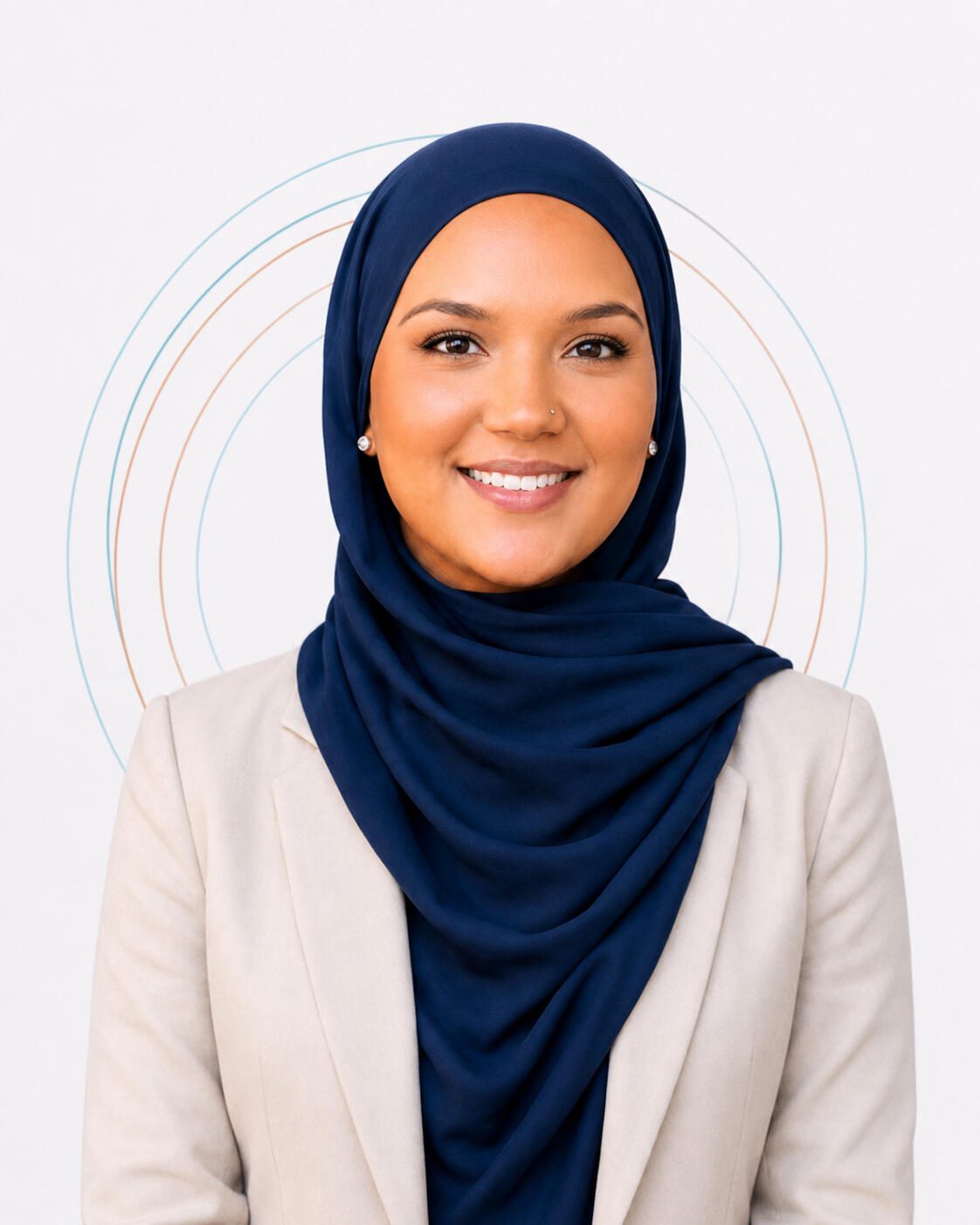
Fareha Ali is the Founder & CEO of Somar360, a company building a spatial-intelligence platform that begins with a wrist-worn wearable and companion app designed to help people understand more of what is happening around them, where it is happening and what may deserve attention.
| Role | Founder & CEO, Somar360 |
| Based in | Austin, TX |
| Also | Global Advisor, Billion Strong |
“Spatial Intelligence for Humans.”
Editor’s note
We feature Fareha Ali for a distinction she draws herself and few founders do: between the direction a company is building toward and the capability it can claim today. Somar360 is pre-prototype, and this piece says so in her words rather than around them. What convinced us is the argument underneath, that a signal detected is not a signal understood, and the record of someone who has been doing that understanding manually since she was four. We’ll publish the next chapter when the evidence arrives.
Executives Diary, Editorial

