

From the Diary of
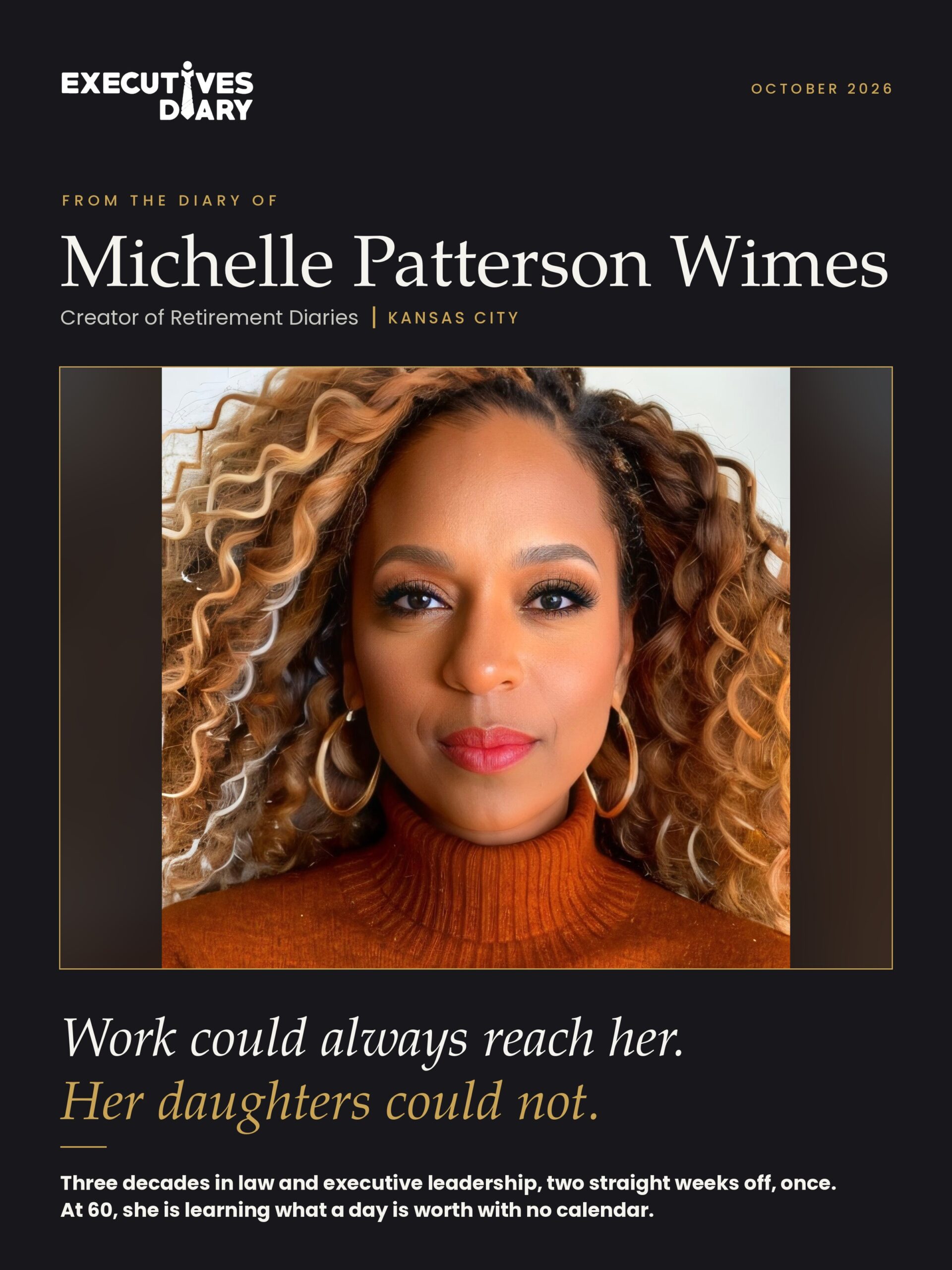
Michelle Patterson Wimes
For the leader a few months or years from leaving: what changes when your time finally belongs to you.
“Thriving requires time that belongs to you.”
The chiropractic appointments were part of the treatment Michelle Patterson Wimes needed for lupus. She kept her phone on for them anyway. Several times, she says, she answered calls from executive leaders “while lying face up on a neck machine designed to stretch my vertebrae.” “I did not experience that behavior as a warning sign,” she says. “I experienced it as efficiency.”
I experienced it as efficiency.
After she retired this summer, she went back to the same machine with no calls waiting. “For the first time, I could allow my body to relax fully and receive the treatment,” she says. “I had been present for the appointment before, but I had never been fully at rest.”
Before retiring, she had taken two consecutive weeks away from work once in her career, for her honeymoon 28 years earlier. The habit is a common one: in a 2023 Pew Research Center survey, 46% of U.S. workers who receive paid time off said they take less than they are offered.
Michelle spent more than three decades working and leading, first as a lawyer and then as an executive, most recently as Executive Vice President and inaugural Chief People Officer at Children’s Mercy Kansas City, a pediatric academic medical center. Now she writes Retirement Diaries, a series on LinkedIn about building a life that is no longer organized around productivity, and she wants to write and speak about “leadership, identity, transition, and the radical act of reclaiming one’s time.” The reader she most wants to reach is “the leader who is a few years, or perhaps only a few months, from leaving but cannot yet imagine who they will be without the calendar, the title, and the constant demand for their expertise.” Her argument is that retirement “is not merely an ending to prepare for financially. It requires a new relationship with time, identity, purpose, and self.”
Why So Few Leaders Stop
Her explanation starts with what executive life rewards. “We are affirmed for our availability, our endurance, and our ability to carry increasingly complex responsibilities,” she says. “We become the person people call when something is difficult, sensitive, or broken. Over time, being needed can begin to feel like being valuable.”
Women executives, she says, “often carry an additional layer of guilt when we take time away from work to be with our children.” Her youngest daughter played college soccer in Lawrence, Kansas, about 50 miles from home. Michelle went to the games and tailgated with the other parents, but her phone was always beside her, and she took calls and answered emails from the car. “I was physically present, yet I was not always emotionally available for the experience.” At the same time, her adult daughters sometimes complained that she was difficult to reach when they needed her.
Work could reach me during a medical treatment or family event, yet my children could not always reach me through the demands of work.
What leaders miss, in her telling, is rarely a milestone. “Sometimes we miss the texture of our own lives: the unhurried conversation, the full benefit of a health treatment, the chance to watch a daughter play without dividing our attention, or the freedom to celebrate with family without guilt. Nothing dramatic has to happen for the cost to be real.”
The career that filled that calendar began in a law firm.
Leaving What She Knew
Michelle’s first boss after law school was Maurice Watson, a leader in the School Law and Education Practice Group at Blackwell Sanders, now Husch Blackwell. He gave her constructive feedback that strengthened her writing and taught her, she says, “how to interpret both the law and people.” He also taught her to ask one question in every interview, deposition and trial: “What is being communicated without being overtly stated?” More than three decades later, she still asks it.
After about five years she was a go-to associate in education and school law, and she was the mother of two children under the age of two. Then Shook, Hardy & Bacon offered her the chance to interview for its International Product Liability Division, with travel throughout Latin America and tobacco litigation, none of which she had done before. “Leaving a firm where I was known and successful for work that was unfamiliar was frightening, especially as a new mother, but I chose to take the opportunity.”
When the international work began winding down several years later, Linda Salfrank, who had worked with her at Blackwell Sanders, invited her to join Spencer Fane Britt & Browne as a partner and work on special education matters. Special education law was new to her, and the move made her the first part-time partner in Spencer Fane’s Kansas City office. About four and a half years later, after developing lupus and while raising three young children, she made what she calls “the difficult decision to leave the active practice of law.” She returned to Shook, Hardy & Bacon as Director of Strategic Initiatives. “That move changed the direction of my career.”
That move changed the direction of my career.
What she had learned in practice went with her.
What the Law Taught Her About People

Practicing employment law, Michelle says, taught her “to pay attention to the distance between what an organization says and what people actually experience.” Good policies and mandatory training, she says, can still sit beside inequitable outcomes.
Lawyers examine evidence, and she lists the questions she learned to ask: “Who was hired? Who advanced? Who received grace? Who was labeled difficult? Whose mistakes were treated as developmental, and whose were treated as proof that they did not belong?” Litigation also taught her that workplace disputes “rarely begin on the day a complaint is filed.”
A people leader who has mostly run programs, in her view, may ask whether the initiative was implemented. She learned to ask what changed, for whom, what patterns remain, and “What evidence supports the story we are telling ourselves?”
The law trained me to recognize organizational risk. Leadership taught me to address the human conditions creating that risk before someone entered a courtroom.
She carried that habit into a string of roles that did not yet exist.
Writing Her Own Job Descriptions
From Shook, Michelle moved to Ogletree Deakins, one of the country’s largest labor and employment law firms, into a position with no existing blueprint. She developed the title Director of Professional Development and Inclusion and wrote her own job description. When the scope grew, she developed the title Chief Diversity and Professional Development Officer and wrote that job description too.
The work she is proudest of from her nine years there is Success the Ogletree Way. She interviewed partners about why they chose to invest in particular associates, then turned those interviews into a competency model for the firm’s labor and employment attorneys that set legal and professional capabilities alongside cultural competence and diversity, equity and inclusion as essential leadership skills. “What made that work meaningful was that inclusion was built into the firm’s definition of professional success rather than treated as a separate program,” she says. She also helped the firm reach a perfect score of 100 on the Human Rights Campaign’s Corporate Equality Index for the first time in its history, in 2016 and each year after.
Children’s Mercy Kansas City recruited her as its inaugural Chief Equity and Inclusion Officer. She later became the hospital’s inaugural Executive Vice President and Chief People Officer. The previous position had been Chief Human Resources Officer, and she changed the title and wrote a new job description “to reflect a broader, more people-centered vision for the work.” She gave the department a new mission and vision and its first written strategic plan, started a monthly Chief People Officer newsletter and brought the full team to volunteer together in the community. The aim was to move beyond process and ask “how those processes affected the people for whom the decisions were being made.” In 2024 the Diversity and Flexibility Alliance gave her its Culture Catalyst Award, and in 2025 the Kansas City Metropolitan Bar Association named her a Baron of the Boardroom.
The evidence she values most arrives through people. A colleague who worked full time while pursuing his doctorate will graduate with his PhD in December. “His success belongs to him, but knowing that my leadership helped create room for it matters deeply to me.”
His success belongs to him, but knowing that my leadership helped create room for it matters deeply to me.
At each threshold, she says, moving forward took “both courage and imagination: the courage not to let fear make the decision and the imagination to define what a new role could become when no model existed.” Retirement, as she sees it, is the next expression of that pattern.
A Day With No Calendar
Her days begin much as they did while she was working, with 45 minutes to an hour of prayer, meditation and reading spiritual books or books focused on daily healing. “That practice creates continuity between the leader I was and the person I am becoming.”
After that she orders the day around three areas, which give her “gentle structure without recreating the rigidity of an executive calendar.” The first is care for herself and her relationships: a massage, a walk with one of her daughters, a Zoom conversation with a good friend. The second is care for her environment, a closet to clean or items to donate. “I do not try to reorganize my entire life in a day. One contained project is enough.” The third is care for the future or the community. She might research tiny-home communities or places to live abroad, mentor a younger professional, or connect with others who chose early retirement.
“A season of simply being does not mean that I do nothing,” she says. “It means that everything I do does not have to produce a result, establish my relevance, or become my next enterprise.” Her challenge, she says, is learning not to turn retirement into “another performance-management exercise.”
A day does not have to be optimized to have value.
Her word for this year is GROUNDED. “For me, it means less proving, less performing, and less living according to other people’s expectations,” she says. “It means asking what would nourish me today and allowing the answer to be enough.”
Where Michelle Is Now
When Executives Diary first wrote to her, Michelle described this season in one line: “My focus lately is on learning to simply be and relax in retirement after spending more than three decades working and leading.”
Retiring early was a dream she had carried for decades. Her mother retired at 59, and, she wrote, “She taught me that a fulfilling career should create the opportunity to enjoy the life you’ve worked so hard to build.” After divorce, she wrote, she “quietly accepted that this particular dream was probably no longer mine.” Circumstances she could not have predicted reopened it, and this summer she retired at 59 after all. She celebrated her 60th in Martha’s Vineyard alongside her mother, who has already turned 80.
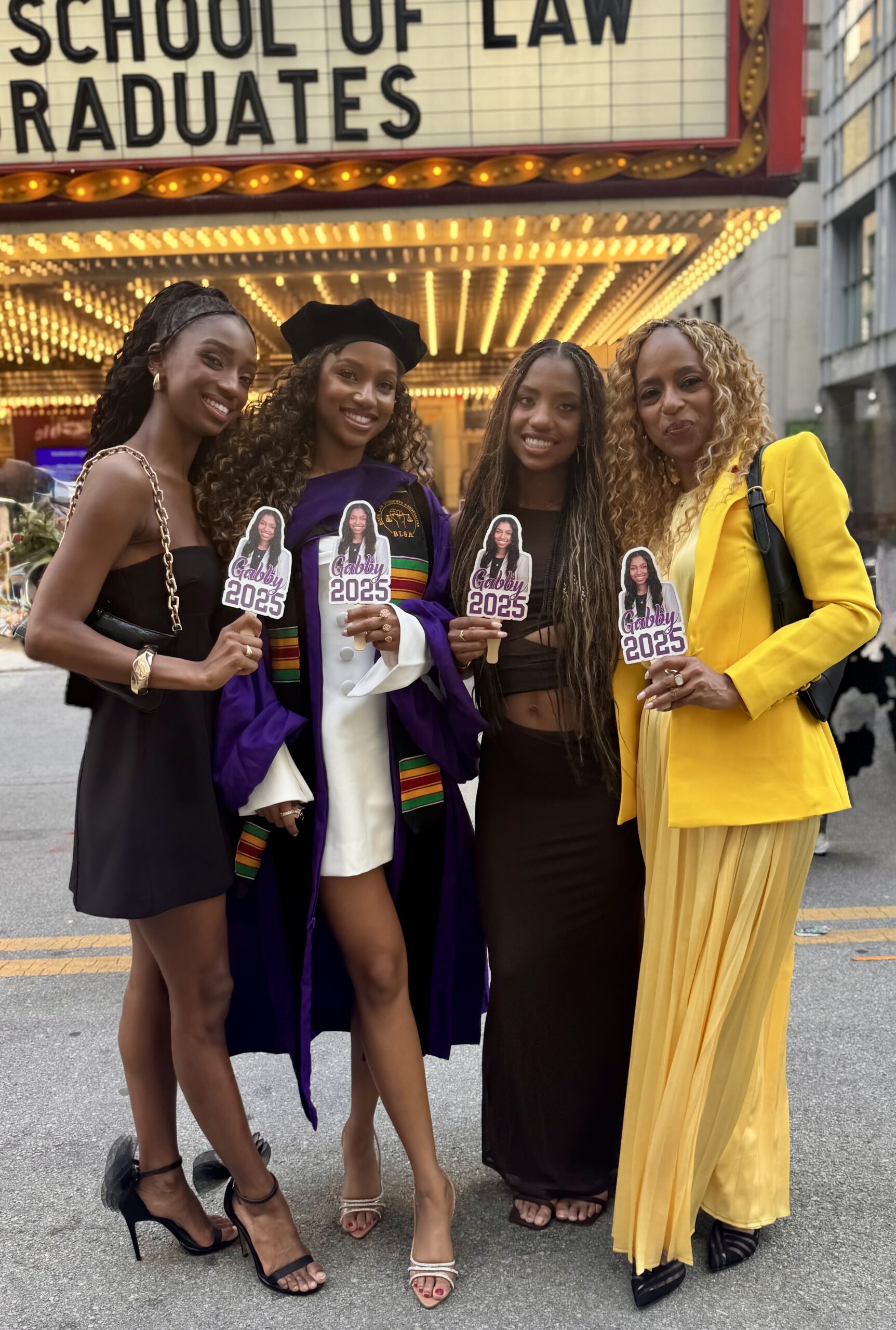
Her three daughters belong in the piece, she says. Sydney, a professional dancer, has already moved to Dubai and will be opening the inaugural Paris-based show of Crazy Horse in Dubai. Gabby, a Northwestern Law graduate, has moved to Los Angeles to practice with White & Case. Saige, who helped the University of Kansas win a Big 12 championship, is pursuing a master’s degree at West Virginia University in her final year of collegiate soccer. Retirement, Michelle says, is letting her be more present for them “while showing them that reinvention does not have an age limit.”
She hopes the series leads to more writing and speaking, and she doesn’t claim to have finished the blueprint. “What’s next is a year of living fully and writing honestly as I build a blueprint for what retirement can look and feel like when our time finally belongs to us.”
Five Lines from Michelle’s Diary
Thriving requires time that belongs to you.
Sometimes a dream isn’t dead. Sometimes the path to it simply changes.
Nothing dramatic has to happen for the cost to be real.
Purpose doesn’t always arrive as the next big professional opportunity.
At 60, I am finally living like my life belongs to me.

