

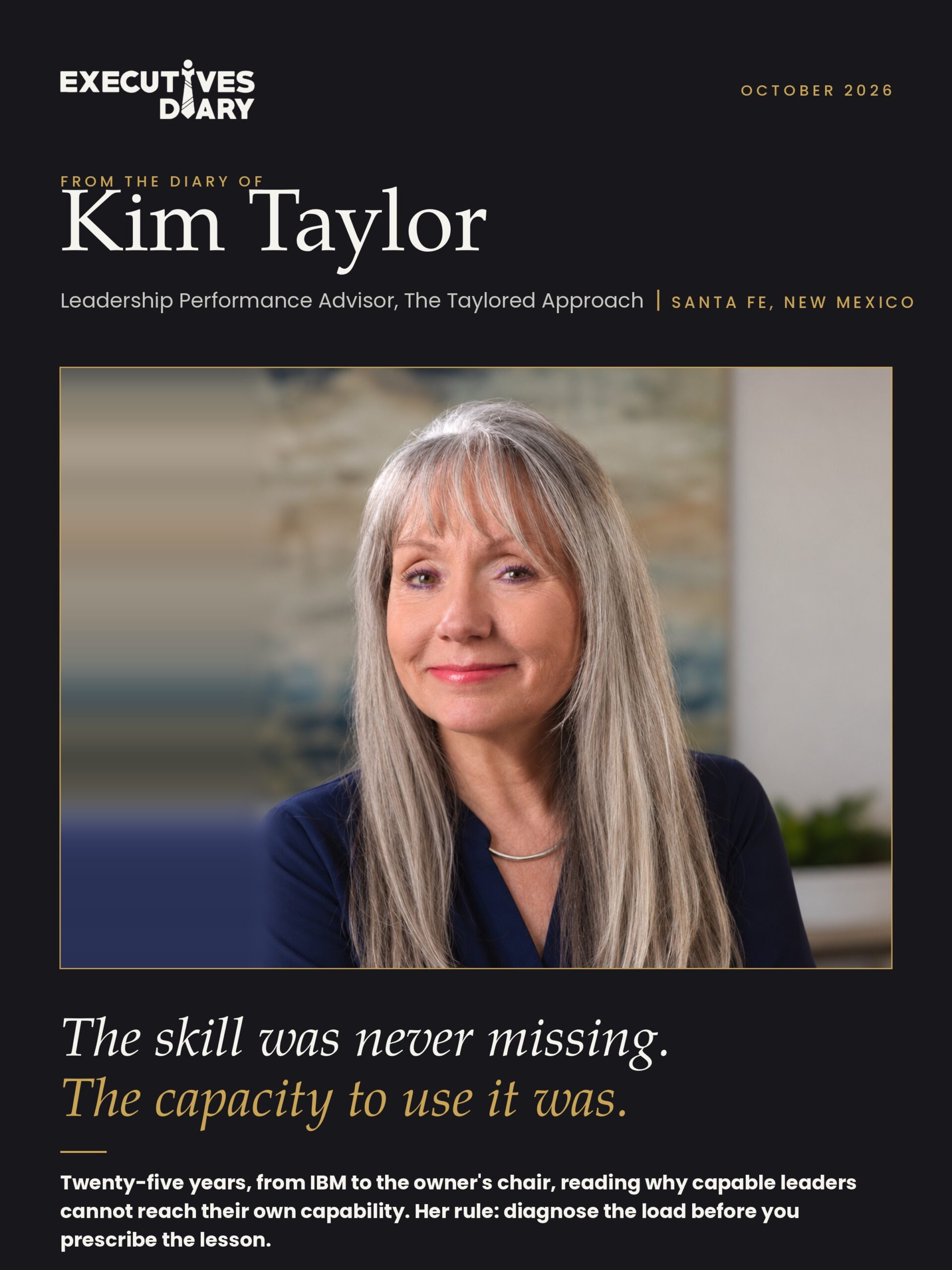
From the Diary of
Kim Taylor
The leader who cannot delegate may not have a delegation problem. Here is how to tell the difference.
“Knowing what to do and having the capacity to do it are two different things.”
Manager engagement has fallen nine percentage points in three years, to 22 percent, according to Gallup’s State of the Global Workplace 2026 report, which also finds managers reporting significant levels of stress, anger, sadness, and loneliness.
Kim Taylor reads those findings through a performance lens. A leader may still be functioning and delivering results while underneath, something is being spent that no one is accounting for.
The standard response to a struggling leader is to teach them something. In 2015, by a Harvard Business Review analysis, companies put roughly $356 billion into training worldwide and got a poor return, because people revert to old ways once the program ends. Taylor’s case is that some of that investment may be aimed at the wrong target, and that understanding what is actually driving the performance issue can lead to a more targeted intervention.

The Skill Was Never Missing
Conventional leadership development focuses on what is visible: communication, delegation, conflict management, executive presence, strategic thinking, decision-making. Taylor does not dispute that any of it matters.
But she does challenge the assumption underneath it: that the human being who is supposed to apply those skills has the capacity available to do so.
A leader can be brilliant, experienced and committed, and know exactly what good leadership looks like. If that leader is depleted or operating without margin, they may not have full access to that capability in the moment it is needed.
We tell an exhausted leader to be more present. We teach an overloaded leader another productivity system. We tell someone operating with no cognitive margin to think more strategically. We give a depleted executive another set of behaviors to practice. And then we are surprised when the training does not translate into sustained change.
Organizations, as she puts it, are essentially demand factories. New initiatives, higher quotas, faster execution, more change. None of that is wrong, because organizations exist to produce results. But human beings produce all of those results, and when demand continually climbs without giving equal attention to the condition and capacity of the people generating those results, something gives.
What gives first can easily be mistaken for a leadership deficit.
Sometimes what looks like a leadership problem is not actually a leadership problem, Taylor says, and if we diagnose the wrong problem, we will keep applying the wrong solution.
The Back Pages of the Notebook
Taylor started her corporate career at IBM in 1997 and began keeping two sets of notes almost immediately. The front of the notebook held the business discussion. The back pages, worked toward the middle, held what she was watching in the room: what helped people perform, where they struggled, how overload showed up, and why extraordinarily capable people sometimes could not reach their own capability.
She had no language for it then.
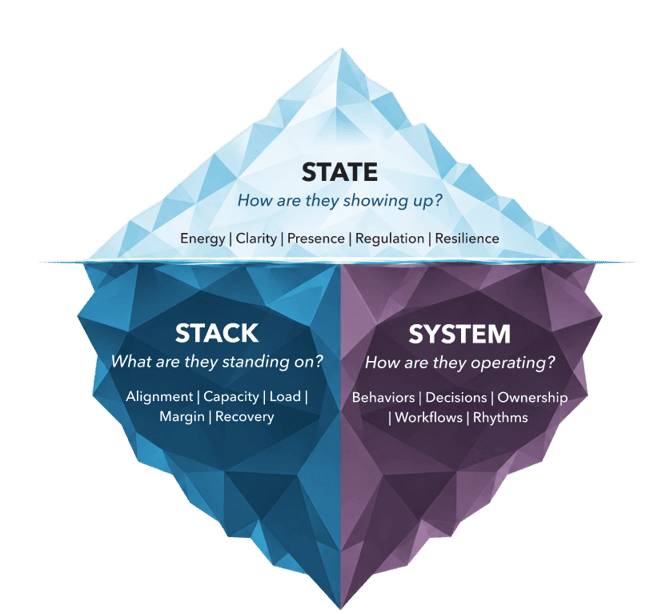
Nearly three decades of consulting, company building and executive coaching later, the language is STATE | STACK | SYSTEM℠. STATE is the leader’s current operating baseline: energy, clarity, presence, regulation, resilience. STACK is the internal operating environment: alignment, capacity, load, margin, recovery. SYSTEM is the external operating approach: behaviors, decisions, ownership, workflows, rhythms.
The interplay matters more than the labels. SYSTEM is where performance becomes visible and where change has to land, which is why organizations intervene there. Taylor’s objection is that when they do it without reading the STATE and STACK underneath, the intervention can land in isolation and fall flat.
A Leader Who Could Not Stop Absorbing
One organization asked Taylor to raise the performance and confidence of six of its department leaders. One was capable, committed and carrying far too much. She had gradually developed a way of leading in which everything flowed toward her: problems, decisions, unfinished work, employee issues, and finally accountability itself.
The surface reading was conventional.
Delegate better. Hold firmer boundaries. Stop doing work that belongs to other people. A traditional intervention could reasonably have started there, but it may not have actually addressed what was driving the behavior.
She had been operating that way for about eighteen months. The load had eaten her margin, and the missing margin was working on her confidence, judgment and sense of agency, which made the behaviors creating the load harder to change. Telling her to delegate, Taylor says, “would have placed another expectation on someone who already had insufficient capacity to implement it.”
So the first move was not a leadership lesson. It was capacity: restoring enough of it for her to access the leadership capability she already had.
How the Change Actually Showed Up
From there, the work became iterative. We would identify a small STATE or STACK shift that increased available capacity, then use that capacity to change something very specific in her SYSTEM: where she held a boundary, how she conducted an accountability conversation, what responsibility she retained or returned to someone else, how she delegated or how she developed another person. Those SYSTEM changes reduced load and increased confidence, creating greater capacity for the next change.
The result showed in how responsibility moved through the team. Previously, when someone failed to carry their part, she compensated. She took the work back, solved the problem herself, or let an accountability conversation end without a clear commitment.
Through her work with STATE | STACK | SYSTEM℠, she stopped.
In its place came specific changes in how she led: giving specific feedback, tolerating the silence after a difficult question, requiring the employee to identify what they would do differently, and following up afterward. Performance reviews were rebuilt as developmental conversations rather than verdicts.
The change reached the team level as well. Meetings that had once been marked by significant silence began filling with questions and ideas. “I’m most proud of learning to lead without carrying everything myself,” the leader reflected afterward, and “I am focusing on the work that truly requires my leadership.”
What the Owner’s Chair Taught Her
Taylor’s perspective is grounded in experience on both sides of the leadership equation: advising leaders and building and operating businesses as an entrepreneur. She spent nine years at Slalom as an executive coach and organizational effectiveness principal. Previously she was vice president of sales and marketing for a small medical manufacturer, rebuilt the sales process, and surpassed the company’s entire ten-year sales history in under two years. Additionally, she founded Healthcare Language Services, a medical interpreting company providing language access services in 35 languages to hospitals and other healthcare facilities, later merged the company with another firm, and saw the combined business sold to an industry leader a few years later.
“As the owner, there is not really anywhere for a gap to hide,” she says. Strategy, revenue, clients, execution, systems and people had to work at once, and none of them could be treated separately.

As the owner, there is not really anywhere for a gap to hide
She has also been on the wrong side of her own framework.
My performance did not suddenly fall apart. I continued performing well. But over time, the mental margin disappeared. I could see opportunities I did not have the capacity to pursue. The creative and expansive thinking became harder to access.
The erosion is slow enough, she notes, that a high performer keeps looking capable while reaching less and less of what makes them exceptional. A client she coached described the other side of it: “Her coaching helped me refine my decision-making, improve team communication, and create a healthier balance between operational demands and strategic vision.”
Underneath it sits a line she has held since early in her career. The human being is not separate from the operating model. The human being is a key component of the operating model.
Where Kim Is Now
She works from Santa Fe, New Mexico, advising organizations on leadership performance, coaching executives, speaking at conferences, and co-founding the ALIGNED Executive Experience for accomplished women leaders.
Outside the work, she is on the hiking trails, which is not incidental to the argument she makes for a living. “I am a nature addict myself and find that the more often I am out in nature, the smoother everything in my life goes,” she says. For Taylor, time in nature is one of the ways she tends to her own STATE and STACK.
What she wants next is to change the conversation organizations are having about leadership performance. “I want STATE | STACK | SYSTEM℠ to begin opening doors to substantive conversations with organizations about what they are seeing in their leaders and what may actually be driving it.”
The Playbook
The Kim Taylor Playbook: How to Tell a Capacity Problem From a Skill Problem
- Diagnose before you prescribe. Establish what is driving the behavior before choosing the intervention, because the wrong diagnosis can lead to the wrong solution.
- Read the load, not the list. A leader who cannot delegate may be carrying months or years of accumulated responsibility rather than missing a technique.
- Restore capacity before adding expectations. Asking a depleted leader to do more places another demand on what is already short.
- Spend new capacity on one change. Turn each small gain in margin into a single specific shift in behavior, then let that shift free up the next.
- Treat recovery as a business variable. Capacity, load and margin belong in the performance conversation, not the personal column.
Kim Taylor advises leaders and organizations on leadership performance at TheTayloredApproach.com. Connect with her on LinkedIn.