

From the Diary of
Melissa Warden
For anyone who is functioning but not really living, and for the people who lead them: why the way back starts with noticing, not fixing.
“You are allowed to rest while things are left undone.”
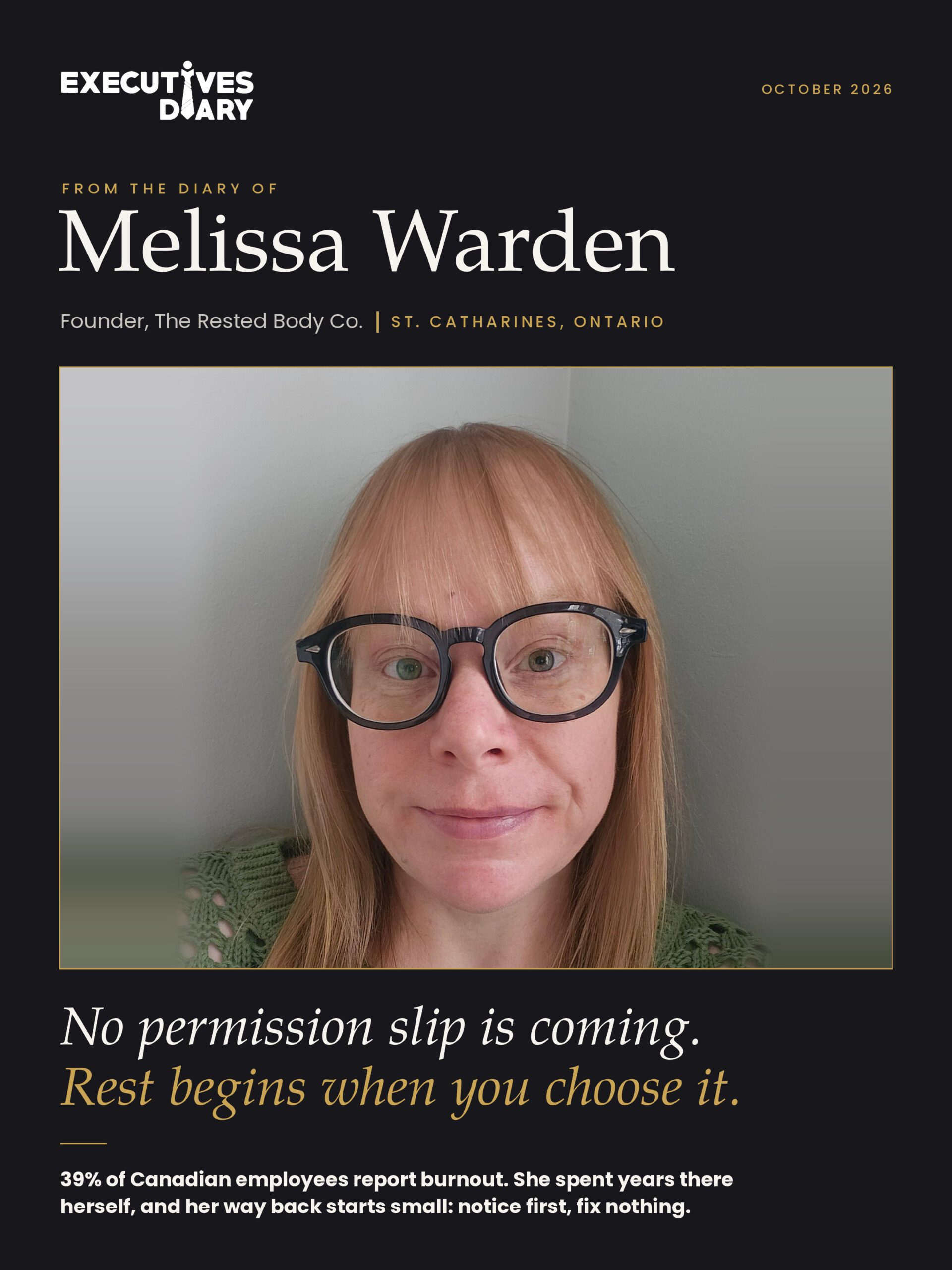
“A few years back, I didn’t recognize the reflection looking back at me in the mirror.”
The woman who wrote that had been, as she has written, in “an extended period of a toxic marriage and an unhealthy workplace, all wrapped up in isolation during covid. It felt like every day was something I merely existed in.” Of that mirror she says: “I’ve stood there with that prickly feeling in my skin wondering how I got there. Where things changed.”
Exhaustion like hers is not rare. In a June 2025 survey of 5,008 employed adults, Mental Health Research Canada found that 39% of Canadian employees report feeling burnt out, up from 35% in 2023.
Melissa Warden found her way back, and built a company on what she learned. She is the Founder of The Rested Body Co., based in St. Catharines, Ontario, which helps “exhausted humans in survival mode reconnect with themselves, rediscover joy and find their way back to rest.” It works through education, practical tools, compassionate support and lived experience: the writing and free resources she shares online, and Rested + Rising, a four-week program for exhausted humans in survival mode that launches in early November.
Waiting for a Permission Slip
Melissa starts with recognition. “Many people in survival mode don’t fully realize it,” she says. “We’re often taught to push through or that exhaustion is weakness. But there is no shame in recognizing you’re in survival mode. Once you recognize it, you have a starting point to what will help you come back to yourself again.”
She does not blame anyone for how they have kept going. “I wouldn’t say how anyone chooses to keep moving is wrong, because it’s what they’ve learned works for them,” she says. “From the outside, we may not always understand it, but to them, it’s how they feel safest, even if they aren’t consciously aware of it.”
What she does notice is how long people stay. “What I tend to notice is people stay in survival mode longer than they realize, because the state becomes so familiar, but also because they often feel like they need to keep pushing forward and hoping for the best.” The beliefs that hold them there are ones she names plainly: “You may believe you need to push through until things get better. Or believe rest will happen once the work, family responsibilities or crisis are over. Or maybe you believe choosing yourself is selfish. We’re often waiting for a permission slip that isn’t going to arrive.”
We’re often waiting for a permission slip that isn’t going to arrive.
Some of the people she has in mind are hiding it. She wants this piece read by “the person who feels like they need to mask how depleted they feel.” The same Mental Health Research Canada survey found that 52% of Canadian workers had faced challenges that affected their work, while only 33% had told their employer.
“Women especially tend to put others first, but it’s something everyone needs to consider,” she says. “At some point, there has to be a moment where you begin to believe that you are deserving of a break, even before you feel fully able to take one.”
Survival mode is not the mistake. Believing you have to remain there until everything is resolved may be the thing that costs you.
What she offers in its place begins with a choice of words.
Home, Not Healing
“I believe in using the word ‘home’ over healing, because you’re not broken,” Melissa says. “You may feel lost. You may feel disconnected. But you’re still in there.” She has the same objection to a second word. “I don’t like the word ‘fix’ either, because it suggests there is something inherently wrong with someone.”
Asked what she does that most people working in rest and the nervous system do not, she answers: “I don’t approach people as broken, and I don’t believe the answer is to fix them. I believe the person they are is still in there, and the work is about helping them reconnect with that person.”
She describes what home can look like: “looking in the mirror and thinking ‘Oh, there you are’. Or smiling in a moment where you feel completely like you again and your body softens.”
There is one sentence she will not use. “I’d never say ‘I know exactly how you feel’ because I don’t; I haven’t walked every step in life in their shoes. But I can empathize.”
Sometimes the thing someone needs most is to know that another person sees them and believes them.
She knows the place she is describing because she has stood in it.
The Bottom of Her Own List
“I’ve been through a toxic marriage, toxic workplaces and difficult relationships,” Melissa says. “I thought I was broken. I thought the ‘me’ I knew was gone. And that’s such a painful feeling.” On LinkedIn she has written that “It had been so long that ‘Melissa’ had really been out in the world, enjoying it,” and that “This is where The Rested Body Co. was born.” She added: “I just didn’t realize it at the time.”
Of that period she says: “I’ve been there, and felt like I was the only one there, and I empathize with how lonely it feels. How your bones ache. How you feel like you can never take in a full breath and exhale with an ease you can feel flow throughout your entire body.”
Rest, she believed, would come later. “I kept putting myself at the bottom of my own list,” she says. “I struggled for a long period, believing rest would somehow reveal itself and show up. But it wasn’t until I made a conscious choice that I could not keep living like I was, and chose myself, that rest ever had the chance to even enter the conversation.”
Having found her way back, she is clear about one thing: “I don’t ever want anyone or anything or any situation to take me from me again.”
I don’t ever want anyone or anything or any situation to take me from me again.
Before there was a company, there was someone who wanted to build one with her.
Stu and a Sleep Program
A few years ago Melissa met Stu, who had a sleep program, and the two worked together to bring it to market. “I had always wanted a business that was mine, and he saw in me a person he believed in and trusted to work together,” she says. “I’d never had that before.”
“He had run businesses before and the fact he saw me as someone to build with meant everything. He saw in me what I knew existed but no one else had ever seemed to notice. Promise. Vision. Creativity. Ambition. Faith.”
That venture did not work out. “It laid the beginnings of what eventually became The Rested Body Co.,” she says. “More importantly, it gave me the footing, and the trust in myself, to move forward with what I knew I was meant to do.” She founded The Rested Body Co. in February 2026.
Starting out, she says, “I went here, there and everywhere, gathering information and trying to do everything at once. It overwhelmed me and burnt me out even.” What helped was three experts in the online business community “who spoke to the way I learn and want to show up and run my business. Quieting the noise gave me focus.”
Quieting the noise gave me focus.
With the people she supports, she starts small.
Small Moments of Safety
Melissa describes one woman she supported early on, who told her she “didn’t realize how many cues her body was giving her that it needed safety.” In Melissa’s words, “She began to notice this was why her nervous system was out of sorts and kept her on edge.”
“What changed for her was being able to recognize her body cues, and start giving herself small moments of safety. By doing this, she was able to relax and better support herself,” she says. “The shift wasn’t that everything changed overnight. It was that she began to recognize there was something worth paying attention to.”
Melissa knows the other habit well. “It’s a very human thing to do. I did it myself when I was in my own prolonged period of survival. I made excuses and kept going.”
That is why she keeps the steps small. “When your body has been braced for so long, small moments can feel more approachable. They give you a chance to experience a little safety or calm without asking you to completely change everything at once.”
We don’t need to muster all the courage in the world to choose different; just noticing there’s something there to pay attention to and wanting different is a beautiful and courageous first step.
Humour, she says, is part of how she got through.
Not Today, Becky
“I am serious and passionate about the things that matter to me, but humour has kept me fueled in the rough times,” Melissa says. “I love a perfectly timed joke, laughing at myself or just having a ridiculous conversation. My nephews and I are especially good at those.”
It shows in her writing, including in how she handles the voice that says “You should be doing more.” “One thing I’ve found helpful is giving those thoughts a name. Mine is Becky. (Apologies to the Becky’s out there.)” The name is the tool. “Because sometimes it’s easier to say, ‘Not today, Becky,’ than to get pulled into another ongoing battle with yourself.” When she asked readers for the names of their own critics, she reported: “I’ve already met a Trevor and a Norman.”
When she asked her readers how they reconnect with themselves, she offered her own answer: “For me, one thing I love is walking out to the lake.”
Where Melissa Is Now
Melissa is building Rested + Rising, a four-week program launching in early November “for exhausted humans in survival mode who are ready to come home to themselves through reconnection, rediscovering joy and rest.” She has written that the heart of the program is simple: “You are not lost. There is still a whole person underneath the exhaustion.”
There is also the free audio, Nothing More Is Required of You Tonight, “a gentle few minutes to help you release some of the tension you’ve carried through the day.” She made it for anyone whose “brain has a habit of turning bedtime into a staff meeting, or a rehearsal for all the things Future You needs to tick off a list.” It comes with no bedtime routine to perfect. “Nothing more is required of you,” she wrote. “End of story.”
Her email list is now 193, up from 34 in the summer.
“Next up for me is launching Rested + Rising in November, running my first cohort and continuing to grow The Rested Body Co. as I support exhausted humans in finding their way back to themselves,” she says. She wants to reach exhausted people who are functioning on the outside but feel disconnected underneath, HR and workplace wellbeing leaders, aligned practitioners in rest, burnout and nervous-system-informed support, and communities focused on wellbeing and sustainable ways of living and working.
The line she wants under her name came from her own prolonged period of survival, when she kept believing rest would arrive once she had got through everything else. “You are allowed to rest before everything is finished,” she says. “You are allowed to take care of yourself before you feel you’ve earned it. And that’s not selfish. That’s being human.”
Five Lines from Melissa’s Diary
- “There’s always going to be something asking for your time, but you are deserving of your time as well.”
- “Even a faint spark of belief is enough to ignite you on a path back to yourself.”
- “Small steps matter.”
- “You don’t need to follow every voice.”
- “You deserve your attention too.”