

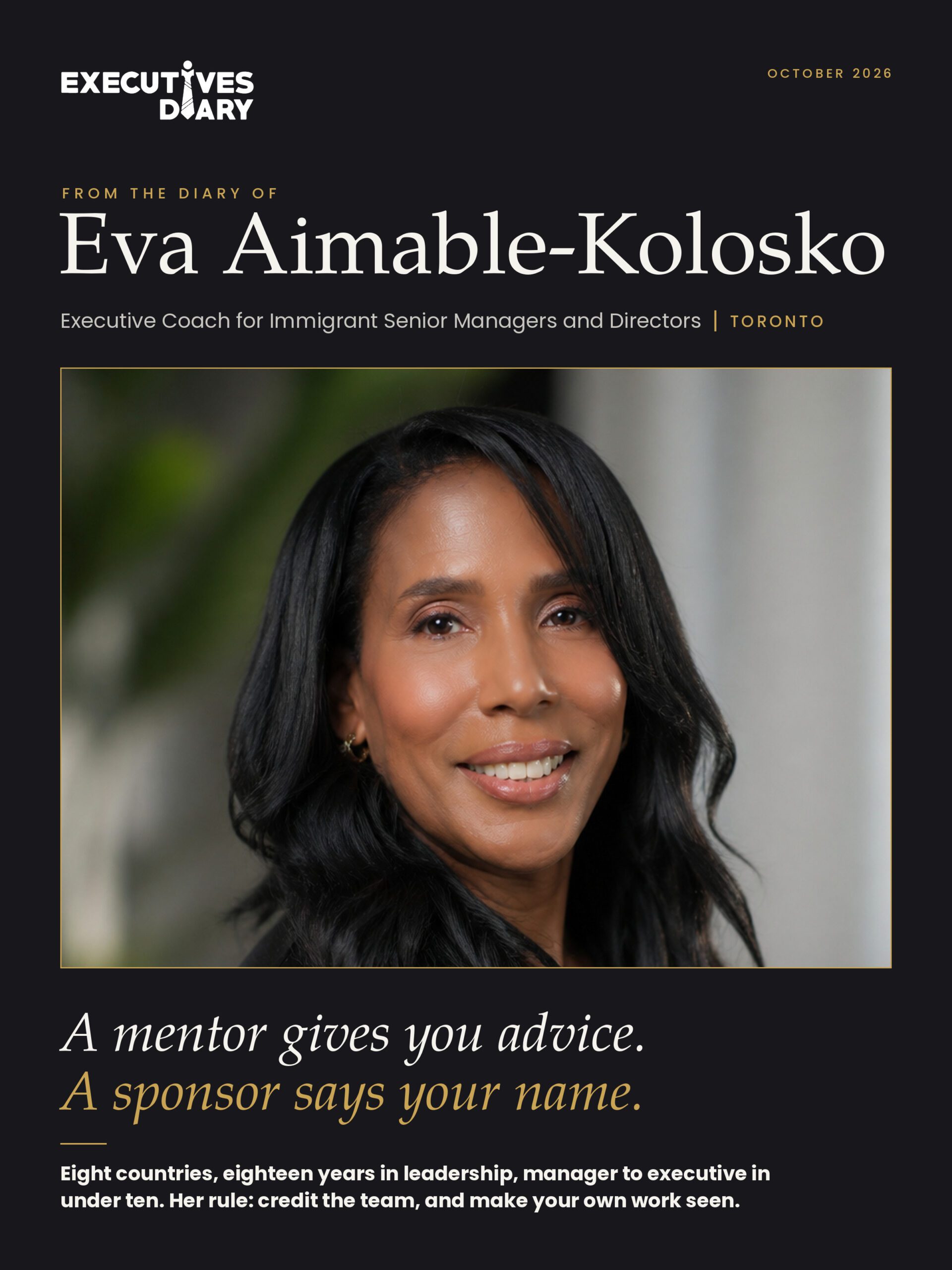
From the Diary of
Eva Aimable-Kolosko
The people deciding your career are working from incomplete information. Here is how to fix that without bragging.
“Career growth isn’t a reward for hard work. It’s a strategy.”
Your reviews are strong. Your projects land. Then the role you wanted goes to someone else, and nobody can quite tell you why.
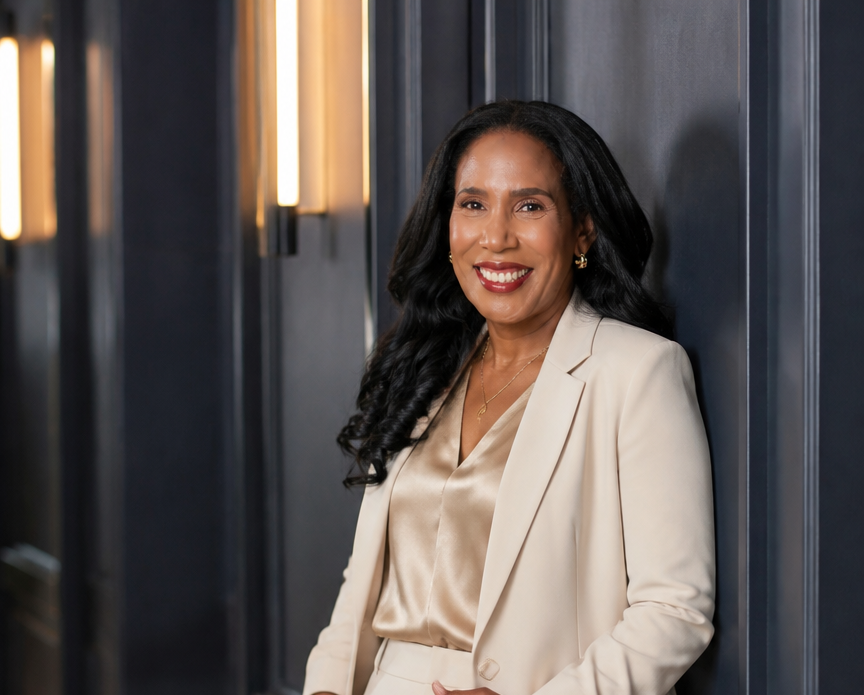
Eva Aimable-Kolosko has heard that story from more senior managers and directors than she can count, and she has lived it. She came to Canada from the UK with a three-month-old son and years of international experience that, she was told, did not count. She reached executive level in under ten years anyway. Then, as an executive in global organizations, she sat on the other side of promotion decisions and saw what actually moves them.
The pattern she describes has numbers behind it. Gallup’s 2026 State of the Global Workplace report puts manager engagement at 22 percent worldwide, down from 31 percent in 2022, and finds that managers account for most of the overall decline. In Canada, Statistics Canada reported in April 2026 that one in four working-age immigrants with post-secondary qualifications say they are overqualified for their job, against one in five people born in Canada. And a July 2026 report for the FTSE Women Leaders Review, built on promotion records and interviews at a global consulting firm, found that leaders are routinely measured against promotion rules nobody ever taught them, and that fewer than a quarter of sponsorship relationships are the kind linked to the strongest promotion rates.
Capability is not the shortage. Recognition is. What follows is her account of why strong results do not travel upward on their own, what senior leaders are actually looking for, and how to close the gap without becoming someone you are not.
The Advice That Works Until It Stops Working
Ask Aimable-Kolosko what advice she was given early that turned out to be wrong, and she does not hesitate. “Work hard, keep your head down and the results will speak for themselves. The right people will notice.” She says it held up for a while. “That was the age-old belief which may work until you get to a certain level but when you become senior you need a different set of skills to grow your career.”
The belief fails for a structural reason, not a moral one.
Aimable-Kolosko describes part of the challenge as an “Invisible Rulebook”: the unwritten expectations around visibility, influence and readiness that shape career decisions but are rarely explained. For leaders building careers across cultures, that can mean learning to read a room whose rules were never explained to you.
Where I disagree is the idea that results will always speak for themselves. They don’t. In large, multilayered organizations, senior leaders simply cannot see everything. I have had people take credit for my ideas and my work, and if I hadn’t made my contribution clear, the people making decisions about my career may never have known.
She frames the consequence plainly: “If decision-makers don’t know the value you bring, you’re asking them to make a decision with incomplete information.” Most of the leaders who come to her are not underperforming. As she puts it on her profile, “The gap is rarely capability. It’s usually credibility, visibility, or influence, and knowing which one to fix changes everything.”
If decision-makers don’t know the value you bring, you’re asking them to make a decision with incomplete information.
The Meeting Her Mentor Told Her to Use
The lesson arrived in a single sentence from a mentor. “You are doing amazing things in this role but I am not sure your VP sees how you are contributing. If you want to get to the next level use your next meeting with him to highlight that.”
Her first reaction was resistance. “I remember thinking ‘Shouldn’t it be about the Team’?” she says. It is, and that is the point she now makes to every client who raises the same objection. “I realized you can give your team the credit and still make your leadership visible. The two are not mutually exclusive.”
That resistance can run even deeper for leaders building careers across cultures, particularly when the unwritten rules of the organization differ from the norms they grew up with.
A lot of very capable leaders resist that because they believe their work should speak for itself. That can be even harder when you come from a culture where talking about your accomplishments feels uncomfortable or even inappropriate. I tell them visibility and self-advocacy are not about becoming the loudest person in the room or bragging. It is about making sure the right people understand the value you are already creating.
She holds the other side of the line just as firmly. “A people leader who makes everything about themselves without the humility to recognize the team behind them, isn’t leading.”
Which Needle to Fix First
Her diagnostic, the Global Leader’s Compass, is designed to help leaders decode the invisible rulebook of career advancement. It covers four areas: credibility, cultural intelligence, influence and impact. The method is to find out which one is actually stalling a career before doing anything else, because the fix for each is different.
Credibility is whether senior people trust your judgment. Cultural intelligence is understanding your own cultural lens, recognizing how culture shapes the people and environments you work in, and adapting how you communicate, lead and motivate others accordingly. Influence is whether you can move people and ideas without formal authority. Impact is whether anyone above you can see the value you are creating.
“Strong performance is the starting point, but senior leaders also need to understand your impact, how you think and what you are capable of taking on next,” she says. “The point is not to improve all four at once. It is to identify which one is limiting your progression and focus there first.”
On LinkedIn she has written about how to do this in practice. When a leader is told they need more executive presence, she writes, it is usually shorthand for three things: more visibility in the organization, more attention to demeanour in high-stakes settings, and more authority when presenting recommendations. “With any feedback, leaders should give examples and explain the behaviour you want to see more of.” If your leader didn’t provide them, ask for examples.
The Question to Ask Your Mentor
The move she sees most capable leaders miss is the difference between advice and advocacy. “A mentor gives you advice and time,” she wrote. “A sponsor says your name in rooms you’re not in.” She has watched a senior leader mentor someone for a year and then declare them not ready. “Advice is easy to get. Advocacy is harder.”
A sponsor says your name in rooms you’re not in.
Her instruction is one question, to be asked of any mentor you already have: “When my name comes up for the next level, what would you need to see to advocate for me?” Then, she says, listen carefully to the answer.
The same logic applies to turning a promotion down. In a recent post she described a senior manager at a Fortune 100 company declining a step up with 10 percent more pay because it would take her away from developing people. “So if you turn down a promotion, name what you want instead.” Name the cross-functional project you want to own and ask for the authority to lead it, because “at some companies, declining a promotion gets mistaken for a lack of drive.”
The Promotion She Refused to Decide For Her
One client came to her with two offers on the table. An external role paid significantly more and would take her deeper into her specialization. Staying meant advocating for a higher-level position with no guarantee of getting it.
“We worked through what she actually wanted her career to look like, what she was worth in the market, and which path would give her the growth she wanted long term,” Aimable-Kolosko says. Her job was not to choose.
She ultimately stayed, successfully advocated for the higher-level role and got the promotion. What mattered most to me was that she came out of the process seeing herself and her value differently. She had tremendous value to the organization and her role; she just hadn’t fully recognized it herself. I believe the role of a coach is to not make the decision for you, but help you make it with greater clarity and confidence.
She knows the cost of climbing without that clarity. “Working my way up to VP required long hours and a lot of travel. I’m proud of what I built, but some of that came at the cost of time I didn’t spend with my young family.” Her team has heard the line that came out of it many times: “Family first; Work can wait.”
It changed her definition of growth. “I used to think career growth meant continuing to move up; the bigger titles. Now I think growth is being deliberate about what you are moving toward while not losing who you are in the process.”
The Experience Behind the Framework

Aimable-Kolosko has lived in eight countries, with over 18 years of leadership experience. She moved from manager to executive in under a decade after arriving in Canada with no North American experience. She has led teams across more than ten countries, and ran enterprise operations, transformation and M&A integration as Vice President Operations at Bond Brand Loyalty, then took a short-term expatriate posting to Manila in 2025 as VP PMO, Transformation & Services at NQX. Earlier she ran a managed payroll services division at ADP. She holds a master’s in tourism and environmental economics from the Universitat de les Illes Balears and a postgraduate diploma in digital transformation from Emeritus, awarded with distinction, alongside PMI and Scrum Alliance certifications.
Her book, Growth Without Borders: A Global Leader’s Toolkit, was published in December 2025 and codifies the frameworks she uses with clients.
The way she leads was shaped by John Maxwell’s The 5 Levels of Leadership. “It was the first book I read from him and it really opened my eyes to what leadership could be. I changed a lot about how I lead from that book.”
Clients who did not take her advice sometimes come back and say so. “My response is never ‘I told you so.’ It is, ‘What did you learn from it, and how do we course correct from here?’”
One leader described her coaching this way: “Eva doesn’t deal in vague inspiration. She pushes you toward real decisions and measurable next steps.”
Where Eva Is Now
Aimable-Kolosko is based in Toronto and works internationally, coaching senior managers and directors in global organizations through focused engagements and running workshops, keynotes and advisory for organizations developing leaders across cultures. If she had never gone into this work, she says, she would probably be in the nonprofit sector. “Giving back and helping others has always been important to me.”
Her forward view is the same one she gives clients. “Your career can enable the life you want, but only if you are deliberate about choosing a path that you believe in.”
The Playbook
The Eva Aimable-Kolosko Playbook: Navigating the Invisible Rulebook
- Credibility: Stop proving yourself by doing more. At senior levels, credibility is also about judgment, how you respond to feedback and what you do with it. Get specific about what needs to change, decide what you will act on, and show the difference.
- Cultural Intelligence: Learn the rules without losing yourself. Understand your own cultural lens, recognize the norms of the organization and culture you are operating in, and adapt how you lead without mistaking adaptation for inauthenticity.
- Influence: Build advocacy, not just relationships. Know who shapes decisions about your career and who will speak for you when you are not in the room. Advice helps. Advocacy changes what happens in those rooms.
- Impact: Make your value visible beyond your role. Strong results are the starting point. Connect your work to what matters to the wider business and make sure decision-makers understand the value you create and what you are ready to take on next.
Eva Aimable-Kolosko coaches senior managers and directors in global organizations at growthwithoutborders.global. Connect with her on LinkedIn.