
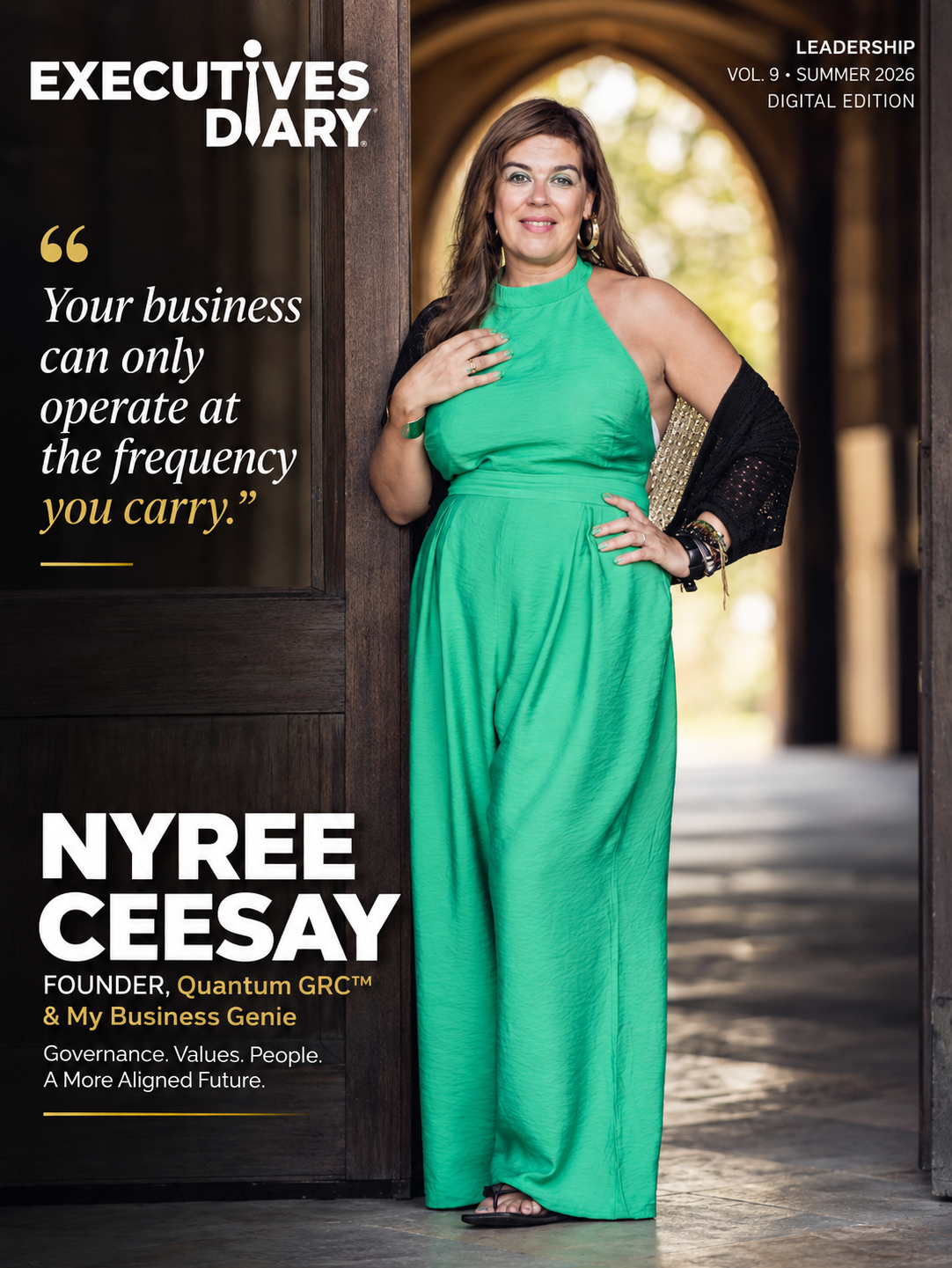
Nyree Ceesay: The Woman Asking What Compliance Has Been Missing
Founder of Quantum GRC™ & My Business GenieA business can have the policies. The procedures. The controls. The regulatory framework. It can pass the audit, satisfy the requirements, and appear perfectly structured from the outside. And still, something can be wrong.
The question is what.
For more than 25 years, Nyree Ceesay has worked inside the world of financial services, governance, risk, and compliance, building and overseeing structures designed to protect businesses, their people, and their clients. But her work has gradually moved toward a question that conventional compliance does not always know how to ask: what happens when the structure is sound, but the person or business operating inside it is not aligned with what it is actually here to do?
Today, as the founder of Quantum GRC™ and My Business Genie, Nyree is developing a different way of thinking about governance. One that brings regulatory expertise into conversation with intuition, energy, values, money, and personal authority. Her premise is strikingly simple. “Your business can only operate at the frequency you carry.”
The Things She Noticed Before She Had the Language
Some careers begin with ambition. Others begin with observation. For Nyree, the questions came first. Growing up and moving through the world, she watched how people were treated, noticing how often they could be extracted from rather than invested in. She saw regulation within financial services and pensions become capable of controlling good people rather than simply protecting them. She noticed the way money could become a mechanism of power rather than a reflection of genuine value.
At the same time, she was naturally drawn to systems, patterns, biology, people, and the forces shaping behavior. She studied Biology and Geography at Keele University and developed an early fascination with astrology, although at the time there was no obvious space in her life to pursue it. She continued along the expected professional path, becoming increasingly skilled at fixing the things others could not, or simply did not want to fix.
Years later, Human Design and Eastern metaphysics would give her new language for some of the patterns she had been absorbing intuitively for years.
Nyree shares, “Everything I witnessed, everything that felt wrong, everything that made me question, none of it was wasted. It was all data. It was all preparation.”
The professional and personal strands were already there. She simply had not yet brought them together.

Then Someone Told Her to Stop Being Intuitive
The moment that changed Nyree’s thinking did not arrive as a promotion or an award. It arrived as a challenge to something she trusted. She was told to stop being intuitive. Someone wanted data. Nyree respected the request. She questioned herself. For a time, she felt smaller for knowing something she could not yet prove in the language others trusted. Then the data came back. It said exactly what she had already known. The experience became a turning point because it forced her to reconsider the supposed opposition between intuition and evidence.
“I hadn’t been wrong. I had just been working in a way that others didn’t yet have a framework to follow.”
That realization became part of the foundation for everything that followed. Data could give people a language through which they could trust what had already been sensed. Structure did not have to suppress intuition. It could create the conditions for intuition to become useful, visible, and understood. In her own words, “That experience levelled me up.” And eventually, it gave her a much bigger question to pursue.
What Happens When the Structure Cannot See the Whole Business?
Every well-run business has a structure. Policies. Controls. Risk frameworks. Regulatory obligations. Layers of oversight designed to keep an organisation accountable, resilient and, ultimately, safe. And yet, sometimes, something important remains outside the frame.
The person at the centre of it all.
Nyree came to understand this from inside the system itself. Her career has spanned financial services, risk, compliance, data protection, AML, customer outcomes, operational resilience, strategy and governance, with director-level responsibility across the UK, Isle of Man and Gibraltar. From strengthening risk and quality-assurance frameworks to reshaping training, competency and customer-protection processes, her work has consistently centred on one thing: making governance visible, practical and connected to the realities of how a business actually operates. Her professional credentials include FPFS and IRMCert, reflecting the depth of expertise underpinning her work across financial services, risk and governance.
She understood the rules. But she also began to see their limits. A framework can govern a business. It cannot, by itself, govern the person running it.
The Idea That Became Quantum GRC™
What if governance could do more than contain risk? What if it could create capacity? That is where Nyree’s thinking began to move beyond conventional GRC and toward Quantum GRC™, her approach to governance, risk and compliance for both the individual and the entity. Its philosophy brings together the regulatory and the energetic without pretending that either world can simply replace the other. Nyree describes it as a tension that sits at the heart of her work:
For her, regulation is not something to bypass. Nor is energetic thinking an excuse to ignore physical consequences. There are always consequences for actions. Boundaries still matter. Governance still matters. Responsibility still matters. But businesses are also made of people, and people carry beliefs, patterns, fears, values, intuition, and capacity into the structures they create.
Quantum GRC™ exists in that space between the two. Nyree calls it “sovereign governance for individual and entity.”
Nyree’s framework is set out in her book Quantum GRC, available now, a foundational text for any professional or business leader ready to approach governance differently.

Building Structures That Can Hold Wealth
Once the idea became clear, Nyree began building around it. Through My Business Genie, her work now extends from conventional GRC expertise into a broader architecture of governance, money, visibility and personal alignment. For financial advisers and firms seeking independent oversight, Independent Audit offers a structured review of Governance, Risk and Compliance, revealing where existing frameworks are strong and where greater clarity may be needed.
For businesses that need governance without the weight of a permanent structure, The Integrity Compass provides fractional GRC support, helping firms navigate regulatory change, emerging risks, strategic decisions and cross-jurisdictional complexity without reducing compliance to repetition and fear.
Then there is The Visibility Codex, which carries the philosophy into the legal infrastructure of a business. Privacy policies, contracts, data-processing agreements and other documents are treated not merely as protective paperwork, but as some of the earliest points of contact between a business and its clients.
Her philosophy can be distilled into a simple observation:
“The moment a client reads your terms, THEY MEET YOU.”
Elsewhere, Centaur Mentor explores the space between logic and insight, considering business as a living system shaped by strategy and effort, but also by timing, pressure, perception and responsibility. Beyond the professional structure sit The Corridor and The Library, spaces for deeper exploration of frequency, money, business and self.
Different expressions. One philosophy. “Build the structure so it can hold what the business is becoming.”
The Money Question Was Never Just About Money
There is another thread running beneath Nyree’s work, and it leads directly to wealth. She does not position herself as a financial adviser. Her interest is in the architecture underneath money: the structures, boundaries, beliefs, and relationships through which value moves.
“Money is energy, and like all energy, it flows or it stagnates depending on the frequency of the structure it moves through.”
For Nyree, genuine value sits at the center.
Money matters, but it is not the starting point. The starting point is whether something of genuine value is being exchanged, whether the structure can support that exchange, and whether the people inside it are able to hold what they are creating.
That thinking eventually became deeply personal.
When the Business Question Became a Human Question
Nyree’s first book, WORTHY: Breaking the Silent Contracts Around Love, Money & Power, explores the invisible agreements people can carry around love, money, worth, inheritance, and power. Published in 2026, WORTHY is available now.
“This book began as proof.”
Proof that she was worthy of an inheritance she had almost been unable to receive, not because it was not hers, but because she could not yet believe it was. After nearly three decades in financial services, Nyree had discovered that some of the most important contracts around money are not written by regulators.
They live in the body.
In relationships.
In family patterns.
In the conditions people unconsciously attach to love, power, money, and worth. WORTHY became a way of naming those contracts and beginning to dissolve them. It is also an important counterpart to her professional work. The same question appears in a different form: what are you carrying, and can the structure you have built actually hold what you say you want?
Governance Begins Somewhere More Personal
Nyree’s answer begins before the policy. Before the spreadsheet. Before precedent or market expectation. She begins with the individual.
“Does it feel right?”
For her, governance exists internally as well as externally. It is the inner knowing, authority, boundaries, and values that keep a person aligned with what they are building. This is why she believes conventional approaches can fall short when mindset support lacks emotional intelligence and self-regulation, or when governance frameworks are imposed on people and organizations that have not examined what is happening underneath.
Her work uses a range of tools and techniques to help people return to themselves first. Because sustainable governance, in her view, begins there. And that is where her understanding of leadership becomes distinctly human. People do not only call her when something is going well. Trust, she says, is reflected in the moments when someone calls because they are worried about something they have not told anyone else.
Her role in those moments is often to reduce fear, the fear of getting something wrong, of questioning oneself, of making the wrong decision. The objective is not to take authority away. It is to help people return to their own.
A Different Future for Business
Nyree is not trying to create another compliance process. She is interested in changing the culture around governance itself. Her vision is a business landscape where governance empowers innovation, where compliance becomes clarity rather than fear, and where companies can grow from integrity rather than pressure. Governance, in Nyree’s framework, begins with self: the mind, the body, the beliefs, the frequency we carry. From there it extends into the business we build. And from there, into the industries we touch. Self. Business. Industry. That is the sequence. And it begins, always, with the individual.
She believes this has implications far beyond individual businesses.
For compliance and GRC professionals, Quantum GRC™ offers language for a more intuitive dimension of work that many people may already experience but have never been able to articulate. For entrepreneurs and leaders, it offers another perspective: structure and boundaries are not necessarily constraints. They can be the conditions that allow a business to expand without distortion. Nyree’s work is inherently cross-border. The framework adapts across jurisdictions and industries, not because she sought a global reach, but because genuine alignment doesn’t respect geography. The collaborations that have shaped this work have been built on shared values, not proximity. We don’t work under each other; we work together, raising the frequency of the businesses, industries and people we touch.
Her philosophy can be reduced to one uncompromising idea:
“You don’t need more restriction. You need resonance, structure, and clean power.”
What Is Left Behind Matters
Nyree’s definition of legacy is not a framework sitting untouched on a shelf. It is what changes because the framework existed. She wants businesses to move away from models that extract from people and toward structures that allow individuals to operate at the level they are capable of. She wants organizations, industries, and people to be better because they encountered the work.
And she measures that differently from conventional business metrics.
“This isn’t philosophy. People feel it. That’s the marker, not documentation, audit trail, certificate on wall.”
That may be the most important distinction in her entire philosophy. After decades spent understanding documentation, controls, systems, and regulatory expectations, Nyree Ceesay is not arguing that structure is unnecessary. She is asking us to build better structures. Structures that can hold people. Structures that can hold value. Structures that can hold wealth. And ultimately, structures that can hold what a business is capable of becoming.
The Nyree Ceesay Playbook: 5 Principles for Sovereign Governance
- 1. Start With Inner Governance: Before turning to the spreadsheet, precedent, or market, ask what feels right. Clarity begins with knowing your own authority, boundaries, values, and direction.
- 2. Give Intuition a Structure: Intuition does not need to compete with evidence. Build the framework that allows what you already know to be understood, trusted, and acted upon.
- 3. Make Governance a Growth Asset: Compliance should do more than satisfy requirements. The right structure creates clarity, protects value, reduces fear, and gives a business the capacity to expand without distortion.
- 4. Build Around Genuine Value: Money is not the starting point. Focus first on the value being exchanged, then create the boundaries and governance that allow that value to circulate cleanly.
- 5. Build What Can Hold What Comes Next: A business structure should evolve with the person and the vision behind it. Sustainable growth requires foundations strong enough to hold greater responsibility, wealth, and possibility.