

From the Diary of
Erica Buchholz
The strongest lever in a struggling family is usually the adult standing next to the child.
“Make it fun, and it will get done.”

A pediatrician gets fifteen minutes. A school counselor has a caseload. A therapist has the child in the room and, out in the waiting area, a parent who was never the referral.
Erica Buchholz has spent seven years arguing that the person in the waiting area is the intervention.
The numbers behind that are not subtle. In 2023 a third of American parents reported high levels of stress over the previous month, against a fifth of other adults, a gap wide enough that the US Surgeon General issued a formal advisory on parental mental health the following year.
A national survey of more than 700 parents run by the Ohio State University College of Nursing put self-reported parental burnout at 57 percent. It also found that the more burned out the parent, the more likely they were to insult, criticize and scream at their children, and the more mental health problems showed up in those children.
The referral chain around a struggling family is mostly built to reach the child. What follows is Buchholz’s case for building one that reaches the parent, and the specific way she does it.

The Parent Nobody Was Assigned To
Every professional in the chain is doing the job in front of them. The pediatrician screens. The therapist treats. The school nurse manages the day. Almost nobody has the hour it would take to sit with the adult who goes home with the child, and that is not a failure of care so much as a gap in how care is arranged.
An umbrella review published this year, pulling together 41 separate reviews of what stresses parents of autistic children, found the same thing from the other direction. Alongside the child’s needs and the family’s finances sat a whole category of pressure created by the healthcare, education and support systems that exist to help. Waiting lists. Not being taken seriously. Care that arrives fragmented. The authors noted that breaking the cycle may require support aimed at the caregiver as well as the child.
Buchholz says the referrers already know this, and resist it anyway.
But when parents are so stressed out, they wind up falling into just managing their day-to-day, and the connection with their kiddo suffers. Professionals who work with parents know that a calm and regulated parent hears what they have to say more clearly than a parent who is coming in super anxious themselves. A lot of professionals help the child directly, but have no real supports or time to provide to the parent, they are just too busy.
The resistance is not disagreement. It is arithmetic.
Regulation First, Then Connection, Despite Tasks
Buchholz learned the sequence on herself, and it cost her to learn it. “When I was exceptionally burntout in a corporate career, I lost about 8 months of connection with my family because I was just trying to survive,” she says.
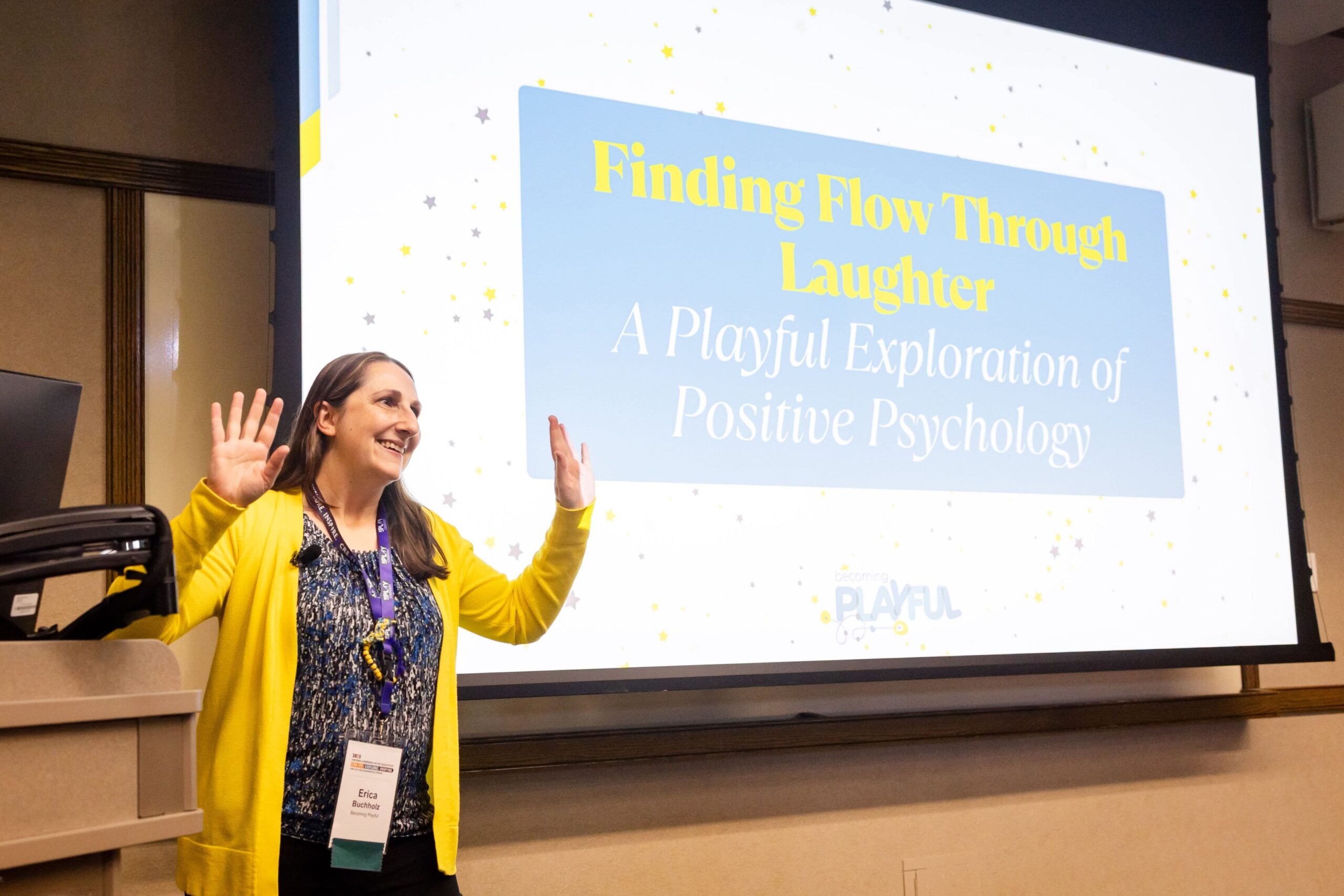
The correction did not arrive in a therapy room. It arrived in a training session where she was qualifying as a laughter yoga facilitator, which is exactly as unserious as it sounds and which she now describes as the first time she let play, laughter and rest go first instead of anxiety. Rest and self-care, she says, “are never selfish, they are actually restorative and the thing that actually gives us energy to be present with our children.”
Others see struggle and rush and grind as the way to get everything done so that they can connect with their family. But I discovered that being playful, laughing intentionally, and doing that first, allows parents to connect with their kiddos, no matter if dishes are dirty or they are late for an appointment. Regulation first, then connection, despite tasks.
The order matters more than the content. Most parenting advice hands the parent a technique and assumes they have the capacity to run it. Buchholz builds the capacity first, on the grounds that a depleted adult cannot execute a good strategy and a regulated one barely needs the strategy at all.
What She Actually Changes
The mechanics are ordinary, which is the point.
She starts with what a parent is carrying rather than what their child is doing. In one case, a high-achieving mother of two, one with additional needs, arrived with a husband working out of the house most of the day and, as Buchholz describes it, the to-do list always playing in her mind. The coaching was a series of Zoom calls that peeled back why the days felt so full, what could be delegated, and which supports would actually create room. Then came the part most parenting programs skip: rewriting the endings of the stories she had been telling herself. By the end, the mother was present on the drive to after-school activities, no longer rushing bedtime, and setting clear boundaries about working after hours.
Buchholz calls the underlying move story-revision rather than skill-building. “The gap is almost never about knowledge,” she has written. “It is about capacity.”
The gap is almost never about knowledge. It is about capacity.
The second move is environmental. When a child’s surroundings put them in constant conflict with the rules of that space, correction becomes the default setting for the whole household, so she has parents redesign the room instead of escalating the response. “It has everything to do with environment design,” she wrote in a post about the exhaustion of a day spent saying no.
The third is the smallest and the oldest.
Without realizing it, until my laughter yoga days, I had always brought joyful energy to a session/call/email because an engaged (rather than burntout/low) state of mind is what lets people show up honestly. We are way more creative after we have laughed a bit. I always started meetings with a bit of lighthearted connections, whether that was a silly joke or sharing a funny animal video. I still send these to clients on hard days.
The Objection From Serious People
The obvious criticism is that this is soft. Buchholz meets it head on, and concedes half of it.
“Most people see the value of laughter in feeling better, but few actually talk about what play is for grownups,” she says. The people who disagree with her, in her account, are the ones selling grind. She grants that dedication and consistent work are real, then points out that the science of flow describes them as “only half of the formula.” The other half is release and restoration.
She used to be on the other side of this argument. “I thought to be professional you had to be serious all of the time,” she says, listing it as the thing she has changed her mind about most recently.
I thought to be professional you had to be serious all of the time.
There is a supporting finding buried in the Ohio State data that rarely gets quoted: the more free play time parents spent with their children, and the lighter the load of structured extracurricular activities, the fewer mental health problems those children had. Play was not the reward for getting the system right. It was part of the system.
Why the Referral Holds
Buchholz has been coaching parents under her own name since 2019, but the method predates the company. Her earliest relevant work was directing academics and career development for post-secondary students with autism, ADHD and other learning differences, managing plans for more than 50 students at a time. She then spent five years running curriculum development for a national early childhood provider, supervising a team of ten writers and trainers. “I have always been a coach, even if I hadn’t used that word before opening my company,” she says. Executive functions, she adds, are “an area that I am really good at helping people navigate.”
I have always been a coach, even if I hadn’t used that word before opening my company.
The credential underneath it is a Ph.D. in Applied Developmental Psychology from George Mason, where her dissertation examined comorbid psychopathologies in toddlers with autism spectrum disorders. She is now back at Mason as a learning strategist in its autism support programs, which means she is working with the eighteen-year-old version of the child her coaching clients are raising.
When the self-trust mentor Teresa Lisum had her on the Evolving Women podcast, the two of them spent the recording laughing. Lisum’s recommendation on her profile puts the work plainly: Buchholz “integrates laughter as a powerful coaching tool, helping her clients recover from burnout, reduce stress, and unlock creative problem-solving.”
Where Erica Is Now
Buchholz works from the Washington DC area, mostly on video, with families who reach her through pediatricians, school counselors, therapists and other coaches. The entry point is a virtual consult about what is happening in the house right now, followed by one-to-one coaching or a Playshop that puts parent and child in the same session. If she had never gone into the field, she says, she would “probably open a campground that has mindset classes and lots of baby animals,” which is not really a different job so much as the same one with better scenery.

The line she repeats most often is the one she would want a referring professional to pass along verbatim: “You are doing so much better than you think you are. A little bit of laughter goes a really long way.”
The Playbook
The Erica Buchholz Playbook: How to Reach a Family Through the Adult
- Treat the parent as the intervention. A regulated parent can hear and act on everything else you recommend, so their state of mind is the first variable to change rather than the last.
- Regulate before you organize. Planning, delegating and boundary-setting only stick when the person doing them has the capacity to sustain them, which is why the sequence runs regulation, then connection, then tasks.
- Rewrite the story before the schedule. Ask what a parent is telling themselves about their own parenting, then find the truer version underneath it, because the harsh story is running the interactions.
- Redesign the room, not the response. When a space keeps putting a child in conflict with its own rules, correction becomes everyone’s default, so change the environment and the corrections drop away.
- Lead with what excites you. Advice to tone yourself down protects other people’s comfort, and the work has gone furthest when Buchholz leaned into the ideas she was excited about instead of shrinking them.
