

From the Diary of
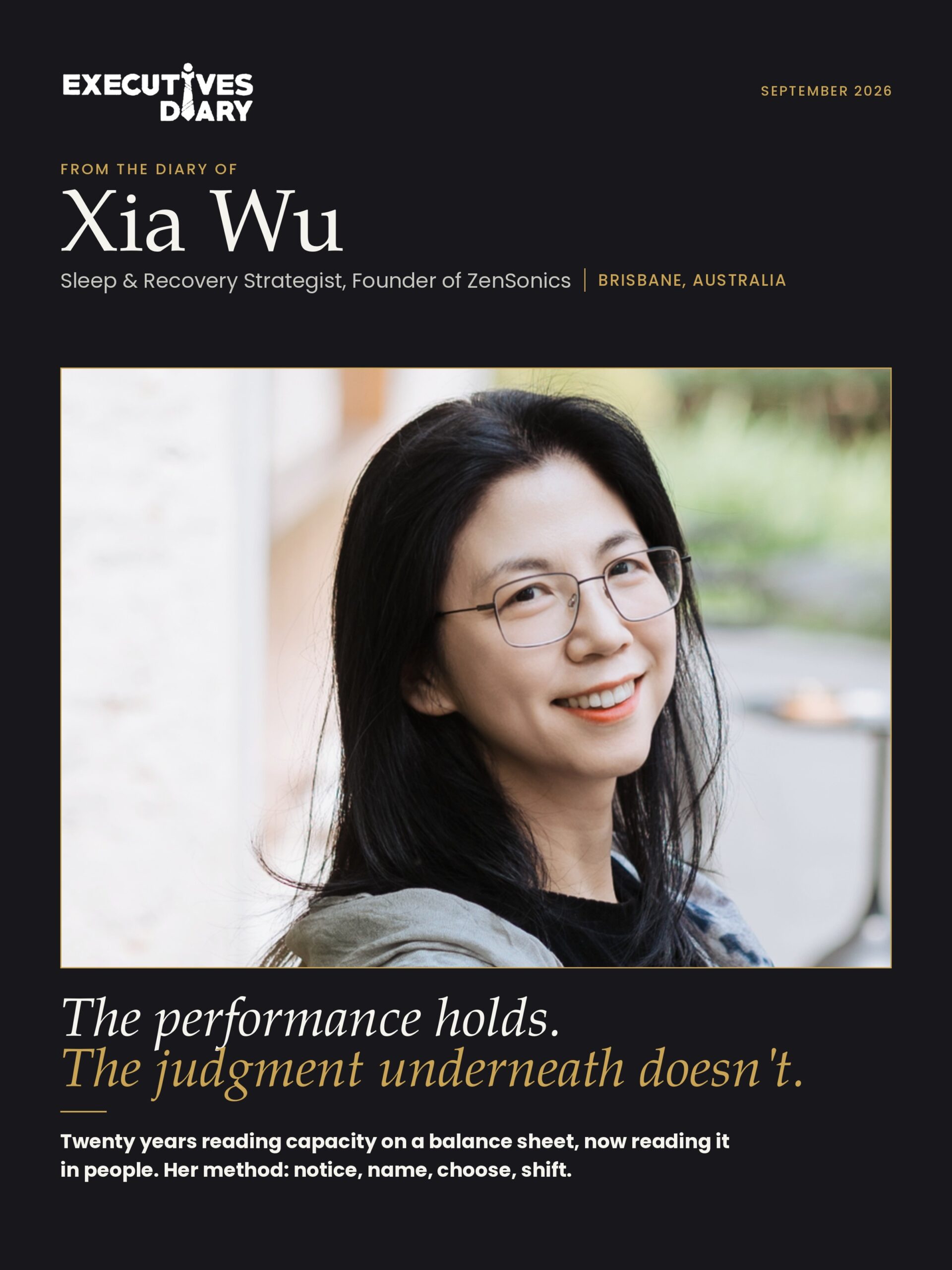
Xia Wu
Nothing looks wrong and you are still delivering. Here is what changes underneath first, and how to protect it.
“The ability to keep going is not the same as the ability to recover.”
Across thirteen countries, more than half of adults get a good night’s sleep four nights a week or less. The two barriers named most often are stress or anxiety, and work. One in five say they do not see their sleep problems as significant.
Xia Wu spent most of her career inside that pattern.
She spent close to twenty years as a CPA, working across financial management and business operations. She was good at it. She was also, for one long stretch, waking tired and foggy while meeting every deadline in front of her, and unable to say why.
The gap between performing well and recovering well is now her subject. Her case is that recovery belongs in the performance conversation rather than the wellbeing one.
Nothing Looks Wrong, and That Is the Difficulty
The familiar picture of a recovery problem is someone visibly coming apart: missed deadlines, a short temper, a collapse. Wu’s argument is that by then the useful window has closed.
What she watches for is earlier and quieter.
They may still be answering emails, attending meetings and making decisions. They may even feel they’re functioning normally. What shifts is the quality and range of thinking underneath the performance.
She is specific about what shifts. Someone who normally tolerates uncertainty starts reaching for quick closure. Someone who usually welcomes challenge becomes attached to their first view. What Wu watches for is the pattern, a change from how someone normally thinks.
In a 2003 study at the University of Pennsylvania, forty-eight adults had their sleep restricted to four or six hours a night for a fortnight. Their performance declined steadily across the two weeks. Their own ratings of how sleepy they felt rose once, early, then flattened. The researchers concluded that participants were largely unaware their thinking was still deteriorating.
The instrument you would use to check whether you need to stop is among the first things to go.
Stopping Work Is Not the Same as Recovering
Nobody arrives announcing a recovery problem. They say they know they should be sleeping better. They say they cannot switch off. They say they are tired, but at night they still want to do one more thing.
What interests Wu is the space between the intention to stop and the actual transition into recovery.
Someone may finish work, sit on the sofa and tell themselves they are relaxing, but then start checking messages, reading the news or scrolling. From the outside, it looks like leisure. But underneath, there may still be a pull towards stimulation, information, completion or responsibility.

That pull is where she starts. Sometimes the message underneath it is that stopping wastes time, or that slowing down means falling behind. Sometimes it is better than that: people keep going because they love the work, and because responsibility does not switch off at six o’clock.
Wu will not treat every pull as a pathology. For one period she was working full time, studying for the CPA and trading the American market from Australia, awake late into the night by choice. So the question she puts to a client is not how to stop. It is what is pulling you to continue, and whether that pull serves you or runs you.
She recognises that pull in herself. She once used her commute to listen to courses and talks at double speed, something she saw as personal development but later recognised could also be a way of continually filling available space. These days, she is more willing to leave some of that space empty.
Notice, Name, Choose, Shift
Underpinning Wu’s work is a nine-facet framework for understanding what shapes our capacity to recover. In practice, she begins with four simple verbs: Notice, Name, Choose, Shift.
The process begins with becoming aware of what is happening and what is keeping the current pattern in motion. From there comes choice, including, sometimes, the conscious choice to keep going, and the ability to shift deliberately when another state is needed.
She teaches it in the evening because the end of the working day gives people room to practise.
The evening is the training ground, not the destination.
“It is to help them develop a more general capacity to recognise when they are in one mode and deliberately move into another,” she says. Once that becomes embodied, it travels: before a difficult conversation, after an intense meeting, or when someone needs to stop carrying one demand into the next.
That repetition matters. Under pressure, people tend to return to what is familiar. DOWNSHIFT is not about experiencing recovery once. It is about making the capacity to shift more familiar and accessible when it is needed.

There is also often a gap between knowing and doing. We can understand a pattern intellectually and still struggle to see it clearly while we are inside it. Sometimes another pair of eyes can notice what we cannot, helping turn awareness into a different response.
A Surgeon and a Soldier Told Her the Same Thing
A surgeon gave her the sentence she now takes into boardrooms. “The strongest teams I’ve worked with treat recovery as part of sustaining good judgment, not something you earn after the work is done.”
Then a man who had served on the frontline in Afghanistan told her he had never struggled to sleep in a war zone. If he stayed active when he had the chance to rest, he could lose it, and he never knew when the next chance would come. He was responsible for other people’s safety.
“Rest wasn’t separate from responsibility,” she wrote afterwards. “Rest was part of responsibility.”
Rest wasn’t separate from responsibility. Rest was part of responsibility.
Most senior professionals run the opposite logic: too much to do to stop.
But that is precisely where Wu thinks recovery matters.
Recovery Does Not Buy You More Time
The higher the responsibility, the more the work tends to depend not simply on completing tasks, but on judgement: deciding what matters, holding uncertainty, seeing beyond the immediate problem, considering perspectives that challenge your own, and changing course when new information appears.
And those decisions often have to be made under pressure.
Wu is not arguing that better recovery gives a leader more time to think. A surgeon may have seconds. An executive may have an hour to make a consequential decision. Her question is whether recovery helps preserve more capacity within the time available, enough to notice an assumption, widen the frame, consider another possibility or remain open to new information before acting.
The decision may still need to be made quickly. The pressure may remain exactly the same.
What can be different is the range of capacity available within that pressure.
This is where the argument turns organisational. Insufficient sleep costs five of the world’s largest economies up to $680 billion in lost output a year, on modelling RAND Europe published in 2016 covering the United States, Japan, Germany, the United Kingdom and Canada. If recovery shapes judgement, and judgement is what senior people are paid for, recovery capacity is a governance question rather than a perk.
“When recovery becomes part of the way we work, people don’t become less committed,” she says. “They become more capable of bringing their best judgement to the work that matters.”
When recovery becomes part of the way we work, people don’t become less committed. They become more capable of bringing their best judgement to the work that matters.
Twenty Years of Watching Capacity on a Balance Sheet
She spent close to twenty years working in finance across manufacturing, government and higher education. In the later part of her career, she also took on management responsibilities, including leading a team through a university-wide restructure and managing the operations for the university’s largest and most complex school.
That is not background colour. It is the source of the frame.
In finance, a system can continue producing an acceptable result while the resources underneath it are gradually being depleted. The important question is not only whether it is performing today, but whether the underlying capacity will still be there tomorrow. I think human performance raises a similar question: What capacity does this person need to preserve so they can continue thinking clearly, making good decisions and carrying responsibility well?
It also lets her hold the conversation in their language. Performance, risk, capacity, sustainability. “I don’t stand outside that world telling people they need to slow down,” she says. “I’ve lived inside it.”
I don’t stand outside that world telling people they need to slow down. I’ve lived inside it.
Since 2023, she has worked with more than two hundred people across one-to-one sessions, group programmes and workplace settings. She is careful about what that number is not. She does not offer it as evidence, and says plainly that the nine-facet framework is not clinically validated.
One founder she coached wrote that she “helped me recognize the importance of downshifting after work, and actually focusing on myself and my personal life.”
A post on why it is so hard to stop scrolling at night took her onto SiriusXM, her first radio interview in English.
Where Xia Is Now
Based in Brisbane, she works with founders, executives and leadership teams globally, and designs corporate recovery programmes including DOWNSHIFT.
Outside her professional work, she has spent more than a decade volunteering with a local Buddhist practice community, and continues her own exploration of Tai Chi, breathwork, sound healing and mindfulness, traditions and practices that were part of her life long before they became part of her professional work.
“I don’t see ambition, responsibility or high performance as problems to be fixed,” she says. “I am interested in what allows people to sustain them without continually having to override themselves.”
I don’t see ambition, responsibility or high performance as problems to be fixed.
