

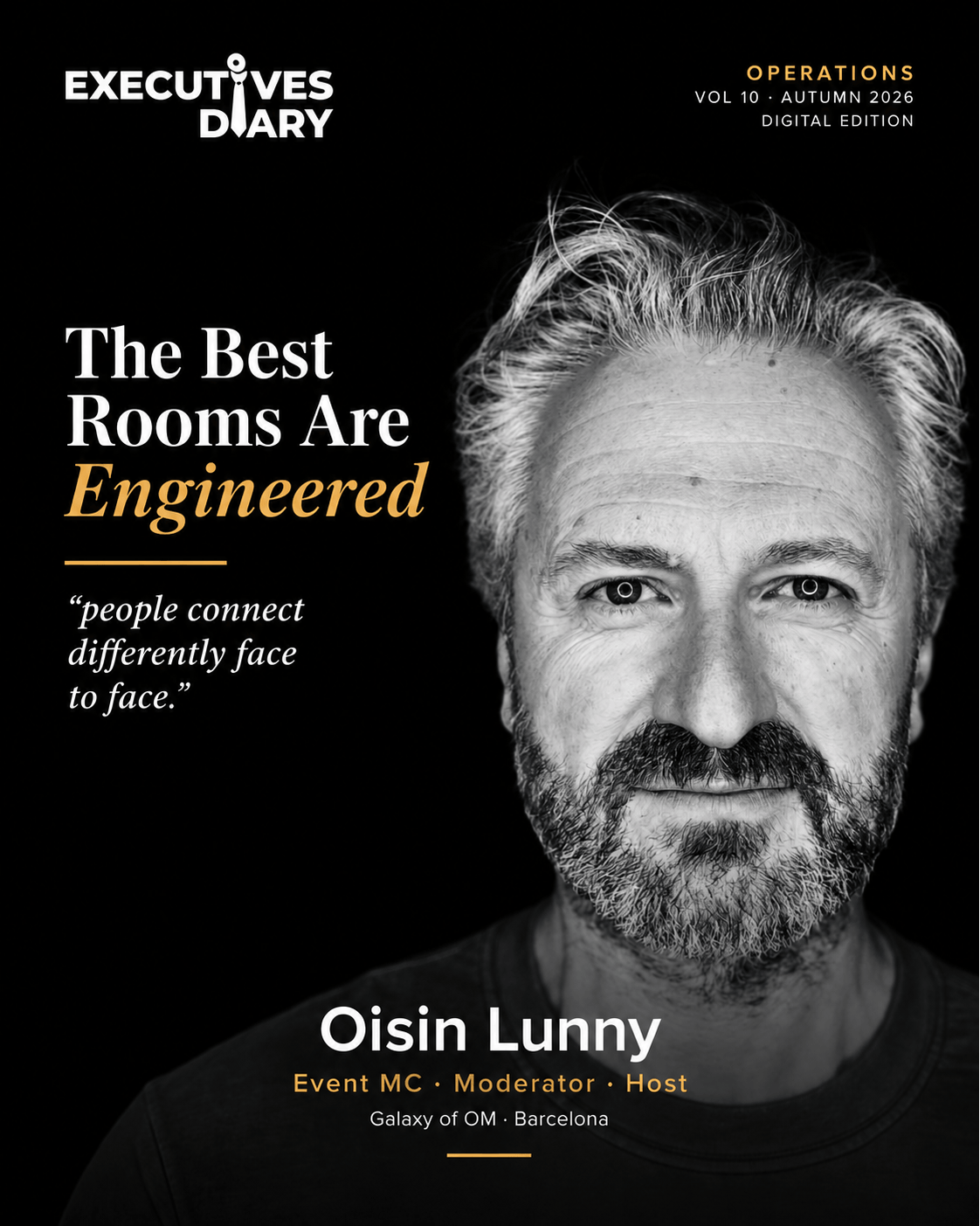
Oisin Lunny
Co-Founder @ Galaxy of OM, S.L.Event MC | moderator & Podcast Host
He spoke at roughly 150 events before anyone hired him to host one, and he argues the sequence is the whole difference.
More than 415 events, close to 50 webinars and close to 170 podcasts sit behind Oisin Lunny’s name, and none of it began in broadcast or drama training. He was a product manager, a country manager and a chief evangelist inside global technology firms first. Hosting is widely treated as a performance job. Lunny argues the order he arrived in is the whole difference. “As a Senior Market Development Manager I had certain outcomes to accomplish, so now I do everything I can to help the speakers I welcome and the panels I moderate reach their best outcomes.”
Oisin Lunny is an event MC, moderator and podcast host based near Barcelona, and has sat on the SXSW advisory board since 2016.
The Conditions Matter More Than the Programme
Good content is necessary and nowhere near sufficient. That is Lunny’s argument about live events, and he has watched the gap hold at SXSW, Mobile World Congress, IBC and SIBOS often enough to treat it as the actual deliverable: “people connect differently face to face.” A strong programme gets the right people into the room. Whether the day produces anything then depends on conditions rather than material. “The quality of connections is related to the spirit of the participants, and the design of the event,” he says.
That reframes the job of the person holding the microphone. They are not there to fill the hour. They are there to engineer the conditions under which the hour produces something, which is a different discipline, and in his account one that corporate seats teach better than stagecraft does. He came to it having occupied all three of the others: the speaker, the organiser, and the delegate sitting in row eight. “I could tell when someone was dialling it in,” he says of the last of those.
He learned the first half of the discipline by failing badly.
A Panic Attack in the Front Row
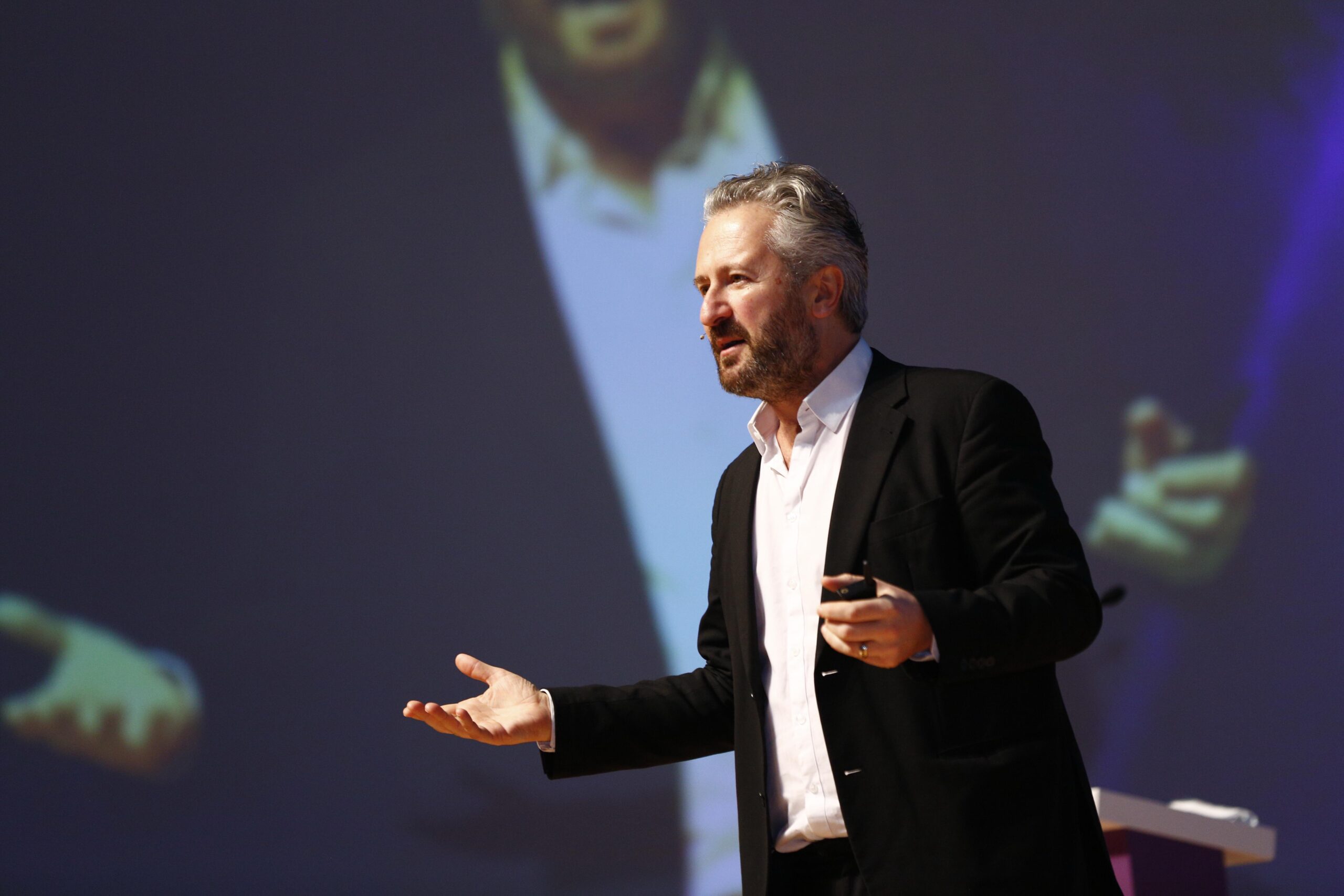
At one of his earliest speaking engagements he was booked back to back with a senior figure from a major research firm, who went first with a world exclusive dataset in front of a room of important people. Sitting in the front row watching it, Lunny came apart. The blood drained from his face. He was sweating, short of breath, and seriously weighing how it would look if he bolted for the door, on the certainty that he had nothing by comparison. He remembered a tip from somewhere about breathing, did some of it, and calmed down enough to look around.
People were yawning. The data was extraordinary and the delivery was monotonous, and the room had quietly left. So he went up after it with the weaker material and gave it everything. “I told a real story, with facts, heart and energy,” he says, and afterwards a queue formed to connect with him rather than with the exclusive. His takeaway from the whole episode was not about confidence: “be authentic, be yourself, and remember to breathe.”
The second half of the discipline shows up when there is nothing wrong at all.
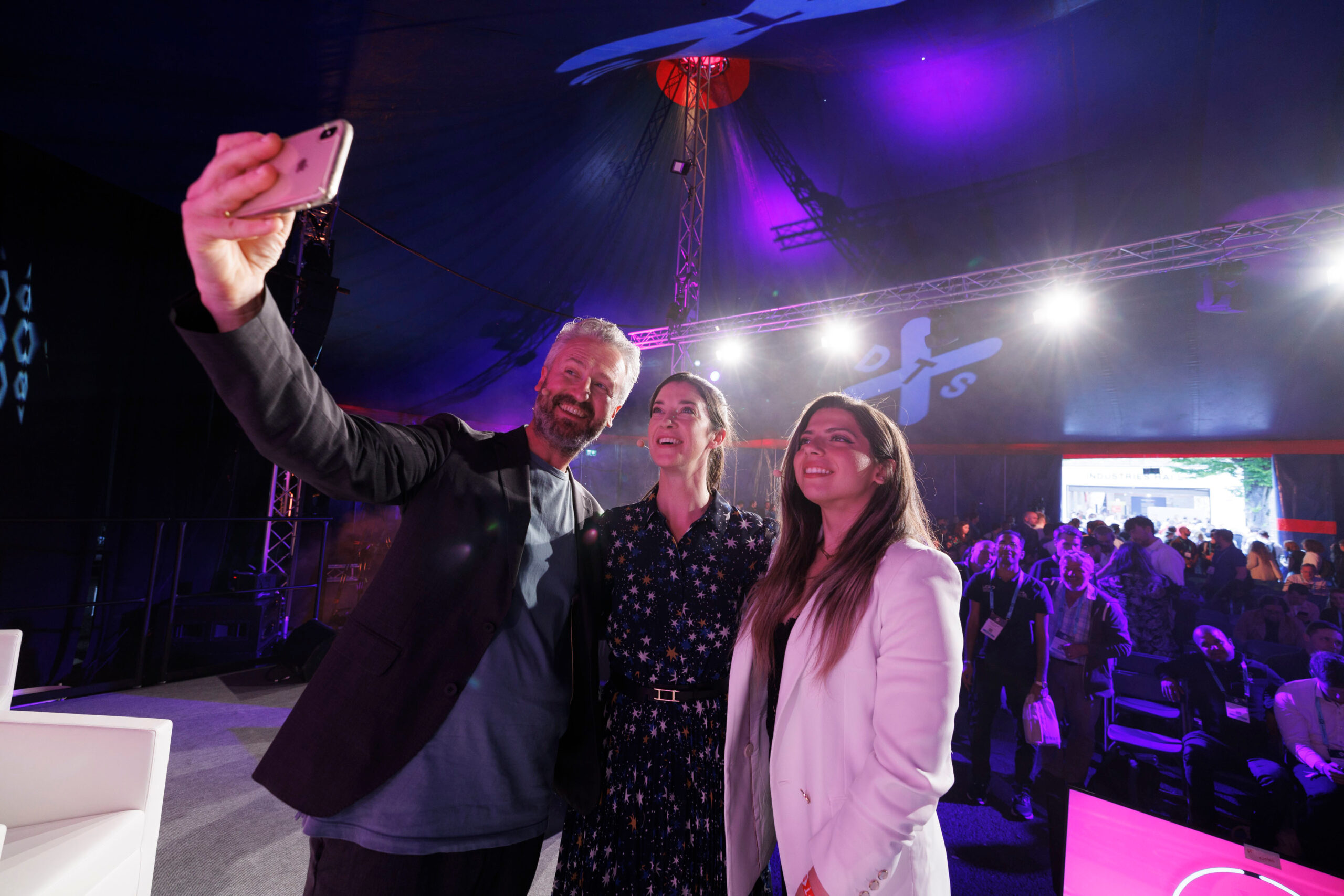
In front of a Dublin Tech Summit audience of 8,000 in 2023, Lunny interviewed two astronauts on the main stage: Dr Norah Patten, due to become the first Irish person in space, and Sara Sabry, the first Egyptian, Arab and African woman to fly. He had spent the previous evening with them at the speakers’ dinner, deliberately not rehearsing the session. “Because we had connected and aligned already on an empathetic level, we had an unwritten understanding on how we could approach the session,” he says. What that bought him on the day was the freedom to get out of the way. When Patten described visiting NASA at fifteen, and when Sabry described the overview effect, the room went completely still. “At several points in the chat you could genuinely have heard a pin drop.”
Thirty-Two Conferences for One Client, Ten Years Apart
A main stage in front of thousands is a format that flatters a host. The counter-case is the boutique B2B conference, where a few dozen people in a room either connect or do not, and there is no production to hide behind.
Lunny has hosted 33 of them for Savant Events, across a working relationship approaching ten years, with five further events booked through 2027. Savant designs specifically for the outcome he argues for, building the programme around high-quality networking and cross-functional collaboration rather than around the sessions.
The measurable version of how that has gone is the repeat booking count. The version he cites is an exchange at the end of a European event, when a VIP delegate found him afterwards. As Lunny recounts it: “You know, we are all high level professionals here, we know our stuff, and I knew a lot of this already, but… after today I understand how to join the dots in a completely new way which I would not have seen otherwise.”
Set the two engagements beside each other and the usual explanations fall away. The scale changed, from a national tech summit to a room of specialists. The subject changed, from human spaceflight to B2B commerce. The production budget changed by an order of magnitude. What did not change was the design intent and the discipline of the person running it. “Face to face connections with the right people in the right setting can be a very fast unlock, and genuinely transformative, I see it again and again.”
What Event Producers and Nervous Speakers Can Steal From 415 Rooms
Lunny has no framework and does not claim one. “Every single event is different but the approach is the same, accuracy, authenticity and empathy.” What sits under that is a preparation sequence a producer can hand to any host this quarter.
- 1. Start with outcomes, not with the running order. Establish what the speakers want, what the organisers need, and what the delegates came for, as three separate answers, before a single question is drafted.
- 2. Run the prep call, and deliberately do not run the session inside it. This is the move most hosts get backwards. “It is important not to have the on stage conversation in the prep call, so I will actually steer away from this to keep things fresh for the audience on stage.” A rehearsed exchange is a dead exchange, and the moderator’s own curiosity is part of what the audience is following.
- 3. Agree the balance between script and improvisation in advance, so that departing from the plan is a decision rather than an accident.
- 4. Get the names and job titles exactly right and exactly current. “As with everything, it is a good idea to be brilliant at the basics.”
- 5. Then work the room live rather than delivering into it. “I am listening intently when the guests are speaking, and recalibrating on the fly to make sure things flow well for them,” he says, condensing or expanding as it runs so the guests hit their marks and the session still ends on time. That last part is the organiser’s outcome, and he treats it as his own: the timing and execution smooth enough that the people who booked the event can actually enjoy the day they built.
Two more travel to the person about to walk on. The first is the technique Lunny was given by a PR advisor before his first live television interview, on CNN, when he was a product manager at Interoute facing a potential audience in the hundreds of millions: line up the two or three points you absolutely must make in the time available, then be natural around them and do not lose the points. “Sometimes remembering the most fundamental ideas can be transformative, even if they sound simple at the time.”
The second is the one he gives to anyone convinced they are the wrong person to be up there, which for a long stretch of his own life he was. “Remember that nobody in the audience knows what you were planning to say, so if you say something different just roll with it. There is no need to stop, to restart or apologise.”
Who Is Oisin Lunny?
Oisin Lunny is an event MC, moderator and podcast host based near Barcelona, Spain, who has hosted, moderated or spoken at more than 415 events, alongside close to 50 webinars and close to 170 podcasts, of which he has MC’d close to 180. Each event counts once however many sessions ran inside it: at IBC 2016 he hosted the two-day Rising Stars conference and moderated seven of its panels and fireside chats.
The corporate record came first. As global product manager at Interoute Communications from 2005, he built the online distribution and media services portfolio into a profitable pan-European business, work recognised with the World Communication Award for Best Content Service in 2006 and the International Webcasting Association’s Best Large Live Webcast award in 2007. Public speaking started there, and started as an assignment: “My boss at the time gave me an empty folder and suggested I fill it with PR and media coverage.” He went on to run the UK and Ireland business for Sulake, then spent eight years at OpenMarket, first as senior market development manager and then as chief evangelist. He was named the number five Most Engaged Marketer on LinkedIn in 2015 by LinkedIn’s UK country manager, wrote for The Guardian from 2013 to 2016, and contributed 64 articles to Forbes, latterly as a senior contributor, with his work translated into Chinese and Arabic.
He has spoken at SXSW six times and joined its advisory board in 2016. He co-founded the content studio Galaxy of OM in 2020, hosts the Audio Talks podcast for HARMAN, and hosted the Always Ready series with HARMAN Automotive and Scuderia Ferrari. At DMEXCO in September 2026 he moderates four sessions, including a fireside chat with Sir Martin Sorrell.
The stage fright is real and it is where the whole thing starts. In the 1990s Lunny was in Marxman, whose four UK chart entries include the number 28 single “All About Eve” in 1993, and who supported U2 and Depeche Mode, and for a long time he declined to tour at all, preferring the studio. “After 100 events things were easier,” he says of the years that followed, and of the way through it: “feel the imposter syndrome and do it anyway.”
Four hundred and fifteen rooms later, the argument he makes is the one his own record forced on him. The person best placed to run a room is the one who has already sat in every other seat in it.