
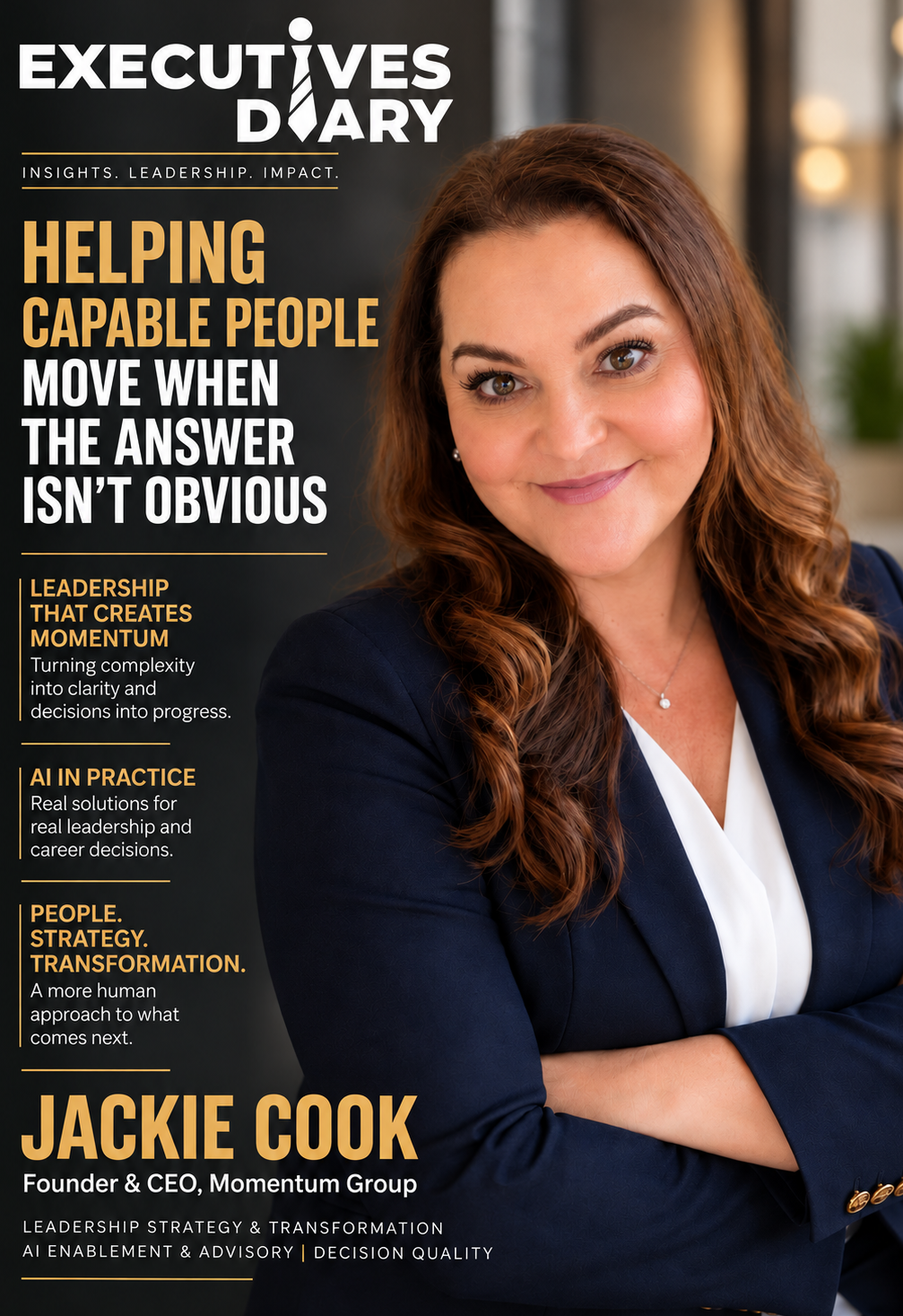
Jackie Cook: Helping Capable People Move When the Answer Isn’t Obvious
Founder & CEO, Momentum Group | Leadership Strategy & Transformation | AI Enablement & Advisory | Decision QualityThe Two Days That Changed the Question
When Jackie Cook’s executive role was eliminated last year, she did what many experienced leaders might do after two decades of demanding work. She decided to step away for a while.
There was no immediate business plan. No carefully mapped transition. Jackie intended to rest, think, and eventually figure out what came next.
Two days later, she was already building.
That small detail says a lot about what followed. Jackie did not simply replace one executive position with another. She began questioning the assumption that her next chapter needed to look like the previous one. What emerged was Momentum Group, a company built around a problem she had spent years seeing inside organizations: people can be highly capable and still struggle to move when the answer is not obvious.
A Career Built Around Problems Worth Solving
Jackie’s perspective did not begin with entrepreneurship or AI. It was formed over more than 20 years of operating inside complex organizations.
She worked across product, operations, client delivery, transformation, talent development, and leadership. At Mercer, she managed a $45 million client portfolio and 86 team members. At Marsh McLennan, she led early-career talent development across multiple regions and countries. At NCM Associates, she built and operationalized the product function, established new processes, shaped a multi-year roadmap, and introduced the company’s first Client Advisory Board.
The titles changed. The underlying work did not.
Jackie kept finding herself in situations where capable people were working hard but the organization was not necessarily moving with the same force.
She saw it especially clearly during transformation. Strategy can be sound. Technology can be available. Smart people can be in the room. Yet execution can still stall when nobody has enough clarity about what is changing, why it matters, what decision is actually being made, or who owns what happens next.
That observation now sits underneath much of her work.
From Losing a Role to Creating One
The elimination of her executive role forced Jackie into a period without the structure that had defined much of her professional life.
That turned out to be useful.
Without a title or organizational mandate telling her what came next, she began paying closer attention to the work she repeatedly chose for herself. Building. Solving. Helping people make sense of complicated situations. Helping leaders through change.
She also discovered something she had not fully appreciated while working inside organizations: she wanted the freedom to act on a good idea without waiting for permission.
That freedom changed the direction of the business. Jackie initially thought she was creating a consulting company. But the people she worked with kept revealing a larger pattern. Leaders were stepping into bigger roles. Professionals were reconsidering their careers. Founders were sitting on ideas they had not yet acted on. Organizations were trying to determine where AI belonged.
Different circumstances. Similar underlying problem.
The old answer was no longer obvious.
When More Information Is Not the Answer
This is where Jackie’s thinking becomes particularly useful for senior leaders.
She separates two problems that are often treated as one: a clarity problem and a decision problem.
Sometimes a leader genuinely needs more information. Sometimes another perspective or another conversation is necessary. But there are also moments when the information is already sufficient and the real difficulty is accepting what the decision requires.
Jackie asks leaders to examine that difference directly: what do you still need to know, and what do you already know but have not decided what to do about?
The distinction came to life in her work with a leader who had been passed over for advancement more than once. The executive believed she needed additional experience before she was ready for senior leadership. Their work together surfaced a different question: whether capability was really the issue, or whether the bigger challenge was recognizing the leadership identity she already possessed and making it visible.
The woman later moved into a Senior Director role leading a division. For Jackie, the result reinforced a larger point.
That is a meaningful distinction in an environment where executives can easily confuse analysis with progress. More data can improve a decision, but it can also become a convenient way to postpone one.

AI Changed the Distance Between an Idea and Reality
Jackie’s work with AI grew from the same instinct that shaped her operating career: find a real problem first, then determine what can actually solve it.
Jackie’s background is in product, operations, and transformation rather than software engineering. Before AI, building a tool around an observed problem could require technical partners, funding, detailed requirements, and months of development before there was even evidence that the idea was useful.
Now the barrier is dramatically lower.
Momentum Navigate, one of her AI-enabled products, grew from conversations with professionals trying to make better decisions during career transitions. They were exhausted by job searching, uncertain about which opportunities fit, and often evaluating roles without enough objectivity. Jackie understood the problem because she had spent years working with people through complex professional decisions. AI gave her a faster way to turn that understanding into something people could use.
That experience has also shaped a more nuanced view of AI’s role in leadership.
AI can write code Jackie could not previously write herself. It can synthesize information, challenge assumptions, explore possibilities, and produce a working prototype quickly. But it cannot decide whether the underlying problem is worth solving or whether a proposed answer makes sense in a particular human or organizational context.
That is where expertise still matters.
For Jackie, the opportunity is not for experienced professionals to abandon what they know and become technologists. It is for them to use technology to extend what their experience makes possible.
A Leadership Company for a Less Certain World
Today, Momentum Group helps people and organizations navigate what’s next across AI, career and leadership. Its work spans advisory services, experiences and AI-enabled products.
Jackie is also applying her product and operational background through CutIQ, a separate venture focused on reducing manual data entry and improving operational visibility in sheet metal fabrication environments.
The common thread is not a particular service.
It is the problem.
Jackie describes it as the gap between capability and movement. A person can have experience, intelligence, ambition, and options and still be unable to determine what deserves action.
That is increasingly relevant as careers become less linear, organizations change faster, and AI alters the relationship between expertise and execution.
That statement also clarifies what makes Jackie’s work different from conventional advisory models. She is not trying to remove uncertainty from leadership, career decisions, or organizational change. She is working on the harder question of how people develop enough judgment to act while uncertainty remains.

The Advantage of Knowing When to Move
Jackie Cook’s career began inside organizations, where her job was often to turn strategy into execution, improve operations, develop people, and make complicated systems work better.
Today, she is applying those same instincts to a different kind of problem.
The world of work is changing faster than many of the structures people once relied on to make decisions about careers, leadership, and growth. AI is accelerating that shift, but it is not eliminating the need for judgment. If anything, it is making judgment more consequential.
For Jackie, the answer is not another promise of certainty.
It is better judgment, clearer decisions, and the willingness to move when the path is still taking shape.