

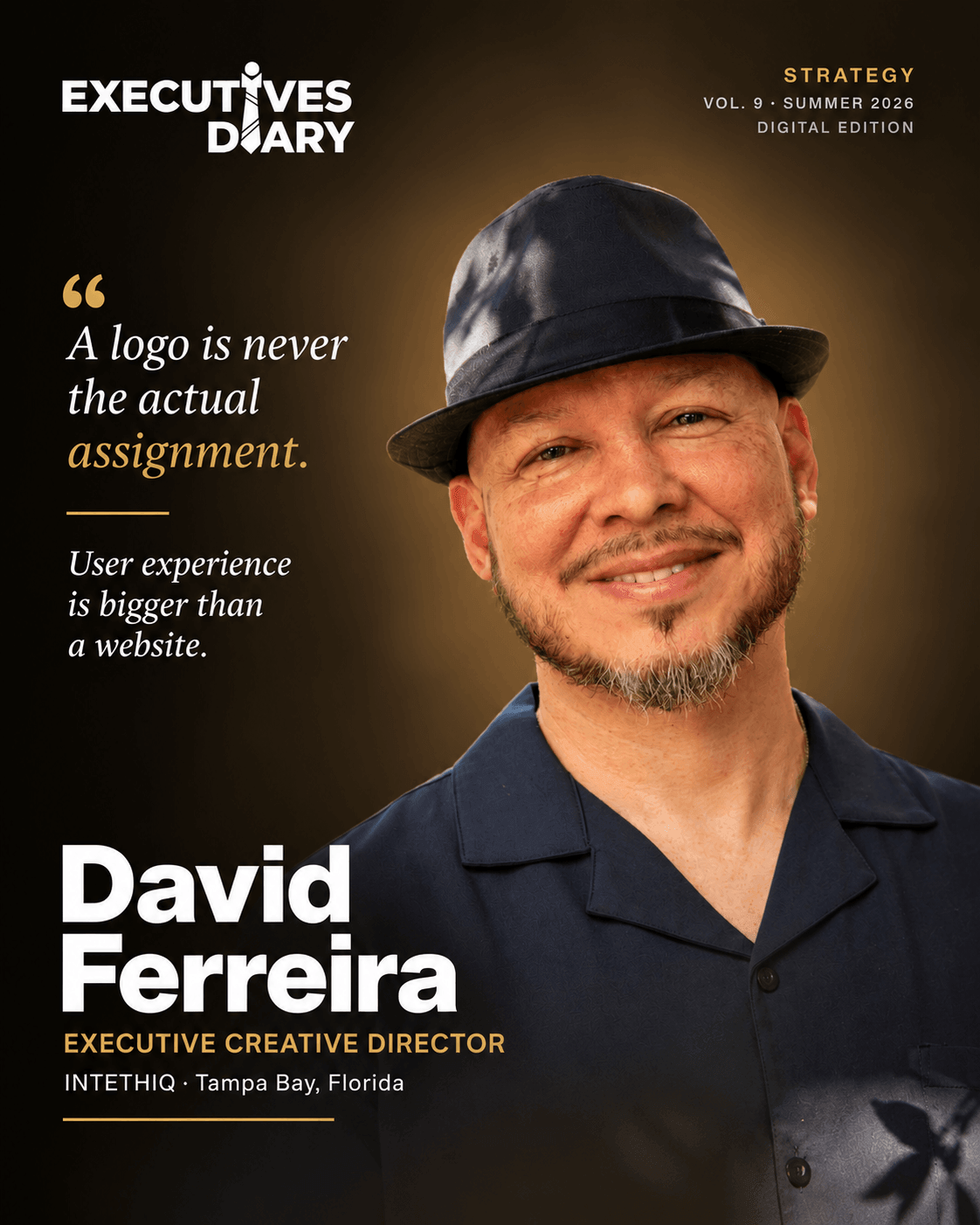
David Ferreira
spent three decades moving from production to executive creative direction, and what he learned on the floor is what most brand engagements skip.In 1994, David Ferreira spent his nights typesetting ads and scanning negatives for an advertising newspaper outside Washington, D.C. Thirty years later, he runs brand strategy and executive communication for organizations that rarely think past the concept stage. The assumption he has spent his career working against is that creative work ends when the idea is approved. “I do not view a logo, website, presentation, campaign, or event piece as an isolated deliverable,” he says.
David Ferreira is Executive Creative Director at INTETHIQ, a Cleveland, Ohio-based consulting firm, while operating from Tampa Bay, Florida. He leads brand strategy, creative direction, and executive communications after more than three decades in creative production, marketing, and communications.
THE SYSTEM UNDERNEATH THE DELIVERABLE
Ferreira’s central argument is that the real test of a brand begins after the idea is approved. “I pressure-test strategy against execution almost instinctively: how the idea will reproduce and scale, how it will be used by real people, and whether it will remain coherent once it leaves the presentation and enters the real world,” he says. That instinct traces directly to the decade he spent inside production departments before he ever held a strategy title, work that taught him a brand only exists once someone has actually built it, correctly, at scale.
The clearest test of that argument came early in his career, at a Texas telecommunications company then transitioning from Data Race to IP AXESS. The company was moving its headquarters from San Antonio to Dallas, growing quickly, and shifting strategic direction, while part of its marketing department relocated and part, including Ferreira, stayed behind. He was given creative direction across two offices during the transition, at a moment when the organization needed its brand to explain what it was becoming, not just announce that something had changed.
Ferreira saw an opportunity beyond the immediate creative assignment: the company was paying an outside vendor to build and maintain its website. He brought that function in-house, redesigning and managing the corporate site himself while also overhauling the collateral, presentations, packaging, and trade-show materials that carried the company’s new identity. Based on the vendor costs the company had previously been paying, bringing the website in-house saved an estimated $18,000 a year. Changes to how collateral was designed and produced saved roughly another $14,000 annually. Together, the two moves produced approximately $32,000 in estimated annual savings, a figure Ferreira describes as directional rather than audited, drawn from the outside costs the company had been carrying before he made the change.
What made the result repeatable, in his telling, was not the specific fix. It was the habit behind it. “Creative leadership creates greater value when you understand the business and organizational system surrounding the deliverable,” he says. He did not treat the website and the collateral as two separate creative problems to solve well. He treated them as one organizational asset the company had been renting from someone else, and brought it in-house because he understood both the design work and the operating cost sitting underneath it.
Ferreira is candid about what he would change in hindsight. He says that earlier in his career he focused more on doing the work well than on documenting its business impact afterward, and that today he treats both as part of the job. It is a small admission that supports the larger claim: the production instinct that finds cost and inefficiency in a workflow is the same instinct that, applied earlier, would have quantified the win as it happened rather than reconstructing it later.
BRINGING PRODUCTION BACK IN-HOUSE, TWICE
The IP AXESS result was not an isolated case. The pattern surfaced again a few years later at FASTSIGNS, where Ferreira worked as a graphic and web designer. The company was outsourcing production work on large-format signage, trade-show graphics, and vehicle graphics that could be brought in-house instead. Ferreira took over full-color process projects directly, redesigning signage and company graphics as needed rather than sending them out. The result, by his account, was approximately $20,000 in reduced outsourced production costs, along with tighter control over turnaround and quality on work that had previously depended on outside vendors.
Different company, different scale of business, and the same underlying pattern: identify work being paid for externally, determine whether it can be responsibly brought inside, and create greater control over cost, quality, and turnaround. What stayed constant across both was not the industry Ferreira happened to be working in. It was the habit of looking at a creative deliverable and seeing the operational cost structure sitting underneath it, a habit that came from years spent on the production floor rather than in a strategy meeting.

That operational perspective is something Ferreira deliberately carries into brand conversations. His approach does not stop at what the brand should look like. He also considers what it costs to produce, maintain, extend, and govern it once the work enters the organization. “User experience is bigger than a website,” he says.
WHAT ANY EXECUTIVE COMMISSIONING BRAND WORK CAN TAKE FROM A PRODUCTION CAREER
Ferreira’s production instincts were sharpened further by nearly six years in technology operations and project leadership with Pasco County Schools. The experience expanded his understanding of scale, systems, service, and the people ultimately depending on the work.
He describes that period as the time when he learned to embrace serving others through technology. The systems mattered, but the people relying on them mattered more. Four lessons from that experience now travel directly into how he approaches brand and creative work.
Key Takeaways / Playbook
- First, test the idea against how it will actually be used, before it ships. “Scale changes how you think,” Ferreira says. “What works for ten people may break down completely when it has to work for thousands.” Before approving a brand asset, ask who will actually touch it day to day and whether it holds up under their conditions, not the conditions of the room where it was approved.
- Second, treat the deliverable as a system, not an object. A logo, a deck, a website, and an event graphic are not separate problems if they are all meant to reinforce the same identity. Ferreira’s habit is to check whether they would still cohere if someone else had to reproduce or extend them without him in the room, what he calls building something repeatable rather than something that only works because one person is there to make it work.
- Third, do not let a compressed timeline lower the standard. Ferreira is direct about the cost of that trade: “One way or another, it is going to cost you. Either you invest up front to do things the right way, or you cut corners, are not taken seriously, and it really costs you.” A rushed brand asset does not fail immediately. It fails the first time a client, partner, or stakeholder notices the inconsistency and starts asking what else was rushed.
- Fourth, measure whether the people depending on the work were actually better equipped by it, not whether the deliverable shipped on time. Ferreira learned this distinction supporting a school district’s technology rollout, where success was never about whether a system was deployed. It was about whether the person on the other end could use it. The same test applies to a rebrand, a pitch deck, or an executive communication: the measure is not simply whether it shipped, but whether it helped the people receiving it understand, decide, or act more effectively. As Ferreira puts it, “If something only works when one particular person is there to make it work, you do not yet have a system.”
WHO IS DAVID FERREIRA?
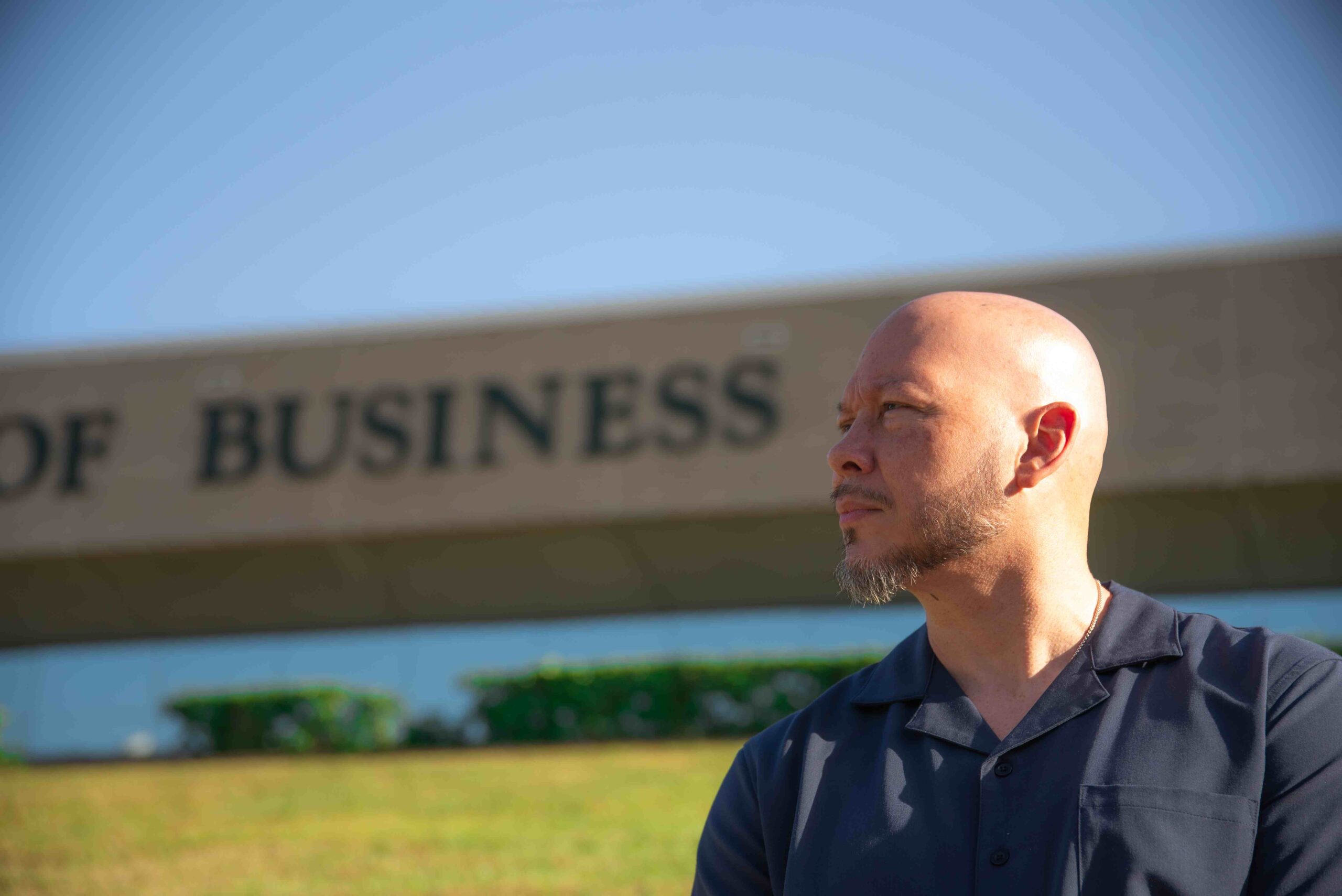
David Ferreira is the Executive Creative Director at INTETHIQ, a Cleveland, Ohio-based consulting firm. Working from Tampa Bay, Florida, he leads brand strategy, creative direction, and executive communications, drawing on more than three decades of experience across creative production, marketing, communications, and technology.
Ferreira’s career began in 1994 at a Washington-area newspaper, where he learned production from the ground up through typesetting, color separation, prepress work, and publication assembly. He later moved through marketing, web, and creative roles at Randolph Air Force Base Services Marketing, IP AXESS, and FASTSIGNS before joining Remuda Ranch, where an unusual role spanning Information Technology and Marketing strengthened his ability to connect technology, communication, user experience, and service. From 2009 to 2016, he operated MASTERGRAFIX, a boutique creative consulting practice serving corporations, nonprofits, founders, authors, speakers, and mission-driven organizations.
Between 2016 and 2022, Ferreira spent nearly six years in technology operations and project leadership with Pasco County Schools, supporting systems used by more than 12,000 people and helping deploy more than 9,000 computers across the district, a stretch he describes as an expansion of his understanding of scale, systems, and service rather than a departure from creative work. He returned to visual and executive communications at The Mosaic Company in 2022, supporting CEO and senior leadership communications while managing global web content, before moving to INTETHIQ in 2024. The shift did not reset his priorities. It confirmed them: build things that work for the people who depend on them, not just for the room where they get approved.
He is the owner and publisher of Featherworks Publications, an independent publishing company he founded in 2024, and a co-founder of Emissary Way, a faith-centered leadership and family-development organization he helps lead on brand strategy, digital experience, and creative direction. He is currently completing his final semester of the Master of Science in Marketing program at the University of South Florida, specializing in Digital Marketing and Brand Management, with graduation expected in December 2026.
Ferreira is based in the Tampa Bay area. The principle underneath his work is perhaps clearest in the way he frames an early brand conversation: “Before we decide what you should look like, we need to clearly articulate who you are, who you serve, why you matter, and what you want people to believe about you.”