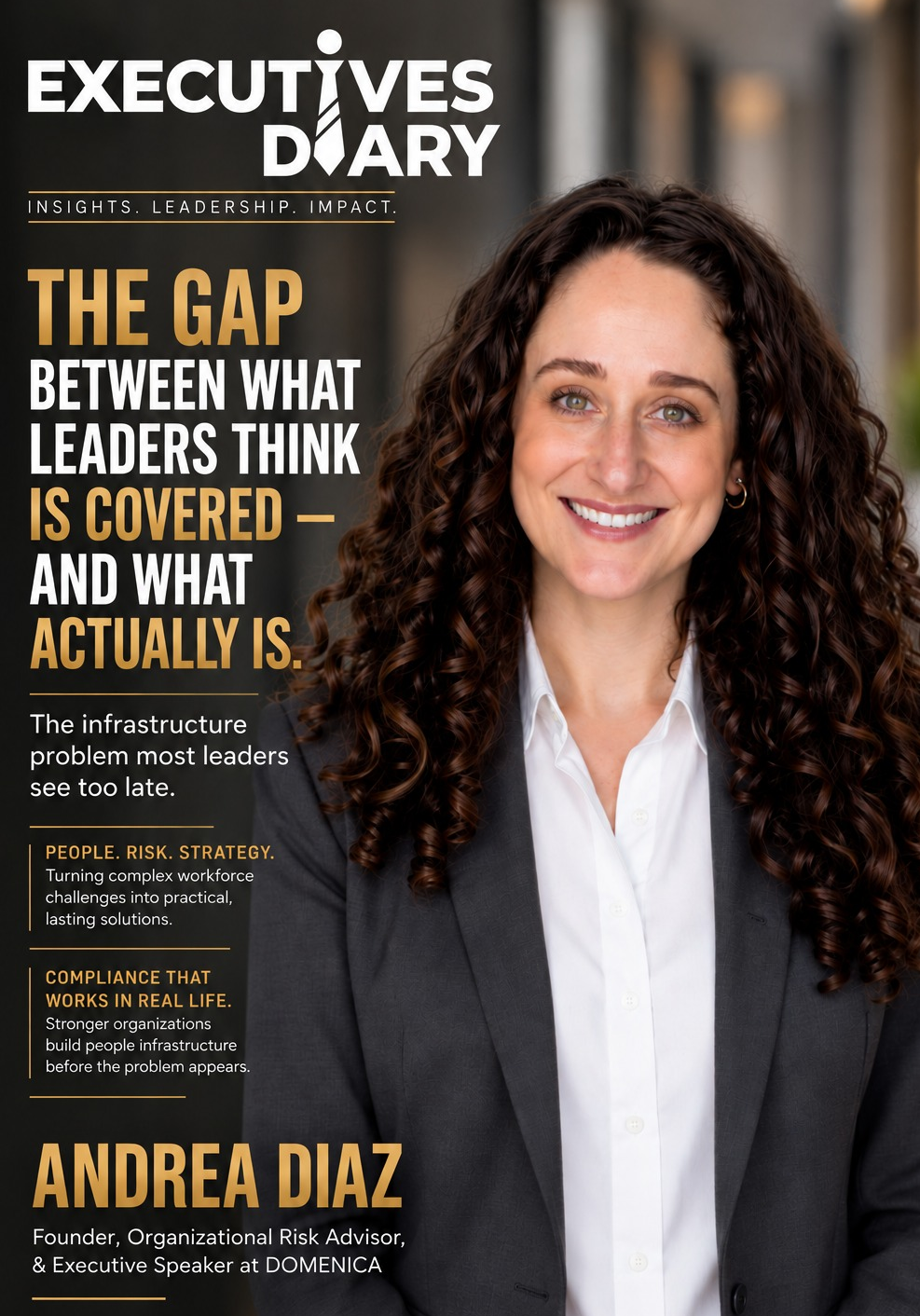
Andrea Diaz
The Gap Between What Leaders Think Is Covered and What Actually IsFounder, Organizational Risk Advisor, Speaker
The Infrastructure Problem Most Leaders See Too Late
Organizations rarely discover weaknesses in their people infrastructure when everything is running smoothly. They discover them when growth accelerates, an investigation begins, a restructuring becomes necessary, or an audit exposes what was never fully built.
Andrea Diaz has spent her career working in those moments.
As the founder of DOMENICA, she advises founders, executive teams, HR leaders, and legal departments facing complex workforce challenges. Her work centers on a deceptively simple question: what is actually exposed, and what needs to be built to close the gap?
That perspective began early in her career, in nonprofit organizations where Andrea repeatedly encountered programs with good intentions but inadequate systems.
That observation became more than a career lesson. It became the foundation of how she thinks about organizations today.
The Lesson That Started With Infrastructure
Andrea’s career began in nonprofits, where she worked across educational and childcare programs. She encountered a recurring problem: organizations often had the right intentions but lacked the systems needed to support them.
Her response was practical: Find the gap. Understand what is missing. Build it.
As she moved into HR and increasingly complex organizations, the same pattern kept appearing. The stakes simply became higher. More employees meant more regulatory exposure. More locations meant more compliance complexity. More organizational change meant more opportunities for small weaknesses to become serious problems.
What surprised Andrea was that organizational size did not solve the problem.
She saw the same fundamental mistake in a 20-person startup and in a global enterprise with more than 75,000 employees: people infrastructure was being treated as something to build after a problem appeared rather than before it.
That realization became the foundation of DOMENICA and the lens through which Andrea now approaches workforce strategy.
When Workforce Decisions Become Business Decisions
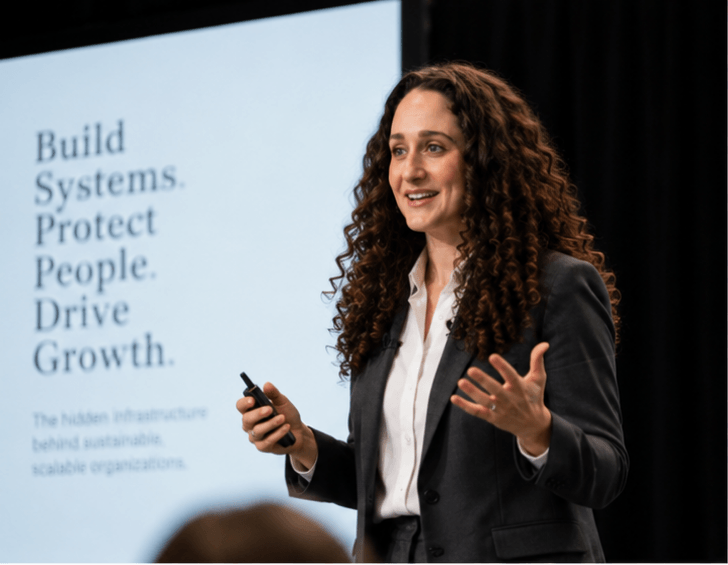
Andrea’s experience has increasingly placed her where HR decisions intersect with legal and operational consequences.
Her work has included fractional and interim HR leadership, restructuring and reductions in workforce, workplace investigations, multi-state compliance, process audits, legal ops project management, M&A integration, immigration compliance, and high-volume file remediation.
These situations rarely come with a perfect answer.
A leader may have to choose between competing risks, each carrying consequences for employees, operations, finances, and the organization itself. Andrea’s role is to make those tradeoffs clear rather than pretend there is a risk-free option.
That perspective has changed how she defines organizational readiness.
The strongest organizations are not necessarily those that experience fewer problems. They are the ones that can identify vulnerabilities early enough to make deliberate decisions instead of discovering them in the middle of a crisis.
Compliance Has to Work in Real Life
Andrea’s background in both HR and legal work gives her another useful perspective: compliance cannot be separated from how people actually experience an organization.
Executives may treat compliance as a legal requirement and employee experience as a separate culture initiative. Andrea sees them as two views of the same infrastructure.
A policy can technically exist while ownership remains unclear. A process can satisfy a baseline requirement while communication makes it confusing. A company can have documentation in place and still lack the systems necessary to operate consistently when pressure arrives.
That is why Andrea asks two questions of the same decision: Is it legally sound, and will people actually experience it as fair and well-run?
The distinction has business consequences.
A restructuring affects the P&L. An investigation consumes leadership capacity. A compliance failure can disrupt operations. Poor workforce systems can weaken trust long before leadership sees the financial consequences.
For Andrea, the common thread is infrastructure. The policy is only one part of the system. The real test is whether the organization can make that system work when it matters.
Building DOMENICA Between Two Imperfect Models
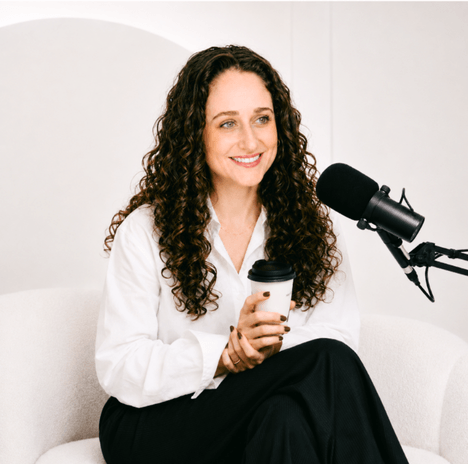
By the time Andrea founded DOMENICA in 2022, she had seen enough to recognize a gap in the traditional approach to senior HR support.
On one side was generic consulting: assess the problem, deliver a recommendation, and hand the work back to the organization.
On the other was the full-time executive model, which could provide senior expertise but was not always appropriate for the organization’s stage, scale, or immediate need.
Andrea wanted something different.
DOMENICA gives organizations access to senior HR leadership while remaining accountable to the work itself. Engagements range from ongoing, embedded support to focused, project-based work — an audit, an investigation, a restructuring — depending on what the moment calls for.
That sentence captures an important part of Andrea’s positioning.
Her value is not simply knowing what an organization should do. It is helping turn the decision into something the organization can actually operate.
What Strong Organizations Build Before They Need It
Andrea believes preparedness begins well before the crisis. She identifies three capabilities organizations should establish in advance:
- 1. Infrastructure: Infrastructure that can withstand real pressure.
- 2. Early-Warning System: An early-warning system for identifying risk.
- 3. Prepared Leadership: Leadership that has practiced making difficult decisions before the stakes become existential.
But preparation also requires a willingness to question familiar ways of working.
Some work can be automated. Some specialized functions are better supported by outside expertise. Some processes need to be rebuilt rather than maintained simply because they have always existed.
The point is not to make an organization dependent on more systems.
It is to create an organization capable of functioning without unnecessary friction.
That is why Andrea’s approach is ultimately broader than compliance. She is interested in whether the organization has the structure, judgment, and flexibility to keep operating when conditions change.
The Business Should Not Consume Its Founder
Andrea applies that same principle to her own company.
Through speaking engagements and Founder Frequency, her newsletter focused on leadership, boundaries, systems, and sustainable growth, she has expanded her work beyond workforce advisory into conversations about what it means to build a business intentionally.
Her philosophy is particularly clear when she talks about her plans for 2027.
Andrea intends to live and work abroad while continuing to build DOMENICA. For her, that is not simply a lifestyle goal. It is evidence that the systems she has built are doing what she believes good systems should do.
They create freedom rather than dependence.
A leader should be able to step away without the organization falling apart. A business should have enough structure to grow without requiring its owner to personally hold every process together.
Andrea’s own company is becoming a practical expression of the principle she asks other founders to consider: build the infrastructure before you need it.
Building What Can Hold
There is a consistent thread running through Andrea’s career, from nonprofit programs to multi-state HR operations, from compliance and investigations to M&A integration, and eventually to DOMENICA.
She keeps returning to the same question:
What needs to exist before the organization is tested?
For a workforce, that may mean clear systems, accountable processes, sound compliance, and leadership prepared to make difficult decisions.
For a growing company, it may mean knowing when internal capacity is no longer enough and when specialized expertise is needed.
For an entrepreneur, it may mean building a business that can support the life they want instead of quietly taking it over.
Andrea Diaz’s work is ultimately about closing the gap between intention and infrastructure.
Because organizations do not prove how well they are built when everything is easy.
They prove it when something difficult arrives and the systems are strong enough to hold.