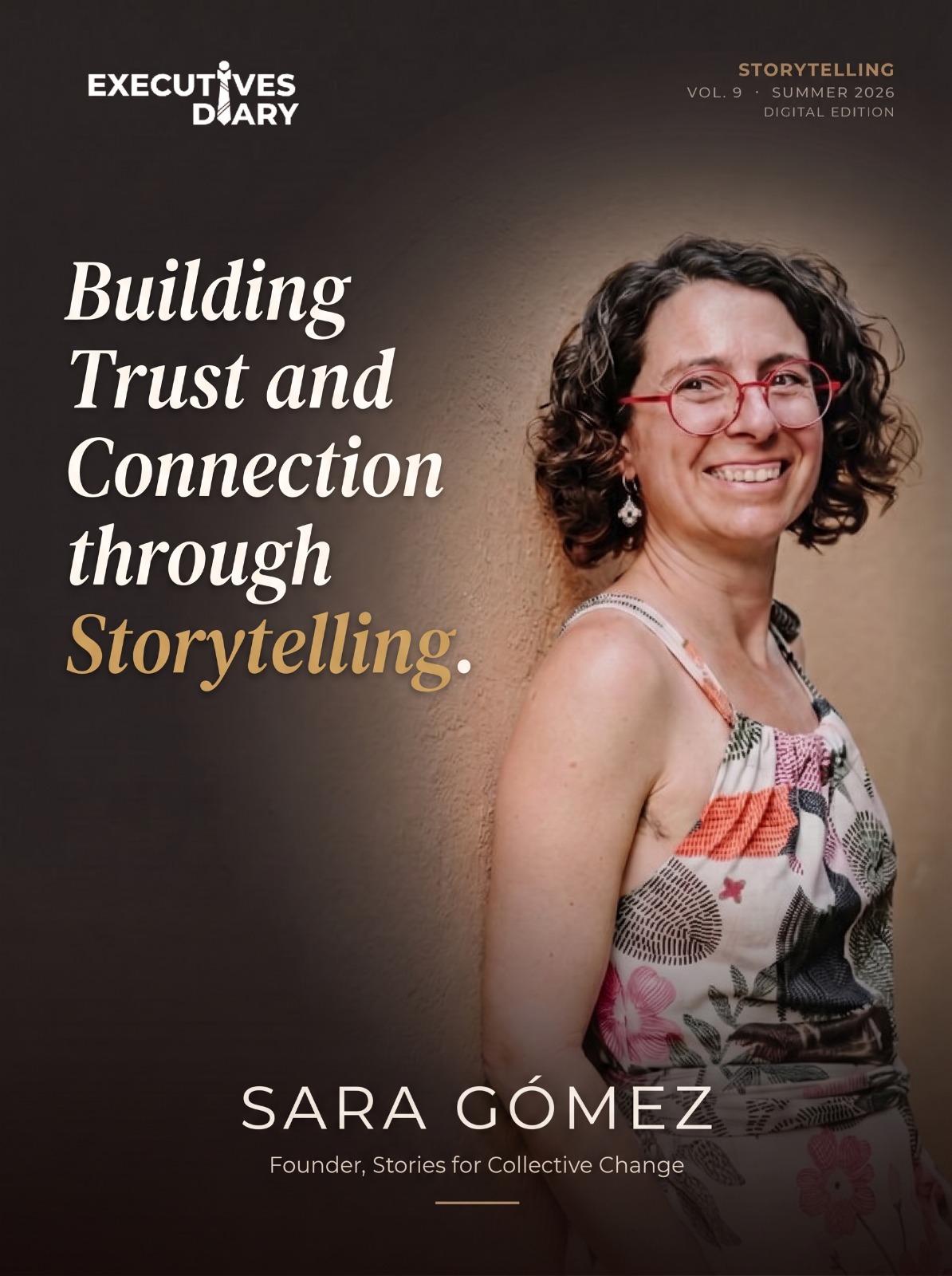
Who is Sara Gómez?
Sara Gómez, based in Tivoli, Italy, is the founder of Stories for Collective Change and co-founder of The Understory. For more than twenty years, she has worked across global health in Mexico, India, the United States, and beyond. She became an expert at telling other people’s stories before realizing, partway through her own career, that she had been keeping her own locked away. When she began to tell her own story, her practice deepened in a way she didn’t expect.
A woman sits in a small room with a mud floor. Light catches dust through the window behind her, and she draws the edge of her sari over her head. She’s talking about her two-year-old son who might not make it through the year. Her voice is steady, but her eyes tell a different story.
The person across from her nods and takes notes, asking carefully prepared questions. Maybe there’s a camera. Maybe just a recorder. The tools don’t matter. What matters is the distance between the two women.
When the interview finishes, she looks down at her hands.
She is thanked for her participation, but she will never see what is published.
She doesn’t get to decide how her story is told. She won’t choose what gets included or what stays hidden. The person holding the camera and the recorder is the person who holds the power.
After the interview, the woman is left hoping whoever tells her story tells it the way she would have wanted.
Learning to Pass the Mic, and the Camera
Sara grew up painfully aware of injustice, living in Brazil, Cyprus, Switzerland and the United States before she turned 12. Even then, she sensed that compassion alone could not solve the world’s problems. By college, she was studying culture, history and philosophy, focusing on Africa and Latin America at Duke University, trying to understand the systems that normalized
suffering and oppression, and how to move beyond them.
After graduation, she spent a year in Gujarat, India, working with the Self Employed Women’s Association, documenting its childcare program through photography and writing. She built trust with women who worked in tobacco factories and agricultural fields, listening to stories of mothers who had to bring infants and toddlers into dangerous workplaces or leave their children left at home because they had no other choice.
Sara wanted to capture strength and resilience. To foster empathy and understanding, not pity. Yet despite her good intentions, she could not shake feelings of discomfort that she often felt.
Like the time she discovered that her interpreter did not respect the people they were interviewing. Or when she found herself sitting with mothers recounting deeply traumatic experiences without knowing how to support them emotionally. The work raised difficult questions about ethics, power, and responsibility.
That year taught her something she has carried ever since: storytelling requires much
more than good intentions.
The lesson deepened during her Master’s in Public Health at the University of North Carolina and later while documenting the impact of abortion restrictions in Mexico and Nicaragua. Again and again, she encountered the same imbalance. The person whose story was being told often had the least say in how it was told.
Each time she felt that discomfort, it pushed her to learn more – to find ways of moving power back into the storyteller’s hands.
She became deeply interested in Photovoice, a community-led research approach that places cameras directly into the hands of community members, giving them a tool to document their own realities and discuss both the challenges and the strengths they see from their own perspectives.
For Sara, it represented something larger than a research method. It represented a different distribution of power.
Then came COVID.
An international move. A season of uncertainty. The beginning of independent consulting.
For the first time, she reflected on what her work could become when it was no longer being defined by someone else. Looking back, she realized storytelling had always been the common thread running through everything she had done.
She also realized she had spent years helping others share their stories while keeping her own locked away.
Two years into consulting, she began changing that.
On LinkedIn, she started writing honestly about the realities behind independent consulting. She shared not only about new clients, speaking invitations, and successful projects, but also about months without income, borrowed money, unpaid credit cards, depression, anxiety, and the uncertainty that rarely appears in professional biographies.
The response surprised her.
Consultants from around the world reached out with the same message.
“Me too. I thought I was the only one.”
By telling her own story honestly, Sara finally modeled the very principle she had spent years teaching others.
Authenticity builds connection and trust.
Stories as Power-Shifting
Today, Sara runs her consulting practice from Italy, partnering with nonprofits, NGOs, and foundations who want to grow support, partnerships and meaningful community engagement through storytelling. She also co-founded The Understory, a membership community built around collective learning and support for women who want to redefine what they have been taught about leadership and success.
Her mission is grounded in a simple belief: a kinder, more equitable world requires shifting power. And one way to do that is to shift whose voices are centered in the stories we tell. She helps organizations tell stories that amplify the voices of people with lived experience, while prioritizing respect and care.
“True leadership requires humility and a willingness to share power,” she says.
That belief shapes every aspect of her work.
Rather than simply helping organizations produce more compelling stories about beneficiaries, Sara teaches them how to place the camera, the microphone, and ultimately the decision-making power into the hands of those whose stories are being told.
Many organizations continue speaking only to audiences that already understand their mission.
“If we want to make real change, we have to communicate beyond our echo chambers,” she has written. “We need to tell stories that invite curiosity from people who might not already agree with us.”
Her work centers participatory storytelling and, trauma-informed practice, prioritizing dignity and respect as non-negotiable principles.
She believes rushed timelines can become invisible sources of harm.
Scrambling to collect stories for donor reports, organizations frequently place the needs of the donors ahead of the dignity of the people whose stories they collect.
“One powerful way to reduce harm is changing our timeline,” she has written. “Collect stories when it makes sense for you and the story holder.”
The organizations she supports build internal storytelling capacity instead of relying on extractive approaches. They learn to collaborate rather than simply document.
Yet beneath every project lies a deeper conviction.
Stories shape what people believe is possible.
“If we want to change the world, we first need to change how people think. Stories inspire people to imagine beyond the limits of their worldview.”
That belief explains why she teaches Storytelling for Bridging Divides.
It explains why she prioritizes listening over persuasion.
It explains why she continues sharing her own struggles publicly.
Every one of those choices shifts whose voices are centered, whose experiences are treated as legitimate, and whose realities become accepted as truth.
The Gómez Playbook: Five Lessons
Listen first.
Real connection begins with understanding. Listening is not a communications tactic. It is the foundation of respectful relationships.
Good intentions are only the beginning.
Care alone does not prevent harm. Examine the power dynamics inherent in telling someone else’s story. Ask whether you are the right person to tell it, and never assume you know what someone wants to share.
Protecting dignity means slowing down.
Deadlines often pressure organizations into rushing consent, skipping trust-building, and prioritizing deliverables over people. Stories deserve to be gathered with care.
Shift power by shifting whose voice is centered.
Invite people to become collaborators with authority over how, and whether, their stories are shared. It will lead to greater trust, more authentic storytelling, and stories that honor the people they represent.
Hope moves people forward.
Stories that focus only on suffering and despair lead to apathy and othering. Stories that reveal resilience, possibility, and practical solutions give people something worth working toward.
The Story She Finally Told
When Sara imagines the future, she sees global health organizations led by people with lived experience.
She imagines policy shaped by those most affected instead of only those controlling funding.
She imagines a world where the person holding the camera is often the same person whose life is being documented.
The woman sitting in that small room no longer waits for someone else to interpret her experience.
She decides how her story is told.
She frames it.
She interprets it.
She chooses what remains private.
The outsider becomes a supporter instead of the architect.
Power shifts.
Sara knows this future cannot be created through mandates alone.
It begins by modeling something different.
Every day, through consulting, community building, teaching, and honest writing, she practices the kind of storytelling that asks people to share power instead of simply sharing stories.
She continues writing openly about financial uncertainty, depression, and the loneliness that often accompanies entrepreneurship because vulnerability can foster trust, connection and understanding that polished success stories rarely can.
That is what authentic leadership looks like.
Someone who spent years helping others find their voices finally stepped into her own story with the same honesty, humility, and courage she has always encouraged in others.
Sara Gómez is the founder of Stories for Collective Change and co-founder of The Understory, and is based in Tivoli, Italy. She works with nonprofits, NGOs, and foundations to strengthen storytelling capacity and communications strategies that center dignity, trust, and participatory practice. To learn more about her work, visit www.saragomezconsulting.com or connect with her on LinkedIn.