

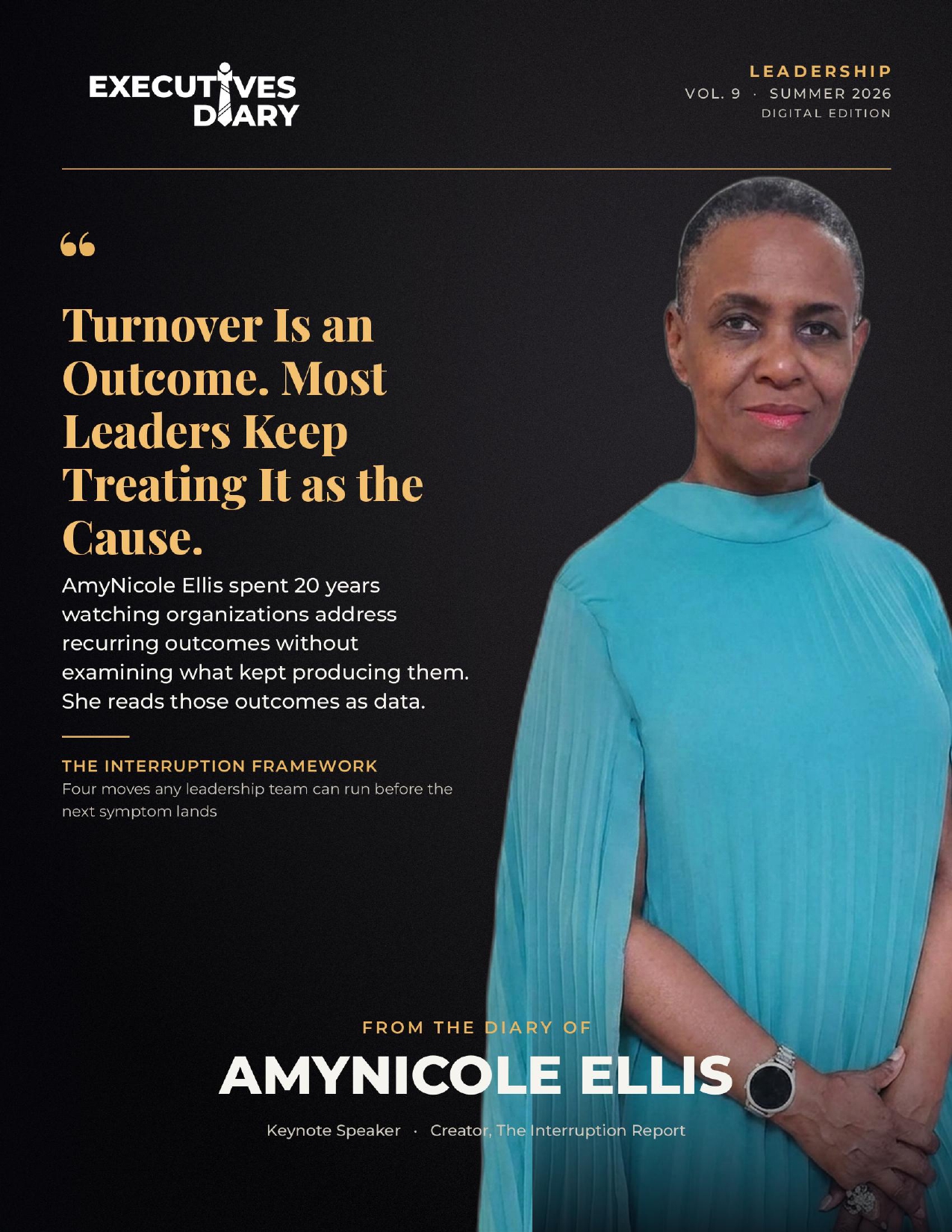
AmyNicole Ellis
Keynote Speaker &Creater of The Interruption Report
The question that follows a third round of unwanted turnover is almost always how to fix it. AmyNicole Ellis asks a different one: what keeps producing this. The distinction is not semantic. One question treats the recurring outcome as the problem and sends leaders after whichever symptom surfaced most recently. The other treats it as evidence of something nobody has named yet. Ellis reached the second question by running it on herself first. “You can’t interrupt a pattern you can’t see,” she says.
AmyNicole Ellis is a keynote speaker and the creator of The Interruption Report, built on a 20-year career inside Human Resources.
The Dataset She Read First
Ellis draws a hard line between an outcome and its cause, and she puts most of what an organization calls a problem on the outcome side of it. Turnover is an outcome. So are burnout, communication breakdowns, and the performance concerns that come back every cycle. “When leaders describe turnover, communication issues, burnout, or performance concerns, I do not immediately see problems to solve,” she says. “I see recurring outcomes to investigate.” The distinction is not academic. Fixing what is visible works, briefly. “That may improve things temporarily, but the same outcome often returns because the pattern producing it was never examined.”
She did not arrive at that position through client work. She arrived at it by running out of separate explanations for her own record: three bankruptcies, three long-term relationships that ended, and a run of career decisions that did not go the way she expected. For years each one got its own account. Then the accounting method changed. “Everything changed when I stopped asking, ‘Why did this happen?’ and started asking, ‘What do these situations have in common?'”
The bankruptcies are the part an audience remembers, and in her telling they function as evidence rather than as an origin story. Three financial collapses across different circumstances are harder to explain as three accidents than as one thing repeating. The circumstances had been different every time, which is what had kept them looking separate. Her own reactions had not been. “That question shifted my attention away from the circumstances and toward my own repeated reactions.” It also cost her the assumption most organizations still run on. “I had to unlearn the idea that every problem required a different solution.”
Different Person, Same Outcome
The clearest reading came out of the relationships. Ellis had stayed in each one well past the point she knew it was finished, never working up the nerve to leave, and each time the other person ended it before she did. Across those years she moved three times. “The pattern was not simply that my relationships ended,” she says. “It was that I stayed after I already knew they were over and waited for someone else to make the decision I had been unwilling to make.” What she remembers thinking, once the comparison was unavoidable: “Different person. Same outcome.”
What made any of it useful to anyone else was the discovery that the pattern did not respect categories. “What I discovered was that the same underlying pattern could show up in completely different areas of life and still produce similar outcomes.” Deferring a decision until someone else is forced to make it is not a relationship habit that happens to show up at work. It is one habit, and it produces its outcome wherever decisions are made. That is where she locates the payoff: “Once the pattern is recognized, leaders can make different decisions because they are responding to what is actually driving the outcome instead of reacting to the latest symptom.”
What a Leadership Team Can Steal From the Interruption
The structured version is The Interruption Leadership Analysis™, which AmyNicole Ellis built to identify the pattern beneath a recurring organizational outcome “before organizations invest time and resources solving symptoms.” The name carries its own definition. “The Interruption,” in her words, “is the point where someone stops reacting to the latest outcome and begins examining the pattern producing it.” The analysis is new and has not yet been completed by an organization. The sequence underneath it is not new, and it is the part a leadership team can run without her in the room.
Investigate Before It Deserves a Solution
- First, refuse the problem as presented. “I do not begin by trying to solve the problem that is presented. My first question is, ‘What keeps happening?'” In practice the first meeting about turnover is not about turnover. It is about how many times this has already happened and what the earlier rounds had in common.
- Second, swap the question. “Rather than asking, ‘How do we fix this?’ I ask, ‘What keeps producing this?'” The first question produces an initiative. The second produces an investigation. Only one of the two survives the same outcome arriving again next year.
- Third, read across events rather than into one. “Instead of looking at one event in isolation, I look across multiple decisions and recurring outcomes to identify what keeps repeating beneath the surface.” A single resignation is an anecdote. Six of them, laid side by side and read for what held constant while the people changed, is a reading.
- Fourth, establish which one is on the table before authorizing a fix. “I want to understand whether the issue being described is the actual pattern or simply the latest outcome of a deeper one.” That sequencing is the rule organizations break first under pressure, and Ellis states it as a rule: “repeated outcomes deserve investigation before they deserve a solution.”
None of the four requires a budget line, which is the argument for running them ahead of anything that does. The cost of skipping them is an initiative funded against a symptom, and the same outcome arriving after it lands.
