
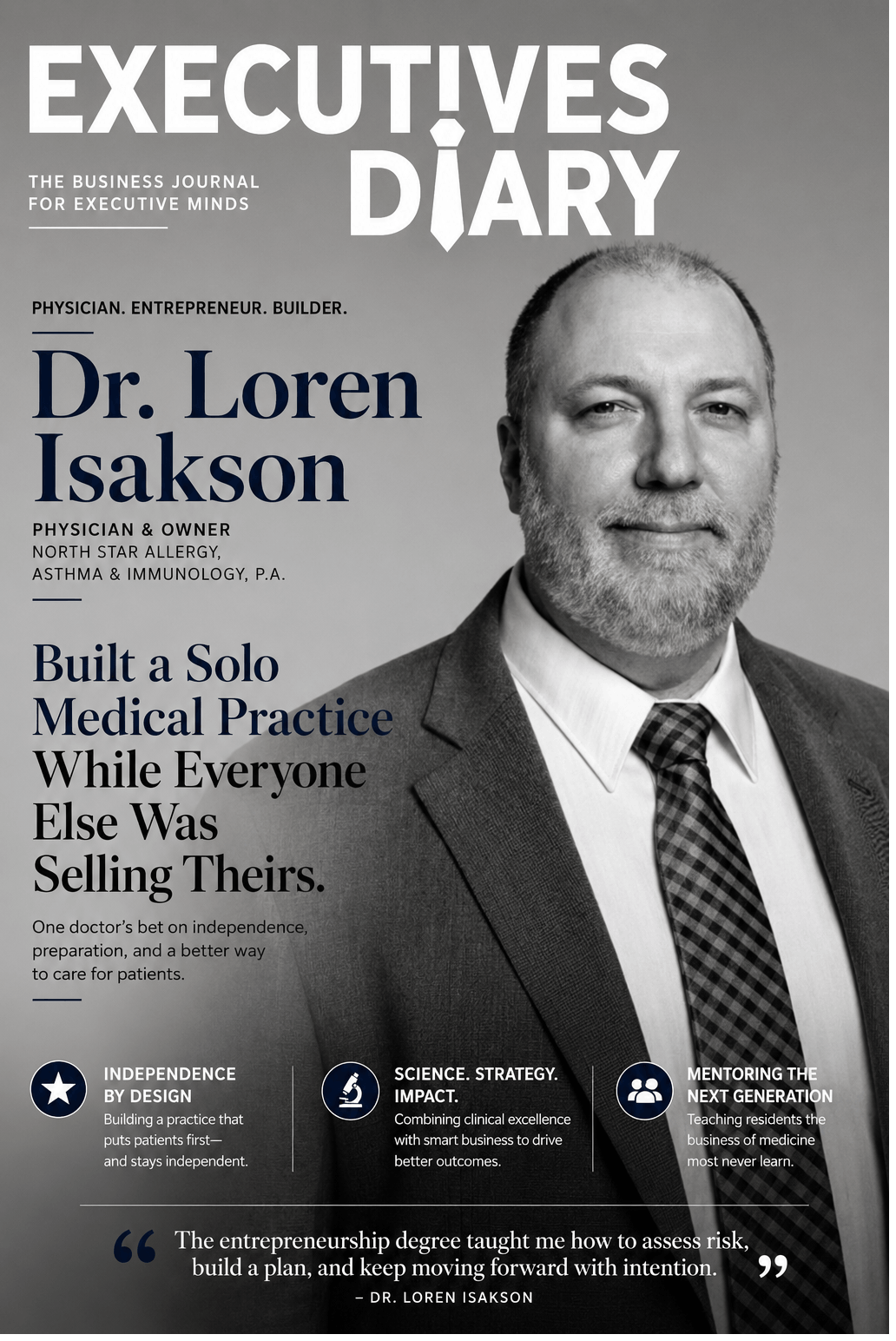
Loren Isakson
Built a Solo Medical Practice While Everyone Else Was Selling Theirs.American medicine has a clear direction right now. Hospitals are acquiring private practices. Private equity firms are absorbing what hospitals don’t want. Independent physicians face increasingly practical arguments about why solo practice cannot survive: administrative costs, insurance negotiations, staffing requirements, compliance burdens. The math, apparently, does not work for one doctor operating alone.
Dr. Isakson read the same industry reports. He signed a lease anyway.
That decision was not born from nostalgia or frustration with corporate medicine. It was the calculated move of a physician who spent two decades accumulating clinical expertise, then deliberately went back to school to learn exactly how to build a business around it. When he launched North Star Allergy, Asthma and Immunology, P.A. in Saint Petersburg, Florida, he was not ignoring the industry’s direction. He understood it well enough to bet against it.
Dr. Loren Isakson is the Physician and Owner of North Star Allergy, Asthma and Immunology, P.A., a solo subspecialty practice he is building from the ground up in the Tampa Bay area. He is board certified in both Allergy and Immunology and General Pediatrics and has 23 years of clinical experience. He added a Master of Science in Entrepreneurship in Applied Technologies from the University of South Florida, and operates at the intersection of medicine, science, and business strategy. What defines him is not just the clinic he runs, but the discipline to build one on his own terms in a system that rewards doing the opposite.
The Foundation That Made Independence Possible
The layers started accumulating early. Dr. Isakson completed his undergraduate degree in Physiology at McGill University, then moved into a Master of Science in Biotechnology at the University of Connecticut. These were not detours from medicine. They were the beginning of a pattern: add expertise, deepen the foundation, then build on top of it.
His clinical training followed the same logic. Residency and then board certification in Pediatrics. Fellowship in Allergy and Immunology at the University of South Florida, followed by additional board certification in that subspecialty. Then came a posting that would prove formative in ways extending well beyond patient care. As the Medical Director of Allergy and Immunology Services at MacDill Air Force Base, Dr. Isakson helped to build a specialty clinic from nothing. No existing infrastructure. No inherited patient panel. Just a need and the responsibility to architect a solution.
That experience taught him something most physicians in established practices never learn: how to create a functional clinical operation before the first patient walks through the door. He saw how an entirely new service line could be constructed inside a rigid institution. More importantly, he discovered the limits of what could be accomplished inside someone else’s structure.
Dr. Isakson has many entrepreneurial ideas – some of which are far afield from traditional medicine. Rather than reinventing himself all at once, he enrolled in USF’s MSEAT program in 2018. The decision to build his own practice as his first foray into business made sense. He was refining something he had been building for years. While broadening his experience in an established area of his expertise, he was simultaneously learning how to run a business on his own for the first time.
The blank canvas of his own practice stopped being an aspiration and became the next step in his personal and professional growth.
What He Is Actually Building
North Star Allergy, Asthma and Immunology, P.A. is currently in what Dr. Isakson calls its “ramp-up phase,” but that term undersells what is happening in the Saint Petersburg clinic. He is not simply growing a practice. He is constructing a specific kind of operation: one with the depth to eventually run clinical trials, the business architecture to sustain independence, and the flexibility to treat patients in a meaningful way that larger systems routinely underserve.
The clinical work itself carries real stakes. Take Penicillin allergy, a label sitting in roughly one in ten American medical charts. Dr. Isakson’s practice actively addresses this problem. Only about one percent of people who do report a Penicillin allergy are actually allergic, and the consequences of keeping incorrect labels are not trivial. Patients don’t receive optimal antibiotics, face higher costs, and this allergy designation contributes to antibiotic resistance patterns. His clinic runs evidence based, structured skin testing and oral drug challenge protocols to safely remove false allergy labels, restoring access to first-line treatments for patients who had been unnecessarily excluded.
He now serves as a faculty member for BayCare’s St. Joseph’s Internal Medicine Residency Program, bringing residents into his solo outpatient clinic for elective rotations. He supervises them directly during patient visits while exposing them to something most residency programs never cover: the business realities of medical practice.
His plan for what comes next is specific. He actively pursues partnerships with companies offering evidence-based products that improve patient outcomes directly inside the clinic. He wants to bring clinical trials to North Star, expanding the practice’s contribution beyond individual patient care into the broader research pipeline.
The Consultant Who Tells Founders Hard Truths
Dr. Isakson’s advisory work through platforms like ScaleHealth, Inlightened, and his own consulting firm, Lynchpin Health Strategies, sits at the same intersection of medicine, science, and business. Over years of reviewing pitch decks and product demonstrations, he identified a consistent pattern in what healthcare startups get wrong.
He is talking about more than unpolished financial projections. For Dr. Isakson, the first failure is usually conceptual. Teams may confuse features with solutions that matter in the real world. He also has a primary question to founders which is simple yet blunt: is this venture realistic given the life you are actually living?
His clinical experience trained him to surface blind spots without softening conclusions. In his clinic, he calls it shared decision-making. In advisory conversations, it is the same framework applied to capital and time instead of medication and procedures.
The core mistake he sees repeatedly is more fundamental. “Healthcare startups need to understand that the end user may not actually be the customer, especially in large systems,” he says. “You can build great software for physicians and still never get a deal at scale if the real decision makers are somewhere else.”
His multidisciplinary background allows him to translate between clinical leaders, IT teams, finance departments, and legal counsel. The people who feel the problem in big systems are rarely the ones who sign commercial contracts. He asks founders the same essential question: does your solution save, earn or waste time and/or money?
Looking Forward While Managing Risk
Dr. Isakson watches emerging technologies with the specific attention of someone who understands both clinical potential and legal exposure. He sees real opportunity in AI, particularly in continuous remote monitoring where artificial intelligence can integrate data across multiple body systems into unified patient health summaries between visits.
But he also flags medicolegal risks when companies rush automated systems into patient-facing roles before liability frameworks exist to support them. Dr. Isakson notes a gap between what AI systems promise and what they can currently deliver. The legal costs of underdeveloped tools released prematurely may ultimately exceed the value of human alternatives.
The Blank Canvas is the Why
At the start, the question was why a physician with two decades of experience in both academic and military environments, an advanced business degree, and established advisory relationships would choose the hardest version of what he could do next.
Dr. Isakson answered it himself. He wanted to start with a blank canvas and paint his vision into existence. That sentence sounds simple. However, it describes someone who examined the constraints of every environment he had worked in, decided none represented his final answer, and built the infrastructure to do something about it.
The whole industry was consolidating, and he was signing a lease. Those two facts are not in conflict.
One of them is just further along.
Key Takeaways / Playbook
- 1. Bet Against Consolidation: Success in independent practice requires building a deliberate, expertise-driven business architecture rather than relying on nostalgia.
- 2. Bridge Clinical and Business Realities: Mitigate modern clinical risk by understanding financial parameters, risk assessment, and operational fundamentals early on.
- 3. Address Real Market Constraints: Startups must evaluate whether their solutions address key decision-makers who manage corporate contracts, scaling effectively past human alternatives.