

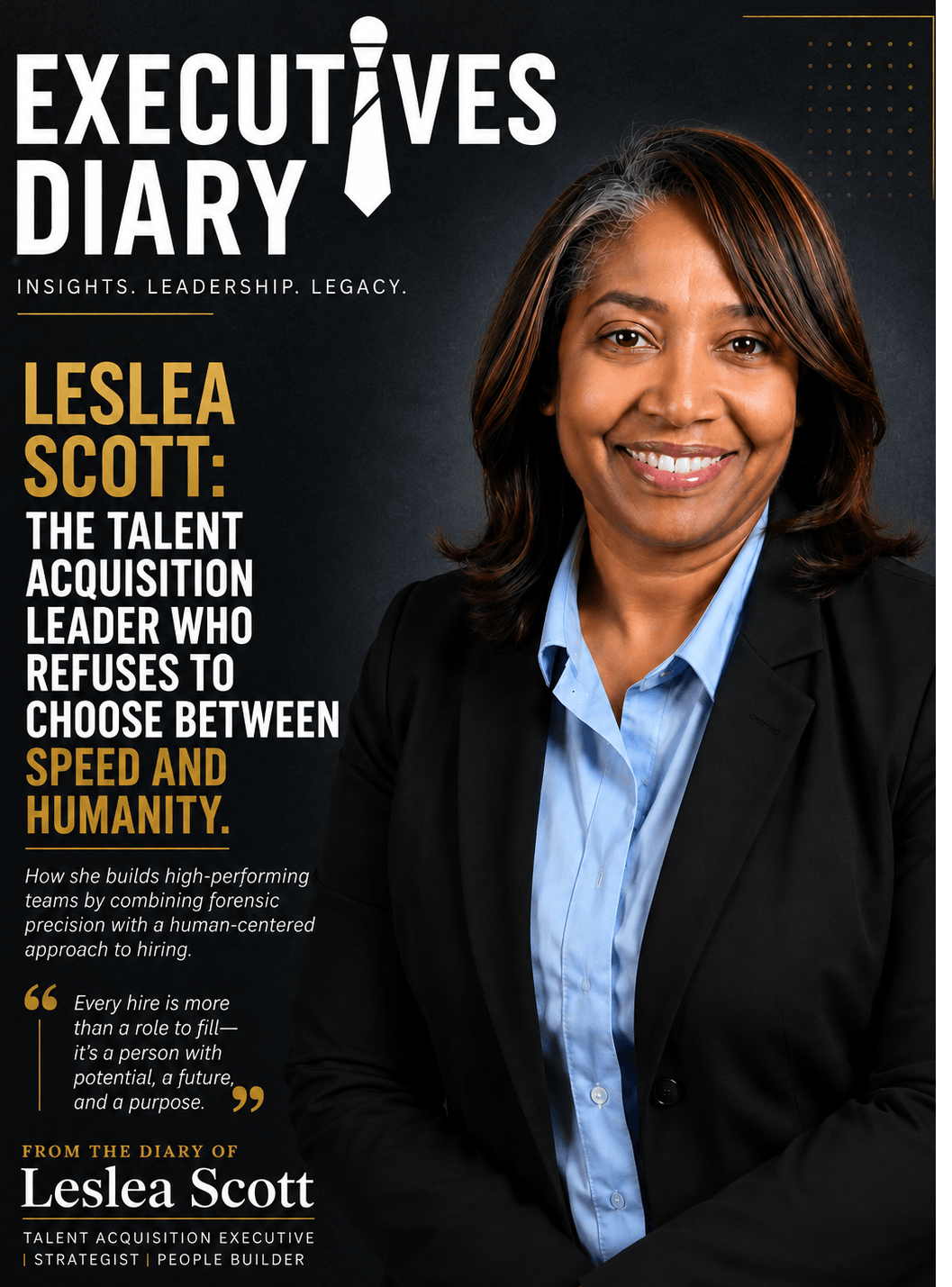
Leslea Scott
The Talent Acquisition Leader who refuses to choose between speed and humanityA hiring manager sits alone late into the evening with an overflowing inbox and an overwhelming number of resumes that seem heavier than expected. She knows the individual she needs is available somewhere, capable, steady, and prepared to lead. However, the system designed to identify that individual has become increasingly impersonal. Silence, delays, and excessive reliance on automation have created an experience that feels less like efficiency and more like invisibility. She begins to question whether anyone on the other side of the process truly cares about her progression or whether she will remain in a state of uncertainty without a definitive response. This experience reflects the reality many candidates encounter, and one that many organizations have come to accept as standard practice.
The Precision That Built Her
Leslea Scott did not begin her career at the highest levels of talent acquisition. Instead, her forensic approach and philosophy developed over time through repeated exposure to organizational challenges, professional setbacks, and a disciplined attention to detail that is often perceived as intensity. Early in her career, she worked across multiple human resources functions, closely observing how organizations approached hiring, onboarding, and retention. Through these experiences, she identified consistent patterns, including prolonged vacancy periods, candidates being overlooked due to process inefficiencies, and hiring decisions driven by speed rather than alignment. These observations led her to conclude that recruiting systems were not ineffective due to individual shortcomings but rather because they were not intentionally designed to function differently.
Her professional development reached a critical turning point during her time at Cosentino, a global building materials organization headquartered in Almería, Spain. This experience served as the foundation for her forensic approach to talent acquisition. At Cosentino, she refined her ability to analyze talent systems with precision by examining both outcomes and underlying causes. She connected operational data with human behavior, identifying systemic breakdowns and developing strategies to address them with intentional design. This approach became the framework for her subsequent leadership roles.
Building on this foundation, Scott advanced into executive leadership roles where she applied a systems-based approach to talent acquisition at scale. At Shawcor, she led talent acquisition across the Western Hemisphere and reduced time to fill from 148 days to 43 days while generating more than $3.8 million in agency cost savings and improving overall hiring quality. At Witt O’Brien’s, she reduced time to fill from 183 days to 29 days and successfully managed 142 hires across government and infrastructure environments within two consecutive quarters, significantly improving workforce deployment efficiency and reducing reliance on external staffing support. At Primoris Services Corporation, she was tasked with building a recruiting function from the ground up for the organization’s largest segment. Over a three-year period, her team executed 10,906 hires while managing a $1.3 million budget with zero overruns and achieving a time to fill average of three days. These outcomes reflect not only operational excellence but also disciplined financial stewardship and scalable talent strategy execution.
Despite these measurable achievements, Scott continued to challenge conventional thinking by asking whether speed and humanity were truly opposing forces or whether they could function in a complementary manner.
Where Data and Humanity Converge
Scott’s philosophy, fully realized through her work at Hire Virtue, is grounded in the principle that high-touch engagement does not equate to increased friction but instead reflects intentionality. Her approach integrates predictive talent mapping, real-time pipeline analytics, and cost per hire modeling aligned with executive-level decision making. While technical in nature, these strategies are implemented to support a fundamentally human-centered objective. Predictive talent mapping involves proactively identifying and engaging talent prior to the emergence of hiring needs, thereby aligning workforce strategy with organizational direction. In a global labor market increasingly influenced by automation and artificial intelligence, her approach distinguishes itself by combining data-driven insights with human judgment to identify potential that extends beyond algorithmic evaluation.
A defining component of Scott’s leadership philosophy is her commitment to elevating the candidate experience and journey. She maintains that individuals should not be treated as transactions or overlooked through automated processes. Instead, every interaction should be intentional, transparent, and respectful, regardless of the outcome. This perspective reinforces her belief that effective recruiting reflects organizational values and serves as a foundational component of business strategy.
From Roles to Pathways
Scott challenges traditional workforce models by advocating for a shift from static roles to dynamic career pathways. She argues that organizations have historically prioritized output over people, resulting in limited opportunities for growth and development. By redefining roles as entry points into structured and visible career trajectories, she emphasizes the importance of long-term development, leadership cultivation, and organizational alignment. This approach enhances engagement, retention, and performance while reinforcing the value of individuals as contributors, problem solvers, and leaders within their respective environments.
The Scott Playbook
The principles that guide Scott’s approach emphasize intentional speed, early-stage quality design, system-level accountability, and the recognition of talent acquisition as a growth function. She underscores that transparency is essential for fostering psychological safety and that organizational success depends on the ability to integrate care and performance rather than treating them as competing priorities. These principles demonstrate a structured and strategic approach to talent acquisition that balances operational efficiency with human-centered leadership.
The Answer to the Question No One Asked
The impact of this philosophy is evident in the transformation of the candidate experience. When individuals receive thoughtful and transparent communication, even in the absence of selection, they are more likely to feel respected and valued. A response that explains decisions, acknowledges strengths, and offers direction demonstrates the potential for organizations to create meaningful engagement by prioritizing human connection alongside operational efficiency.
A Model, Not Just a Method
Scott’s work represents more than a recruiting methodology. It reflects a comprehensive model that demonstrates how organizations can achieve speed, scale, and precision without compromising the human element. Across the environments she has influenced, consistent outcomes include reduced hiring timelines, measurable cost savings, improved alignment, enhanced candidate experiences, and increased retention. These results reinforce the understanding that organizational reputation is shaped not only by outcomes but by the way individuals are treated throughout the process.