

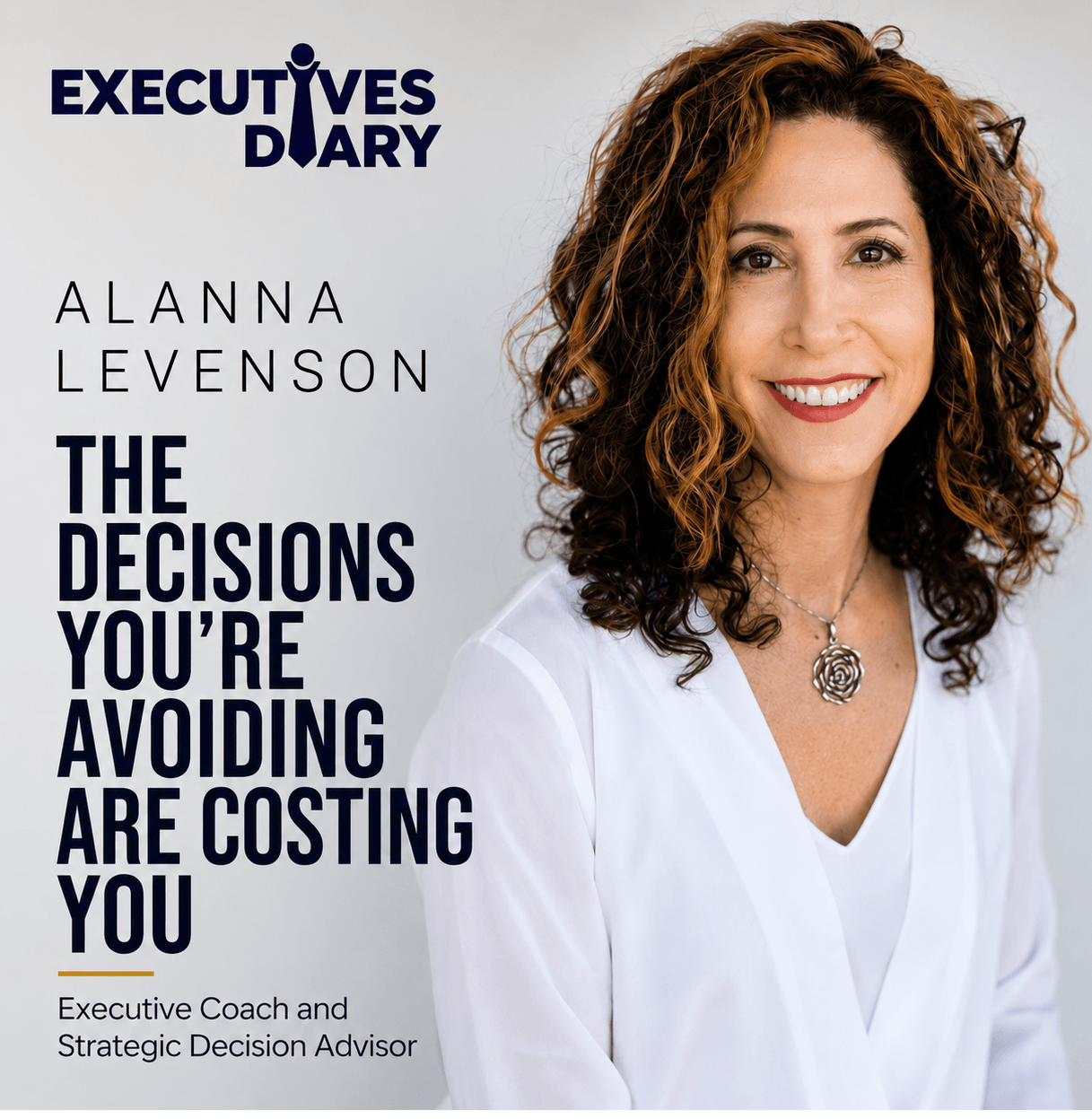
Alanna Levenson
Doesn’t Fix Leaders. She Helps Them Face the Decisions They’ve Been Avoiding.The first thing most leaders expect from a coach is reassurance. A softer landing. Someone to help them feel better about the choices they have already made and the direction they are already heading.
What Alanna Levenson offers is something different.
What she offers instead is something far more uncomfortable and infinitely more valuable: the willingness to sit with successful, capable leaders in the exact moment they realize a decision can no longer be postponed. When there are no easy answers and encouragement isn’t enough, she provides the steady presence required to finally make the call that changes everything.
Her clients describe the experience in terms that have nothing to do with comfort. The founder whose sales jumped from a few hundred thousand to two million dollars in eighteen months credits her with helping him push through the fear of operating at a larger scale. Another executive recalls three sessions where she identified a behavioral pattern that had been sabotaging his leadership for years. A third remembers the moment she asked the single question that made an avoided decision unavoidable.
The Fractional Chief Decision Officer Who Built Her Role from Scratch
Alanna Levenson is the founder of I Love My Life Coaching and in today’s work environment often serves as a Fractional Chief Decision Officer, a role that did not exist until she created it as a result of her more than two decades of working with founders and executives in the United States and Mexico. She also coaches globally through Torch, co-founded The Culture Bridge for cross-cultural leadership development, and recently joined OI Coaching as a Mindset Performance Coach focusing on sustainable high performance.
The name of her practice sounds aspirational. Her method is surgical. She steps into organizations at the moments where decisions carry real weight: M&A integration, role expansion, rapid growth phases, and pre-exit transitions. The leaders who call her are not struggling with competence or capability. They are wrestling with something more complex and more costly: the quiet accumulation of choices they cannot bring themselves to finalize.
The Evolution from Individual Performance to Organizational Decision-Making
Alanna began building her practice in 2005, when executive coaching was still fighting for credibility in serious business environments. Her early training at iPEC Coaching introduced her to Core Energy Coaching, the concept that a leader’s internal state directly influences their external results. Not as motivational theory, but as measurable, observable reality.
She took that foundation and stress-tested it in real businesses with real consequences.
Her education at Cornell University’s ILR School added the structural vocabulary she needed to speak credibly to enterprise leaders. Where iPEC gave her frameworks for individual transformation, Cornell provided deep understanding of organizational behavior, unconscious bias, and performance dynamics. The combination allowed her to work at both the personal and systemic levels simultaneously.
Over two decades, her client base evolved naturally. Solo professionals became founders managing multi-state operations. Directors became VPs responsible for global teams. The stakes grew higher. The pressure intensified. And the core problem remained remarkably consistent: highly capable leaders getting stuck not because they lacked intelligence or options, but because they could not bring themselves to make the decisions that would change their trajectory.
That became her specialty. Not leadership development in the traditional sense, but decision acceleration when everything else had stalled.
The Hidden Weight of Decision Drag
The work Alanna does today centers on a phenomenon she calls “decision drag,” and it is far more common among high-performing leaders than most would admit publicly. From the outside, everything appears functional. The executive is capable, credible, maintaining control. Internally, they are carrying competing identities, unresolved loyalties, and emotional attachments that make clear choices impossibly heavy.
In M&A scenarios, she sees this most clearly. The business is no longer just an asset to be optimized. It represents years of personal sacrifice, professional reputation, and proof of identity. Even when the numbers fully support a transition, the internal resistance can paralyze the process. Leaders find themselves rewriting emails, renegotiating clauses, and delaying signatures not because of valuation concerns, but because of questions they have not asked themselves about who they become after the deal closes.
During rapid growth phases, the pattern shifts but the core issue remains. Leaders who built companies through direct execution struggle to become architects of strategy and communication. The habits that created success no longer scale, but abandoning those habits feels like abandoning the identity that earned them their position in the first place.
Her process cuts through this directly. She creates a confidential space where leaders can think out loud, question themselves honestly, and hear what their own words reveal about the real barriers to movement. Then she identifies the leverage points that shift the entire system and helps leaders commit to decisions with self-generated accountability built in.
The results speak to the effectiveness of this approach. One client saw her close rate double not through sales script changes, but by learning to communicate her vision clearly enough that prospects could see themselves building it with her. A director at a cement company started taking three seconds to settle his internal state before difficult conversations. His team began opening up to him almost immediately, transforming both trust levels and decision quality.
Another client spent months avoiding a webinar launch that no longer aligned with her business direction. The relief of finally canceling it, despite the sunk costs and public announcements, freed up energy that had been trapped in resentment and restored her ability to focus on work that actually mattered.
Reading the Silence That Precedes the Crisis
Alanna has developed particular expertise in remote and distributed team dynamics, where traditional management indicators often miss critical warning signs. She teaches leaders to watch for something more subtle than missed deadlines or obvious conflict: the gradual onset of team silence.
When strong contributors stop offering honest feedback, when meetings become polite instead of engaged, when disagreement disappears from team conversations, she sees it as evidence that trust is eroding long before performance metrics will reflect the damage. Her advice is not to launch surveys or schedule more check-ins, but to slow down and start listening for what is not being said.
This requires leaders to develop what she considers one of the most valuable skills in modern business: the ability to read people before the problems show up in spreadsheets. It means noticing hesitation, withdrawal, and the subtle shifts in energy that precede larger organizational breakdowns.
Through her contracted work with Torch, she has applied this approach across roughly 50 leadership engagements, supporting clients connected to accounts such as Airbnb, LinkedIn, HP, Cemex, Procore, and Coinbase. These engagements often run for six to twelve months, giving the work enough time to move beyond surface coaching and into the real pressure points of leadership: clarity, decision speed, and communication during uncertainty.
The Integration of Sustainable Performance
Her recent work with OI Coaching brings a dimension she has been incorporating informally for years into full focus. The quality of a leader’s decisions is inseparable from their physical and mental state. Many executives normalize chronic stress and exhaustion as the price of operating at high levels, then wonder why their judgment and relationships deteriorate over time.
This integration represents an evolution in her thinking about sustainable leadership. The leaders who perform at the highest levels over time are typically those who learn to manage their energy and attention above and beyond their workload.
She is also completing a certification in equine-assisted coaching, a discipline that provides leaders with immediate, unfiltered feedback about their presence and emotional steadiness. Horses respond to congruence and authentic calm rather than titles or authority, offering a pure test of the internal state she has spent two decades helping leaders develop.
The Moment Everything Changes
Twenty-one years of practice has taught Alanna Levenson that the heaviest weight leaders carry is not the complexity of their decisions, but the energy required to avoid making them. The founder circling the same strategic question for months. The executive postponing the conversation that everyone knows needs to happen. The CEO holding onto team members who can no longer grow with the company.
The transformation happens not when leaders find the perfect solution, but when they finally stop pretending the current situation is sustainable. When they admit that the strategy they have been forcing no longer fits. When they acknowledge that the decision they have been avoiding has already been made in their hearts, and now their actions simply need to catch up.
Alanna Levenson built her career on the understanding that successful leaders do not need someone to fix them. They need someone willing to sit with them in the uncomfortable space between knowing what needs to happen and finding the courage to make it happen. In a business culture that rewards constant motion, she offers something both rarer and more demanding: the discipline to stop long enough to actually decide.
The relief her clients describe is not the comfort of an easier path, but the freedom that comes from finally carrying only the weight of decisions they have actually made.
Key Profile & Engagement Details
- Experience & Practice: Over two decades of building an executive practice since 2005; Founder of I Love My Life Coaching and creator of the Fractional Chief Decision Officer role.
- Credentials & Frameworks: Core Energy Coaching trained at iPEC Coaching; corporate and structural vocabulary backed by Cornell University’s ILR School.
- Global Reach & Enterprise Portfolio: Core coach through Torch and Mindset Performance Coach with OI Coaching, supporting leaders tied to major platforms like Airbnb, LinkedIn, HP, Cemex, Procore, and Coinbase.
