

Designing governance and decision architecture to turn visionary ideas into structured, cross-border ventures
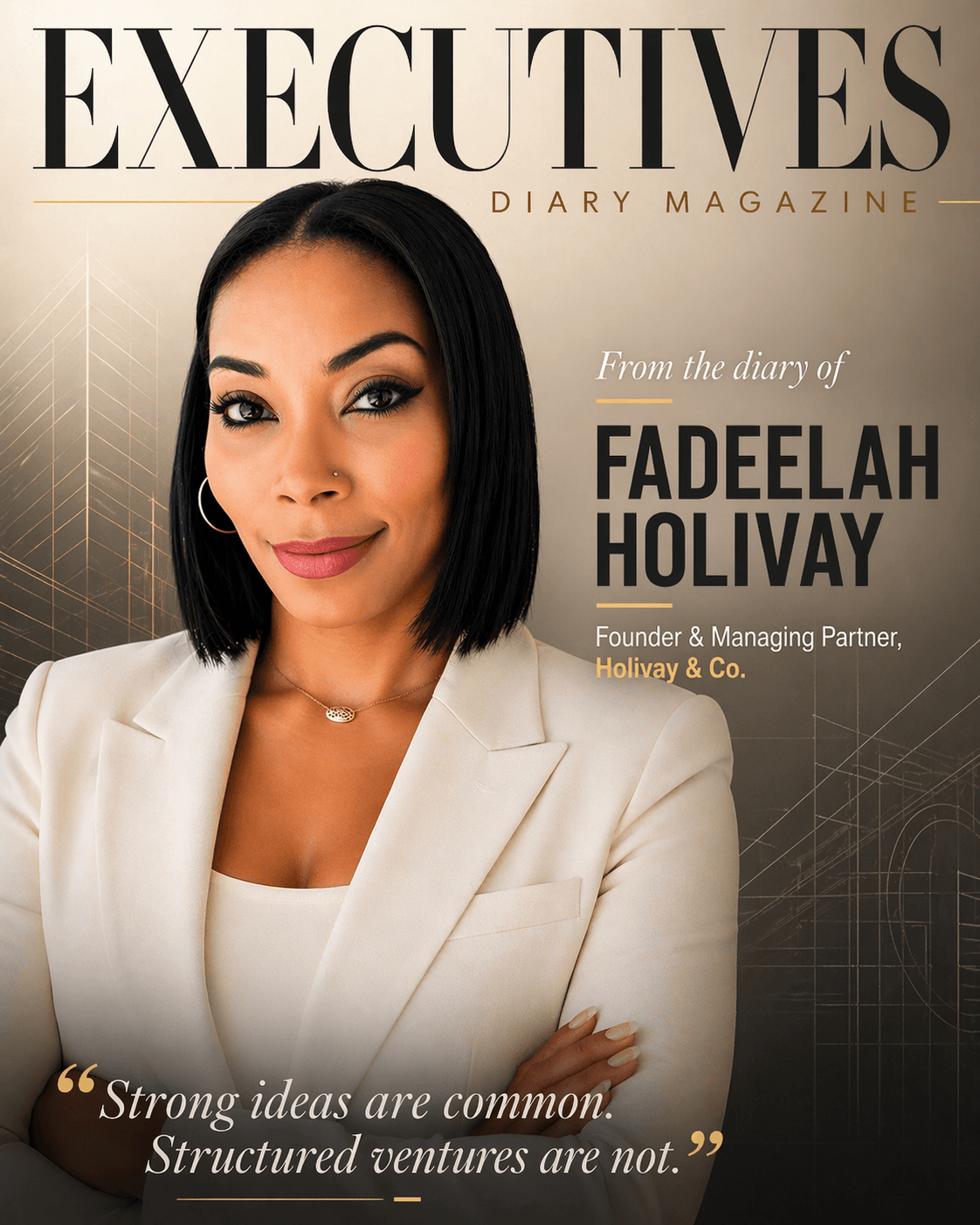
Fadeelah Holivay – The Architect of Scalable Ventures
Fadeelah Holivay is the Founder of Holivay & Co. and a strategic operator specializing in the structural integrity of high-growth businesses. With a career spanning major global retailers and multi-billion-dollar real estate portfolios, she bridges the gap between visionary ambition and disciplined execution. Holivay designs the governance frameworks and decision architectures that allow cross-border ventures to thrive, moving founders from the center of daily bottlenecks to the helm of scalable, partner-ready organizations.
The silence that follows a massive breakthrough is rarely peaceful. For many founders, it is the sound of a system beginning to buckle under the weight of its own success. You have the capital, the talent, and the market fit. Yet, somehow, the momentum feels heavier than it did in the lean days. Progress pauses between steps. Decisions that used to take minutes now stretch into weeks of meetings and second-guessing.
This is the hidden tax of growth. It is a universal tension that exists when the vision of a leader outpaces the skeletal structure of the organization. Most people look at a slowing business and see a talent problem or a need for more heads in seats. Fadeelah Holivay looks at the same business and sees a failure of architecture.
The Structural Shift
Success in the early stages of a venture depends almost entirely on the founder being everywhere at once. It is a period defined by sheer force of will. But as an organization matures, that same proximity becomes a liability. Holivay, the Founder and Managing Partner of Holivay & Co., has spent a career observing this specific inflection point. She has seen extraordinary concepts stall because the operating architecture behind them simply did not exist.
There is a common misconception that execution is about working harder or pushing teams to move faster. Holivay views it differently. To her, execution is a design challenge. It is about how work is organized, how decisions are made, and how ownership is defined. Without structure, teams stay busy, but the needle remains static.
The realization that execution issues are structural was a defining moment for Holivay. Early in her career, she was focused on the grit of getting things done. However, while working alongside C-suite leaders at major corporations, she noticed a recurring pattern. Even the most capable teams would struggle when decision pathways were murky. If the owner of a task is not clear, the work moves in circles.
Building Across Borders
Holivay’s perspective is not confined to a single market or a domestic lens. She has traveled to 34 countries and conducted extensive research on international migration and global markets. This global exposure has taught her that cross-border work is not just an operational hurdle. With a background in international business and international relations, and experience working across markets including Japan, Sweden, Nigeria, Mexico, Canada, Europe, and the Middle East, her perspective is grounded not only in travel, but in years of operating across diverse business environments. It is a test of how people build trust and navigate complexity in different environments.
From China to Nigeria and Sweden to the Middle East, she has helped organizations bridge the gap between high-level strategy and local execution. The challenge in international business is rarely the distance. It is the compounding complexity that arises when cultural differences are not accounted for in the venture’s governance.
When a venture is designed to operate across markets from the outset, complexity becomes a manageable variable rather than a constant crisis. In parallel to her work with leadership teams, Holivay leads Valtier, a specialized platform of Holivay & Co., engaged when opportunities are real and multiple stakeholders, capital, and execution must align cleanly for momentum to hold. The platform supports founders, operators, and investors through ownership structuring, governance design, decision authority frameworks, and execution alignment across complex transactions and growth environments. She is focused on the architecture that allows ventures to remain scalable and partner-ready, regardless of the geography they occupy.
The Founder’s Bottleneck
There is a particular vulnerability in being a visionary leader. You see the future so clearly that the messy details of the present can feel like distractions. Many women leaders, in particular, find themselves navigating systems that were not built for their specific style of growth. They prioritize alignment and clarity because they know that chaos is a luxury they cannot afford.
The moment a founder realizes they have become the bottleneck is often met with guilt. Holivay is quick to normalize this. She notes that being deeply involved is what makes a business work in the beginning. The shift, however, is moving from being the one driving every initiative to being the one who designed how things move.
It is a transition from a doer to an architect. This requires a level of intentionality that most fast-moving companies overlook. It means defining what only the founder can do and structuring the rest so that the team can act with total confidence. When the structure is sound, the leader is no longer the single point of failure.
The Decision Engine
If execution is the body of a company, decision-making is the nervous system. As companies grow, decisions naturally become more layered. More input, more perspectives, and more moments of hesitation enter the fray. If the way decisions are made does not evolve with the business, the entire organism slows down.
Holivay focuses on simplifying these pathways. Not every decision requires the same level of scrutiny. When everything is treated with the same weight, the most critical items get buried in the noise. By creating clarity around who owns a decision and how far they can take it, a leader restores the rhythm of the business.
Alignment around intent is the final piece of the puzzle. When a team understands the “why” behind a strategy, they do not need to check in at every turn. They become an extension of the leader’s vision, capable of navigating obstacles without constant intervention. This is how real scale begins.
The Holivay Playbook: 5 Lessons
1. Treat execution as architecture: Stop trying to solve speed problems with more effort and start solving them with better structures.
2. Design for the exit of the founder: Build systems that allow the business to move forward without the founder being the primary driver of every decision.
3. Clarify decision ownership early: Identify which decisions belong to which roles and remove the unnecessary loops that cause progress to pause.
4. Build cross-border governance from day one: If you plan to scale internationally, ensure your governance can handle the complexity of different markets before you enter them.
5. Prioritize clarity over capacity: Adding more people to a confusing system only creates more confusion, so fix the flow of work before you expand the team.
A New Standard of Leadership
Holivay’s work reflects a broader focus on building ventures that are not only compelling in concept but structured to move, align, and sustain as they grow. Through Valtier, she helps ventures and transactions move from complexity to clarity by ensuring ownership, governance, and execution structures are built to scale under pressure. A great idea without a governance structure is just a dream with a deadline. By focusing on the intersection of strategy and execution, she helps founders turn their visionary concepts into durable, scalable ventures.
The goal is not just to build a company that works. The goal is to build a company that thrives because its foundation is as strong as its vision. This requires a willingness to look at the boring details of governance and find the beauty in them. It is the difference between a project that flashes and fades and a venture that leaves a lasting mark on the world.
Execution is not a mystery; it is a choice to be disciplined about the structures we build.
The most powerful thing a leader can build is a business that no longer needs them to be its heart, but rather its architect. “Strong ideas are common. Structured ventures are not.”