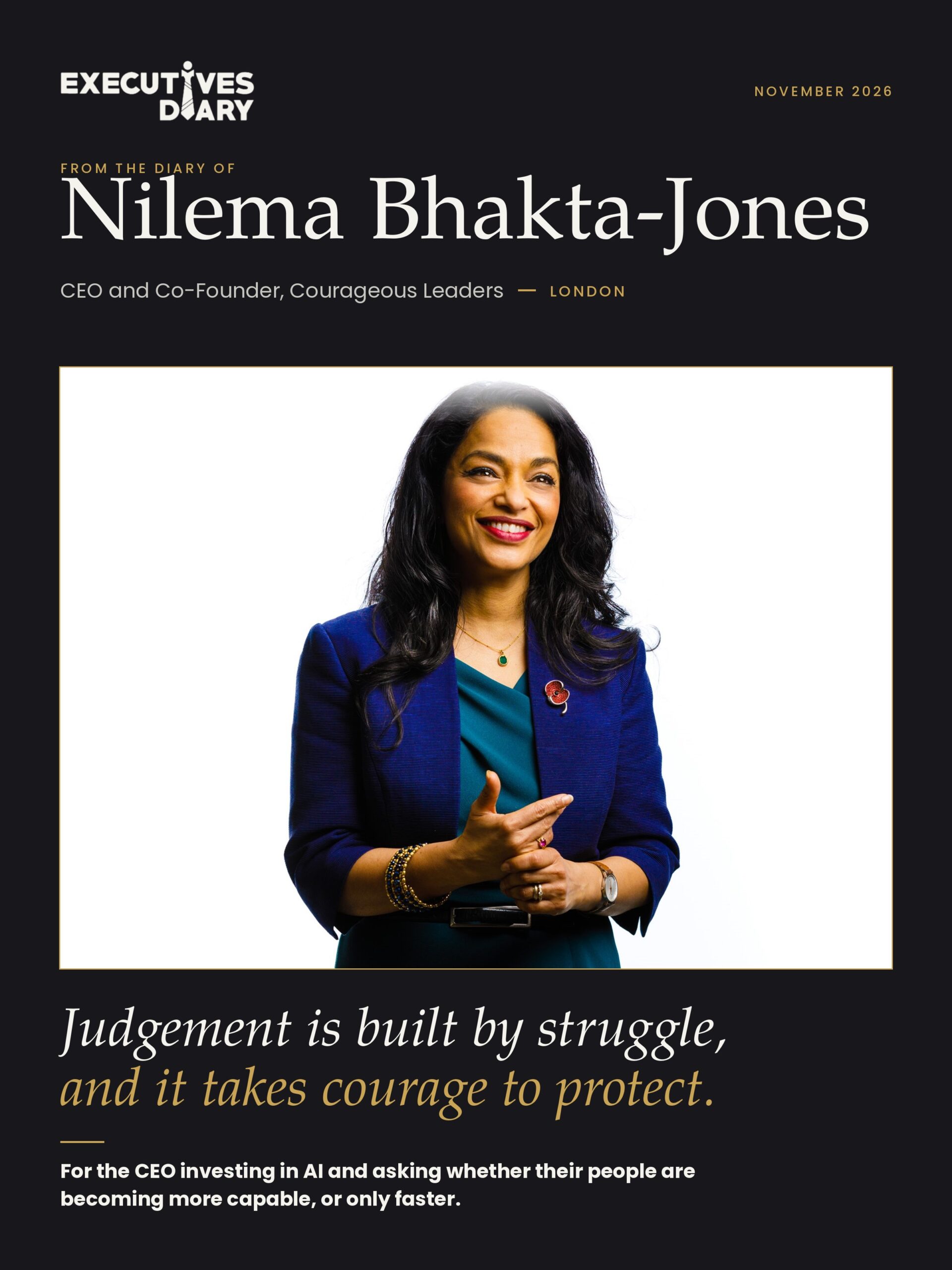
From the Diary of
Nilema Bhakta-Jones
For the CEO investing in AI and asking whether their people are becoming more capable, or only faster.
“Critical thinking is a muscle, and it needs exercising on ourselves too.”
“One day I opened my cupboard and found one tin of tuna. I could not afford the train fare to Oxford County Court for my next court appearance.”
It was 1994. Nilema Bhakta-Jones had just been called to the English Bar, with loans for Bar school (for Barristers), pupillage and rent, and no family money behind her. She had come to law with a clear purpose. She was born and raised in Rhodesia (now Zimbabwe), “in a society divided by racial segregation. I saw early how some human beings were treated as worth less than others.” Her heroes were people who challenged that injustice: Gandhi, Mandela, Thurgood Marshall and Martin Luther King Jr. Three of them were lawyers. “I chose law because I wanted to give a voice to people who were not being heard by challenging inequity.”
Purpose did not pay the train fare. She took a salaried role prosecuting for HM Customs & Excise. “At the time, it felt like admitting defeat. It became an extraordinary education in evidence, responsibility and the importance of not yielding to pressure for a particular outcome.” The move taught her, she says, “that changing direction does not mean abandoning your purpose.” That lesson runs through everything that followed, including the question she is now asking about AI.
A lone voice, and a loss

Six years as an international litigator at Simmons & Simmons led to a move in-house, and eleven years as General Counsel of Ascential, including its transition from private equity ownership to a listing on the London Stock Exchange in February 2016. There she learnt “that the hardest business decisions are rarely purely technical. They involve people, competing interests and consequences that cannot always be reduced to a legal answer.” Sometimes that meant being a lone voice: speaking up where others would not and representing perspectives in rooms where those people were not present. She has written about sitting opposite a CEO deciding whether an event should go ahead while terrorist attacks were taking place close by.
Later that year, she lost both her parents, within three months of each other. She founded the Courageous Leaders event in honour of her mother’s “life of courage, service and leadership.” Since 2017 the event’s proceeds have supported education for marginalised girls in Zimbabwe, the country she grew up in, through Plan International UK. That support, she says, has helped unlock £1 million for Plan International UK’s SAGE project, which has helped more than 22,500 girls access education.
Her mother’s words stay with her: “Education is the passport to the world. But it is not enough, the more learned you become the more incumbent it is upon you to give back.” Her mother likened a leader who balances height, flexibility and humility to bamboo: the taller it grows, the lower it bows. Both ideas, that learning carries an obligation and that the tallest should bow lowest, shape how she thinks about the professionals coming up behind her.
Education is the passport to the world.
In 2017 she went back to learning, at Harvard Business School, to study how leaders build a culture of innovation and use technology to solve everyday problems and bring about positive change. She became CEO of the legal technology start-up Alacrity Law, then COO of Farillio, a platform supporting smaller businesses, and was later hired as Group General Counsel at Kantar (a Bain Capital company), a business that combined technology with human expertise, to lead a diverse global team through a three-year transformation to ready the business for listing.
Today Nilema is CEO and Co-Founder of Courageous Leaders, which she runs in London with her husband, Shaun Jones, working with leaders and teams through coaching, mentoring, facilitation and leadership programmes. Shaun brings 25 years of expertise in brand, design, product and creativity. She brings 26 years in law, as a barrister, prosecutor, international litigator and General Counsel, and 7 years in commercial executive and consultancy roles. The reader she has in mind now is “the CEO, Managing Partner or Chief People Officer who is investing in AI and asking: are we making our people more capable, or simply making their work faster?”
Faster, or more capable?
Her answer is that keeping people capable now has to be designed for, and that it takes courage. It starts with what routine work was doing for the people who did it. The case for AI usually begins with what it can take off the desk: research, drafting, analysis. Some of that work, she has written, “was doing something else. For professionals, it was teaching us.” It was where memory and critical thinking were built, where people learnt to spot patterns, and where judgement and intuition formed. Her own career was built that way: a prosecutor learning to weigh evidence, a General Counsel making calls in the grey that no textbook settled.
Judgement, she says, is built through productive struggle: the thousands of micro-decisions, difficult problems and uncomfortable calls of a working life. “That is how a lawyer or a leader develops intuition and the instinct to make a good decision in seconds. AI is taking that struggle out of early careers.”
The research she follows points the same way, and she calls it emerging. In a study of four colonoscopy centres in Poland, experienced endoscopists who had begun using an AI detection tool routinely found fewer precancerous growths when they worked without it: their detection rate fell from 28.4% to 22.4%. In a field experiment with nearly 1,000 high school maths students, those who practised with an unrestricted GPT-4 tool scored 17% lower than students who never had it, once it was taken away. Both studies were published in 2025.
Her clients already see the commercial stakes. “What our clients understand is that the market already pays for judgement as a distinct, ownable skillset.” If creativity and original thinking decline, she asks, where does an organisation’s competitive edge come from, when everyone is working with the same large language models and the output risks converging? One firm has put a number on the problem: EY US is investing $100 million to reward its people for skills that include judgement and adaptability.
One of the biggest risks is that we become faster at producing answers (and mountains of AI workslop) while losing the ability to judge whether those answers are any good.
“I have been speaking about the opportunities and ethical challenges of AI since 2016; this issue was not foreseen,” she says. Researchers call it cognitive offloading, or cognitive surrender. She does not argue against using AI. “There is a difference between asking AI to challenge your reasoning and accepting its answer without examining it.”
What she adds is accountability. More than a human in the loop, she wants “a ‘human on the hook’: a person with the expertise, authority and time to examine the output and take responsibility for its use.” She sees that as the cornerstone of trust in any organisation using AI. “Trust must be the currency of business.” Keeping people capable, in her view, now has to be designed for, and holding that line takes the same courage she needed as a lone voice in the room.
Trust must be the currency of business.
When asking for time to think looks like resistance
Challenge, in her view, now means going against the prevailing narrative of adoption: ask no questions, everyone is doing it. “That takes courage.”
When speed is rewarded, asking for time to think can look like resistance. When a polished answer supports what a powerful person already believes, challenging it can carry a personal cost.
She has seen that cost in client work. One senior leader came to Courageous Leaders while assembling a new leadership team during significant organisational change, with difficult relationships with more powerful stakeholders. Her professional judgement told her that an approach being taken at the top carried material financial risks, and that the executive team and the CEO had flaws in their understanding of it. Challenging it carried a personal cost. Nilema, through coaching, worked through the leader’s reasoning with her, tested the evidence and prepared for those conversations. “Her concerns were initially dismissed; subsequent developments supported her assessment.”
The other half of the engagement was how this leader led. She had come from an organisation where culture and psychological safety were actively supported and now had to choose how to lead where those conditions were less evident. Courageous Leaders helped her build the culture she wanted inside her own team, through facilitated sessions on trust, silos and priorities. The team went on to be recognised within the organisation for high performance, consistent quality and delivery, and as one of its most trusted and collaborative teams. “The courage was both to challenge upwards and to stay true to her values in how she led. Sometimes you have to build it your way to prove it works,” Nilema says.
Questioning your own explanation
A different client needed courage of another kind. An executive leader came to Courageous Leaders because their leadership team was struggling to turn a clear commercial opportunity into growth. The first act of courage, Nilema says, was the leader’s willingness to acknowledge their own contribution, and to question how their leadership might be reinforcing the very behaviours they wanted to change.
Confidential one-to-one interviews came first, with findings that could challenge the leader’s account as well as the team’s. The leader then stood in front of the team and took responsibility for their part. An offsite built on those findings followed, using LEGO® Serious Play®, personal storytelling and work on values and shared priorities. The leader reported stronger relationships, better collaboration and positive momentum against revenue goals. The work led to a repeat engagement and recommendations to two of the organisation’s private equity-backed clients.
“For me, this is an important expression of critical thinking: having the courage to question your own explanation of a problem, listen to evidence you may find uncomfortable and change how you lead.” That capability is what she is now building a programme around.
What Courageous Thinking™ is being built to do
Courageous Thinking™ is designed to strengthen critical thinking, judgement and the courage to challenge. Her particular concern is people entering professions such as law, where work that once helped develop expertise is increasingly being automated: the kind of work that taught her. The programme centres on experiential learning: framing problems, examining evidence, debating alternatives and explaining decisions. “We want people to practise questioning a convincing answer, including their own, and taking responsibility for what they recommend.”
At work, she asks leaders to give teams space to form their own view, test it with AI and explain what changed their mind, to keep difficult problems, with feedback, for less experienced colleagues, and to ask whether people can defend a recommendation as well as how quickly they produced it.
She is clear about what it does not yet claim. “It is not a claim that we have already demonstrated how to prevent AI-related skills loss.” And on the science: “The research is evolving. Our responsibility is to draw on it carefully, be clear about what we know and assess what changes through our work.”
She holds her own claims to the same standard. When people asked for the citations behind one of her talks, she has written, she went back to every source. Most stood up well, a few were less settled than she had been describing them, and she said so in public. Her conclusion: “Critical thinking is a muscle, and it needs exercising on ourselves too.”
Where Nilema Is Now
Over the next twelve months, she wants more organisations to work with Courageous Leaders on critical thinking, judgement and the human capabilities their future leaders will need. “We work with leaders who care about commercial performance (what), purpose (why) and appreciate that how they achieve it matters.”
Her day starts before she gets out of bed, with a short gratitude practice that keeps her grounded. The line she lives by is her own: “Live life on purpose and make it count, do what makes your heart sing.”
More than thirty years after the tin of tuna, the purpose that took her into law still holds: giving a voice to people who are not yet in the room, now including the next generation of professionals. For the leaders she works with, she puts the case in two sentences. “Leadership is stewardship. That includes preparing the next generation to exercise judgement in circumstances we cannot yet predict.”
Leadership is stewardship.
The Playbook
Five Reflections from Nilema
- Can they defend it? Ask whether people can defend a recommendation, as well as how quickly they produced it.
- What changed your mind? Give teams space to form their own view, test it with AI and explain what changed their mind.
- Who is on the hook? To build trust with all your stakeholders, especially your customers, name a person with the expertise, authority and time to examine AI output and take responsibility for its use.
- Where will the next generation learn? Keep difficult problems, with feedback, for less experienced colleagues.
- Is my own explanation right? Have the courage to question your own explanation of a problem and listen to evidence you may find uncomfortable.