
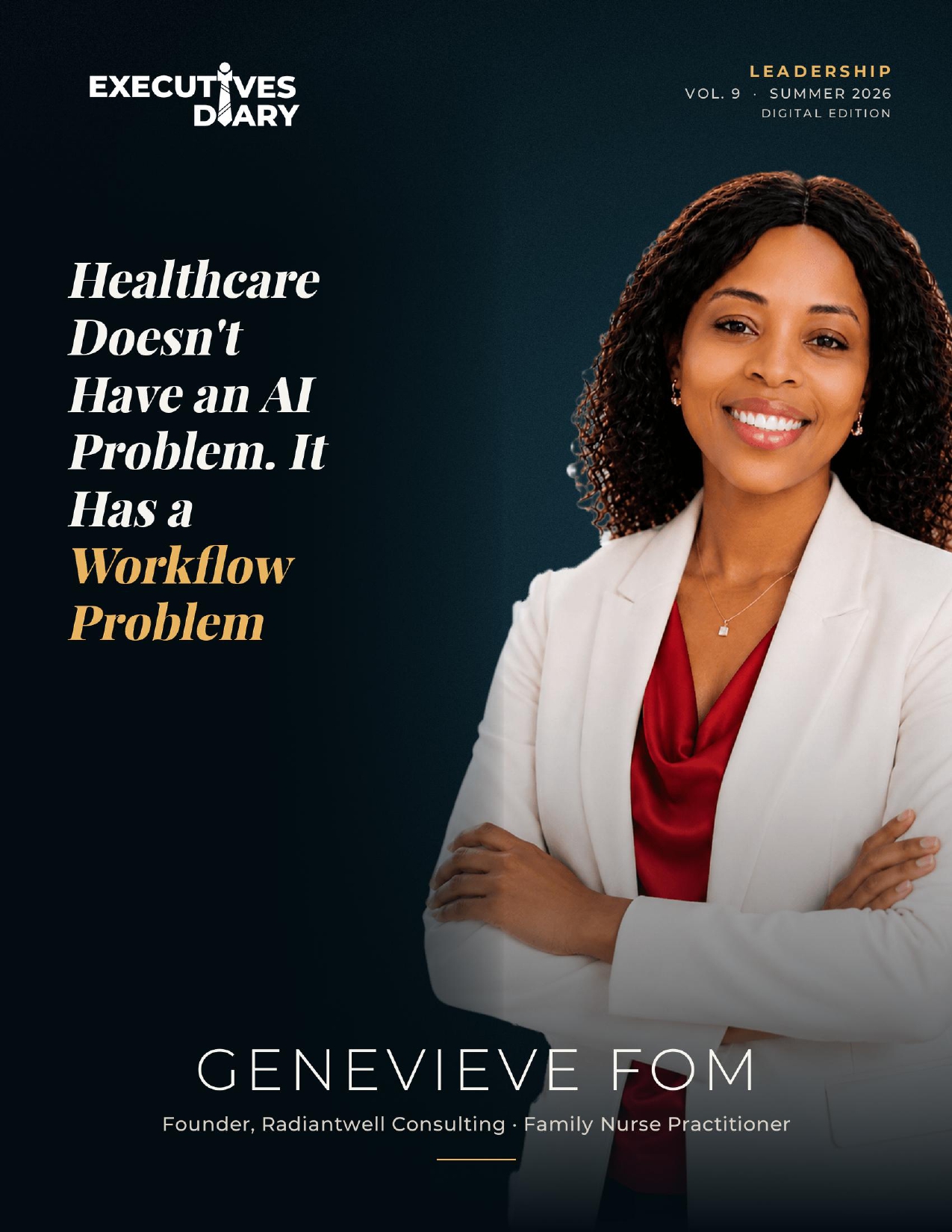
Founder, RadiantWell Network | Family Nurse Practitioner | Healthcare AI Strategist | Clinician-Centered AI & Healthcare Transformation Advisor
Healthcare’s AI Question Is Becoming a Leadership Question
Healthcare leaders are no longer deciding whether artificial intelligence belongs in healthcare. The harder questions are more consequential: Where should an organization begin? What should it prioritize? How can it modernize without disrupting patient care? And how can leaders make decisions today without creating expensive problems tomorrow?
Genevieve Fom believes those questions are fundamentally about leadership, not simply technology. Before asking which AI solution to implement, she believes executives need to understand the work that technology is entering. That means examining workflows, clinician capacity, organizational realities, leadership priorities, and the conditions required for technology to improve care rather than add another layer of complexity.
As Founder of RadiantWell Network and the leader of its healthcare advisory arm, RadiantWell Consulting, Genevieve Fom brings together clinical practice, executive strategy, workflow design, and AI implementation. A Family Nurse Practitioner and Healthcare AI Strategist, she brings an uncommon perspective to the conversation because she continues to practice clinically while advising healthcare organizations on AI strategy and implementation. Her central question is not simply whether technology can perform a task. It is whether that technology belongs in the work at all.
A Perspective Shaped by Two Continents
Fom grew up in Cameroon, often described as “Africa in miniature” because of its remarkable cultural diversity and varied geography. She began her education in a French-speaking school system before continuing her academic and professional path in the United States, where she earned her nursing and advanced practice degrees.
Living, learning, and working across two continents, two languages, and two very different healthcare systems shaped more than her career. It shaped the way she understands people and leadership. She learned that circumstances may differ, but people consistently need to be heard, supported, and given the opportunity to do meaningful work.
An early experience with internet access also expanded her sense of what was possible. At a time when the internet was still uncommon in her community, gaining access exposed her to ideas, careers, and possibilities she had never imagined.
It reinforced a lesson that continues to influence her work today.
That curiosity has remained a constant through every major transition in her life, including her move into clinical practice and eventually healthcare AI strategy. It is also why she approaches technology by first trying to understand the people and environment surrounding it.

The Code Blue That Made the Problem Impossible to Ignore
More than a decade across emergency care, urgent care, and clinical practice gave Fom a close view of the pressures healthcare professionals carry every day. She experienced the documentation burden, interruptions, competing priorities, communication gaps, and difficult tradeoffs that exist alongside the clinical work patients actually see.
Then came a moment that changed the direction of her thinking.
After her team successfully resuscitated a patient during a Code Blue in the emergency department, Fom spent significantly more time documenting the encounter than she had spent caring for the patient.
The experience forced her to confront a question that would eventually become central to her work.
The question was bigger than documentation.
It was about what healthcare systems ask clinicians to spend their limited attention doing.
Over the years, Fom watched healthcare organizations invest in new technologies, including AI, with the expectation that those tools would reduce administrative burden. Yet some initiatives struggled not because the technology itself was incapable, but because it was placed into workflows that were already fragmented, interrupted, and cognitively demanding.
That distinction changed her view of healthcare innovation.
The problem was not simply whether technology worked.
The problem was whether the surrounding system was designed to allow it to work.
Before Implementation Comes the Decision
Healthcare organizations often begin evaluating AI with a familiar question:
Will this work?
Fom believes there is a more important question. “Will this work here?”
That final word captures a significant part of her approach.
A technology can perform exceptionally well in one healthcare organization and struggle in another because the people, workflows, leadership priorities, culture, and operational realities are different. A capable tool does not automatically become a useful solution simply because it has succeeded somewhere else.
Fom encourages healthcare leaders to examine how care is actually delivered before introducing new technology. Where does friction exist? Where do clinicians lose time? Where is unnecessary cognitive burden accumulating? Will the technology simplify the work, or simply automate an existing inefficiency?
Her perspective can be summed up in a simple distinction: clinicians follow workflows, not tools.
That is why she also emphasizes AI placement. The question is not only what an AI system can do, but where it enters the workflow and what happens to the people working around it.
This thinking forms the foundation of her advisory work through RadiantWell Consulting. Rather than treating implementation itself as success, Fom helps healthcare leaders evaluate whether an AI opportunity actually fits the environment in which it will operate.
Her conclusion is deliberately challenging.
For executives, that reframes the AI decision entirely. Instead of asking how quickly an organization can adopt a new tool, the more useful question becomes whether the organization has identified the right problem, prepared the right workflow, and created the right conditions for the technology to support the people doing the work.

The Clinician Should Remain the Primary Intelligence
What gives Fom’s perspective particular weight is that she has not stepped away from clinical practice to advise from a distance. She continues to practice as a Family Nurse Practitioner while working with healthcare leaders on AI strategy and implementation.
That position gives her a perspective few technology conversations can provide. She sees AI from the executive side, where leaders must make decisions about investment, implementation, workforce readiness, and operational risk. She also sees it from the clinical side, where those decisions become part of an actual workday and ultimately affect a patient.
That is why she does not evaluate AI solely by what the technology can do. She evaluates it by what happens to the clinician and the patient when the technology becomes part of the workflow.
Her questions are practical:
- Will this actually make a clinician’s day easier?
- Will it improve patient care?
- Will it fit naturally into existing workflows?
- Will clinicians trust it?
- Will it reduce administrative burden, or simply create another layer of complexity?
That perspective has led Fom to a principle that increasingly defines her work:
For Fom, this is not an argument against artificial intelligence. It is an argument for putting technology in its proper role. AI can process information, identify patterns, organize evidence, reduce administrative work, and support decision-making. But clinical judgment also depends on professional experience, contextual understanding, ethical responsibility, and an understanding of the individual patient.
Technology can strengthen those capabilities. It should not become the authority that replaces them.
Turning a Philosophy Into a Practical Framework
Fom’s work increasingly centers on helping healthcare executives turn that philosophy into practical decisions.
Through RadiantWell Consulting, the healthcare advisory arm of RadiantWell Network, she advises organizations evaluating AI, digital health strategies, and workflow transformation. Her approach combines clinical experience with executive-level strategy, helping leaders assess not just whether a technology is capable, but whether it is appropriate for the environment in which it will be used.
Her POINT Framework™ provides a clinician-led approach for evaluating where, whether, and how AI can support healthcare workflows.
Her free guide, Why Most Healthcare AI Fails, explores why clinicians follow workflows rather than tools, why AI placement can matter more than capability, and the five workflow zones where AI may create value.
The framework gives structure to a philosophy that runs throughout her work: understand the work first, then determine where technology belongs.
That approach also changes how organizations should measure success.
The number of AI tools implemented is not necessarily evidence of progress.
A more meaningful measure is whether clinicians have more capacity to think, exercise judgment, communicate with patients, and provide care because of the technology.

Protecting the Resource Technology Cannot Replace
At the center of Fom’s philosophy is something healthcare organizations cannot simply purchase more of.
Attention.
Every interruption, unnecessary click, fragmented workflow, and administrative demand competes for the mental capacity clinicians need to make sound decisions and remain present with patients.
That makes protecting clinician attention more than an operational concern. It becomes a patient care priority.
It also explains why Fom’s work extends beyond AI implementation itself. Her focus is on the conditions healthcare leaders create around technology: the workflows they design, the decisions they make, the burdens they remove, and the capacity they protect.
The future of healthcare will not necessarily belong to the organizations that adopt the most AI.
It will belong to organizations that know where AI belongs, where it does not, and how to use it without compromising the human expertise at the center of care.
The Leadership Principle Behind the Technology
Fom’s perspective ultimately brings the AI conversation back to leadership.
Technology will continue to advance. New tools will enter healthcare. Organizations will face pressure to modernize, experiment, and adapt.
Her role is not to argue against that change.
It is to help leaders make better decisions within it.
For Fom, that principle connects everything: her clinical experience, her advisory work, her focus on workflow, her emphasis on clinician attention, and the frameworks she is developing to help healthcare leaders evaluate AI more responsibly.
The clinician should lead.
AI should follow the work.
The patient should remain the purpose.
And when technology creates the conditions for clinicians to think more clearly, work with less unnecessary friction, and give more of their attention to the people in their care, innovation has finally done what it was supposed to do.
It has made better care easier to deliver.
Connect & Learn More:
- Website: radiantwellnetwork.com
- LinkedIn: linkedin.com/in/genevieve-fom
- POINT Framework™: radiantwellnetwork.info/point-framework