

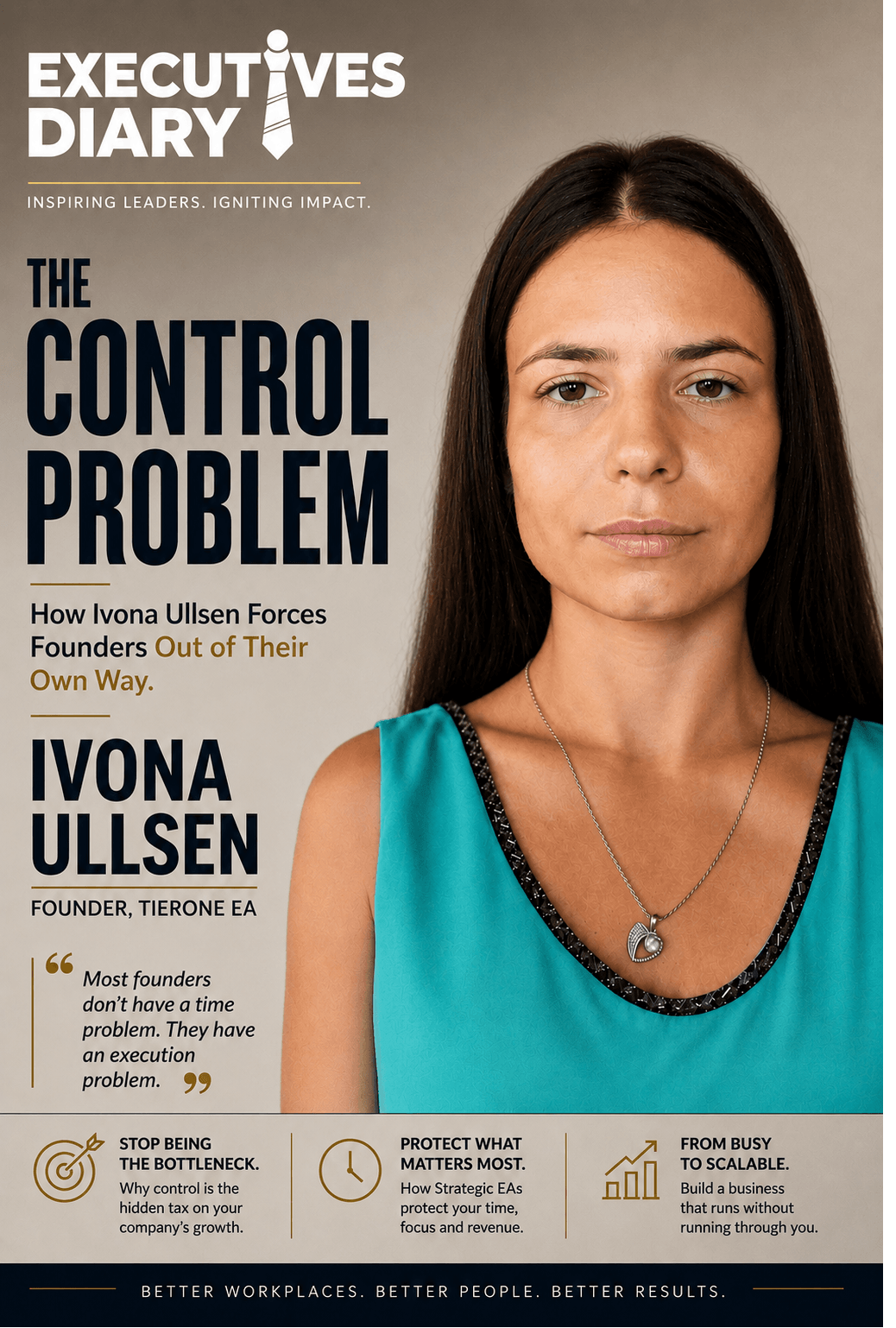
The Control Problem: How Ivona Ullsen Forces Founders Out of Their Own Way.
The Exhausted Executive’s Daily Prison
The founder is exhausted, but the inbox is full and the calendar is worse. Every client wants “just a quick update.” Sales needs a decision. Operations need approval. The CRM is a graveyard of half-warmed leads that never got a second touch.
The founder thinks the problem is time. Ivona Ullsen disagrees. In her world, time is only a symptom. The real issue is control, and the quiet belief many founders carry that nothing moves unless they touch it.
They do not say this out loud. They say they “just like visibility” or that “things slip when I am not in the loop.” Ivona has a sharper description for what is actually happening.
The Founder Who Calls Out the Lie
Ivona Ullsen is the founder of TierOne EA, a Belgrade-based firm that installs Strategic Executive Assistants inside scaling companies. Her focus is simple to state and difficult for most entrepreneurs to accept: she helps them stop being the bottleneck in their own business.
She does not sell “extra hands.” She sells the one thing most founders claim to crave and quietly sabotage: space to think.
From Philosophy to Operational Truth
Before TierOne EA, Ivona studied at the University of Philosophy in Novi Sad, which trained her to watch people closely and listen for what they were not saying. That philosophical foundation shows in how she approaches founder behavior today.
She noticed the same pattern repeating across companies. Support roles were framed as helpers, not operators. Tasks were completed, yet outcomes lagged. Founders hired assistants, then kept them on a short leash, which guaranteed two things: the founder stayed tired, and the business kept leaning on the same person for every decision that mattered.
“You see founders doing ten, twenty, thirty thousand a month and still acting as the human reminder system for the entire company. That’s not a growth ceiling. That’s a control problem.”
Her route into this work was formalized through virtual assistance and digital marketing training, but the core insight came from observation, not theory. She saw the quiet tax of control: vacations that were not really vacations, “CEO days” that dissolved into email triage, and companies that grew while their founder’s life compressed.
The System That Forces Founders to Step Back
TierOne EA installs what Ivona calls Strategic Executive Assistants, and the word “installs” is deliberate. She is not placing people; she is building operational infrastructure with a person at the center of it.
The distinction matters. A task VA waits to be told. A Strategic EA treats the business as a system and acts accordingly.
“Traditional support is input-based. You give a task, they complete the task. What I care about is outcome-based support. Does revenue keep moving? Do projects finish. Does the founder actually get 10 to 15 hours a week back, not just feel a bit more organized.”
Her Strategic EAs own follow-ups. They keep projects from stalling. They write and maintain simple SOPs so continuity does not evaporate when the founder boards a flight. They protect what Ivona calls the Power Hour: protected, distraction-free time for high-value work.
“Businesses don’t grow from busyness. They grow when the founder actually has protected time for high-stakes thinking. If protecting that hour feels impossible, that’s the signal you’re carrying too much execution personally.”
Ivona’’s model extends beyond the EA relationship itself. Depending on client needs, she coordinates specialists across automation setup, CRM workflows, and lead management. The founder does not manage these moving parts.
“Manual processes depend on memory and mood. Systems do not. My job is to make sure a lead isn’t lost just because a busy founder had a long day.”
One of her sharpest critiques targets a common assumption: that serious EAs must sit in the office, visible and local.
“Your EA doesn’t need a desk. They need autonomy. If you don’t trust someone to work remotely, you don’t have a proximity problem. You have a control problem.”
The Intervention That Changes Everything
The founders who find Ivona are not failing. They are succeeding by the numbers and still drowning. They have crossed the threshold where individual effort should give way to operational structure, but the structure was never built.
This is the control problem in its final form. Not malice. Not ego. Just a structural failure that compounds quietly until the founder cannot see past the next task on their list.
“Most ten to hundred thousand a month founders don’t need a Chief of Staff. They need to stop acting as the operator. Until execution stops routing through you, every ‘strategic hire’ is just a more expensive band-aid.”
Ivona is not selling them relief. She is selling them a reckoning with how their business actually works, and what it will cost them if they refuse to change it. The real shift begins the first morning a founder sits down for their Power Hour and realizes they are not the human reminder system keeping the whole thing alive.
They are finally running the company, instead of running inside it.
