

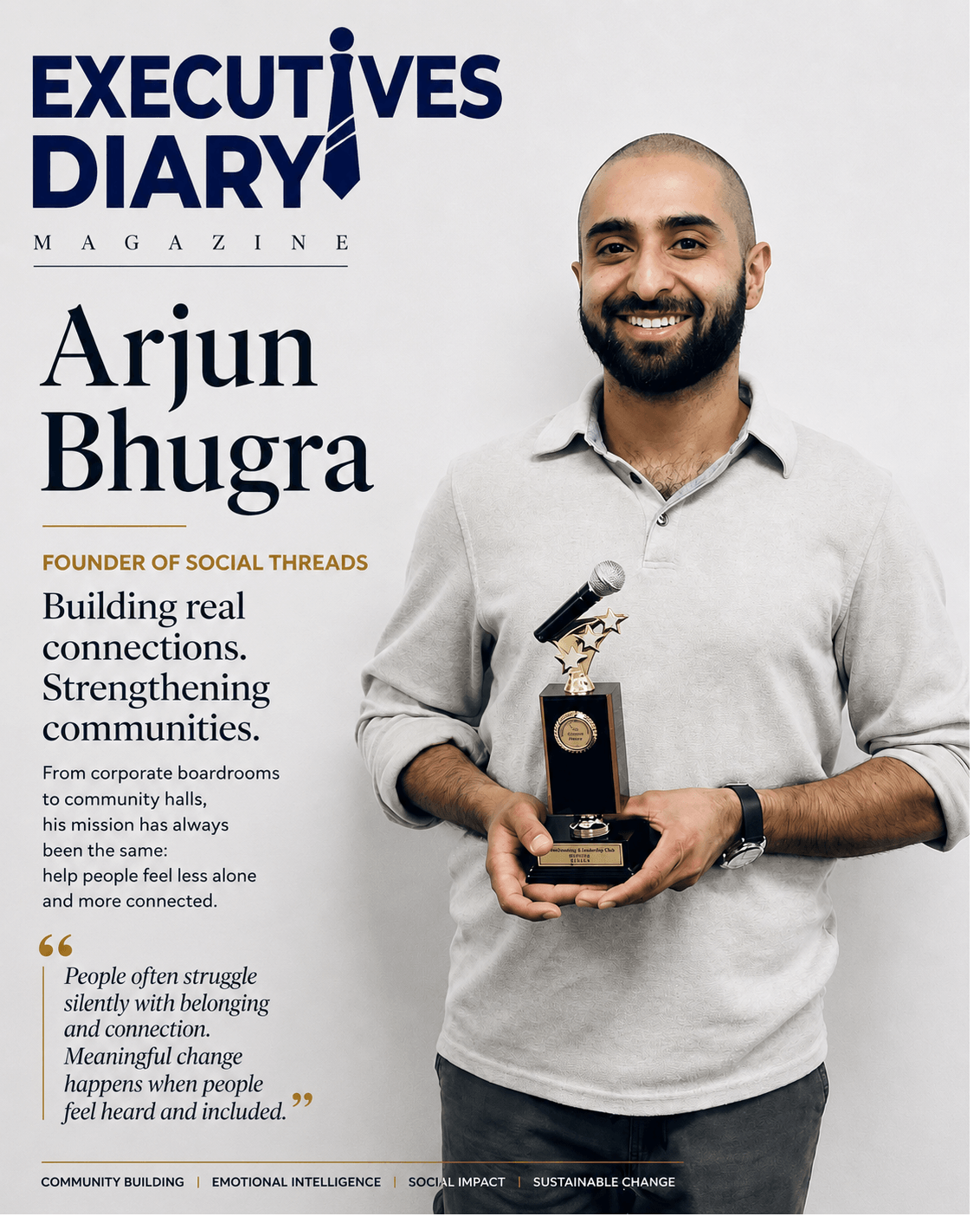
Arjun Bhugra
Fifty-Two Strangers Walked Into a Hall in Melbourne. Arjun Bhugra Watched a Community Begin.The dinner was not supposed to be a large event. Arjun Bhugra had organized a community gathering in Melbourne, modest in ambition and modest in expectation. He had hoped people would come. He had not planned for fifty-two of them. What struck him that evening was not the number. It was the moment the hesitant ones, the people who had almost talked themselves out of showing up, became familiar faces by the end of the night. That moment told him everything he needed to know about what he had built, and why it needed to grow.
Arjun Bhugra is the founder of Social Threads, a grassroots non-profit initiative based in Melbourne that runs low-cost workshops and community events designed to help people connect, start conversations, and build emotional intelligence. He is also completing an MBA at RMIT University. He is twenty-something years into a life that has moved between continents, corporate boardrooms, hospital wards, and community halls, and every stop along the way has pointed toward the same conclusion: connection does not happen by accident. It has to be built.
Commerce First, Then Something Shifted
Arjun’s path did not begin in community work. It began at The University of Western Australia, where he studied commerce, and where the first signs of a broader curiosity were already visible. He founded a current affairs club at St Catherine’s College, not because it was required of him, but because he wanted a room where people could sit down and talk seriously about the world. He served as a residential advisor, a community engagement representative, and a drummer in the college’s Battle of the Bands. These were not resume-builders. They were early evidence of someone who consistently moved toward people rather than away from them.
After graduating, Arjun moved through roles that, on paper, looked like a conventional business career taking shape. He worked in corporate social responsibility at Nestlé and PepsiCo, spent time in content and marketing, and held a position as an assistant marketing manager. But something was accumulating beneath the surface of those roles, a growing awareness that the problems he found most urgent were not being addressed in boardrooms.
He returned to university. This time, for a Master of Social Work at Monash University, a deliberate turn away from commercial work and toward something harder and less rewarded. What followed was three years in public sector social work that would shape everything that came after. He worked with men who used domestic violence, helping them build accountability and insight. He worked in geriatric wards, facilitating patient discharge within multidisciplinary teams. He worked with Social Workers for Climate Action. Each placement added a layer to his understanding of what it looks like when people are failed by the systems meant to hold them.
The Real Lessons Social Work Teaches You
The clinical language of social work can sometimes obscure what the work actually involves. It involves sitting across from people at the worst points of their lives and choosing, again and again, to remain present. For Arjun, those years produced a specific and durable insight.
That observation sounds simple. It is not. It takes years of proximity to human difficulty to understand that loneliness is not a personality flaw or a temporary condition. It is a structural problem, one that exists even in cities that appear, from the outside, to be thriving. Melbourne is a vibrant, cosmopolitan city. It is also a city where migrants, students, and people navigating life transitions can spend months without a single meaningful conversation outside of obligation. Arjun had watched that reality up close. He had seen what it cost people.
Social Threads was his response.
The Room Where Strangers Become Familiar Faces
Founded in September 2025 and formally incorporated as a non-profit association in Victoria, Social Threads runs workshops that give people practical tools for starting conversations and building emotional intelligence. It organizes community events that are affordable and accessible, designed not for people who are already comfortable in social settings, but for the ones who almost don’t show up.
That distinction matters enormously to Arjun. “The biggest challenge is that many people want connection but struggle to take the first step,” he says. “Creating spaces where people feel safe and welcomed is often the hardest and most important part.”
The fifty-two people who attended that community dinner were not a marketing success. They were proof of a thesis. When the environment is right, when the cost is low enough, the format is welcoming enough, and the intention is clear enough, people who have been quietly isolated will walk through the door. Some of them will stay. Some of them will come back. “Once the people who were initially hesitant to show up become familiar faces, that’s when you know you are onto something special,” Arjun says.
He is now working to scale that something. He is pursuing local grants and building partnerships with NGOs and community organizations to expand Social Threads’ reach, with particular interest in collaborations that can supply meals, materials, and outreach capacity. His MBA, which he is completing alongside running the organisation, is not incidental to this work. “My MBA has helped me think beyond passion and focus on sustainability, partnerships, and long-term impact,” he says. The goal is to preserve what makes Social Threads work at the grassroots level while giving it the structural backbone to last.
He has also been amplifying the message publicly. A recent win in a speaking competition and an appearance on SYN FM have extended his reach beyond the halls where Social Threads events are held. The core argument he brings to every platform is the same one that drove him out of corporate work and into social work, and eventually into building something of his own. Social disconnection deserves to be treated as seriously as any other public health concern. Building community should be a deliberate act, not an afterthought.
The Question the Dinner Answered
Arjun Bhugra started his career in commerce and spent years in corporate environments that measured success in margins and market share. He left that world not because it was wrong, but because it was answering a different question than the one he needed to ask. The question he needed to ask was simpler and considerably harder: what does it actually take to make someone feel less alone?
The fifty-two people who walked into that hall in Melbourne did not know they were validating an answer. They were just looking for a room where they might belong.
He made sure they found one.
Key Takeaways / Playbook
- 1. Intentional Connection: Connection does not happen by accident. It has to be built.
- 2. Overcoming Isolation: The biggest challenge is that many people want connection but struggle to take the first step. Creating spaces where people feel safe and welcomed is often the hardest and most important part.
- 3. Strategic Impact: Combining a mission-focused background like social work with structural insights from an MBA helps move beyond passion to focus on sustainability, partnerships, and long-term impact.
